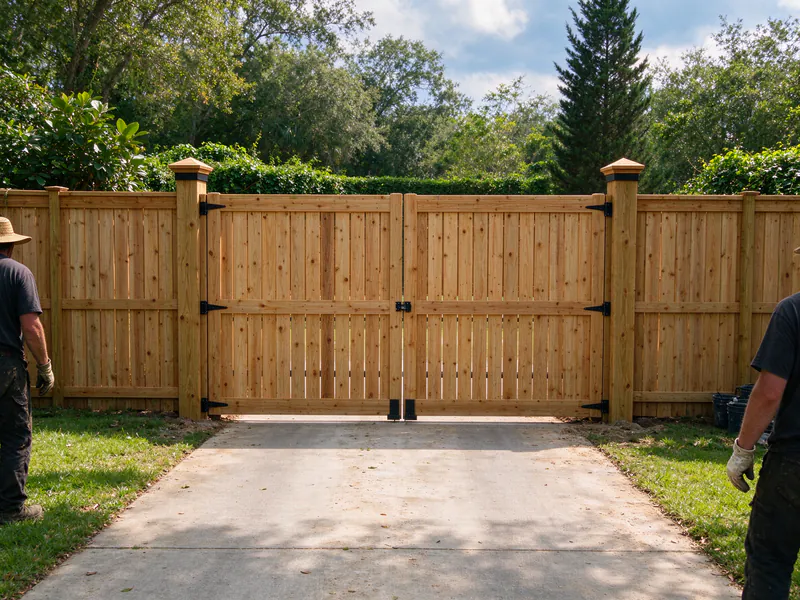
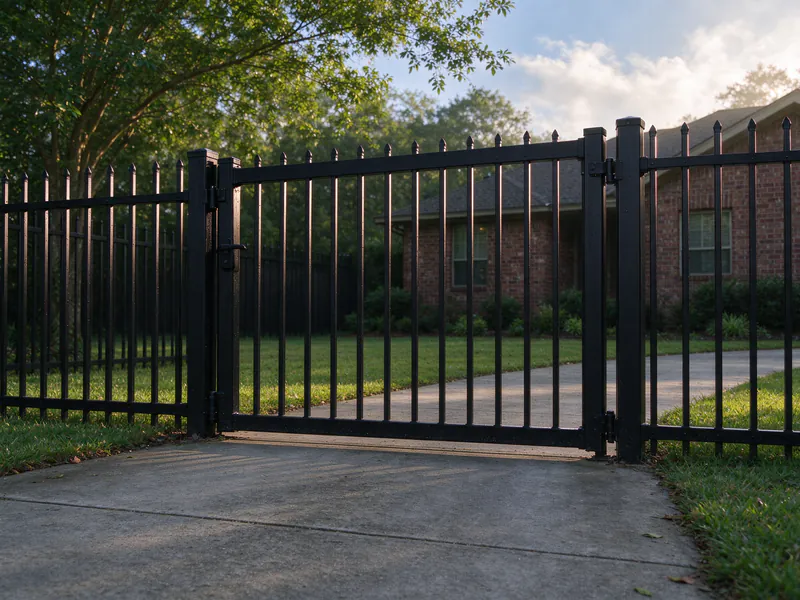
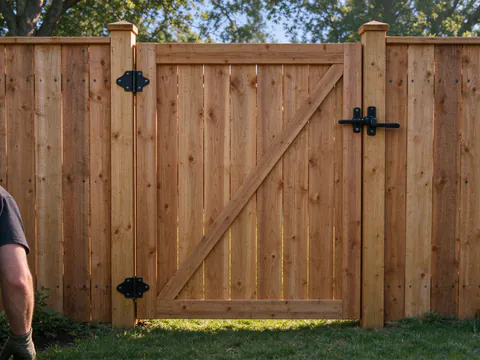
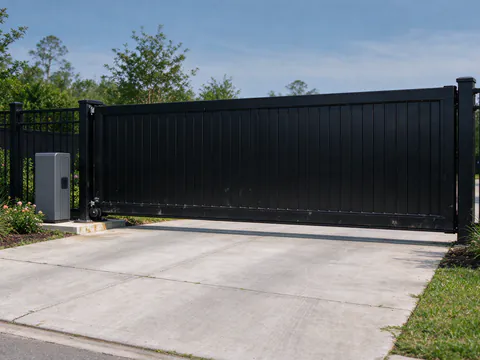
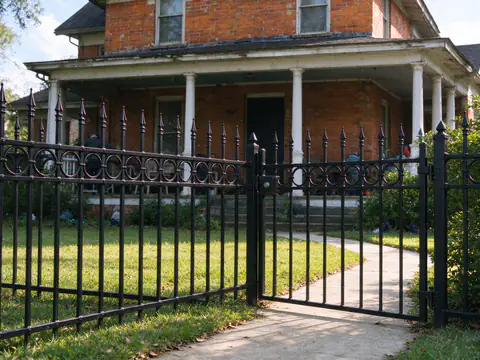
A driveway gate is a fence gate scaled up until its weight and width change the engineering. Palisades Hammond Fence installs manual driveway gates, single-leaf and double-leaf, in wood, steel, aluminum and chain link across Hammond and the towns around it, from a farm entrance off a parish road to a gated drive inside city limits. Installation is carried out by licensed and insured fence contractors.
Every leaf is hung on posts sized for its weight, because a driveway gate fails at the hinge post long before the gate itself wears out.
This page is about manual gates you open by hand. Smaller pedestrian and garden gates are on the gate installation page, and adding an opener is covered under automatic gate installation. Gates in a ranch or pasture line are planned with the farm fence around them.
What makes a driveway gate its own job
Three numbers separate a driveway gate from a walk gate: the width, the weight and how far the leaf sticks out from its hinge. A 12 ft steel leaf hanging off one post puts a load on that post many times what a 4 ft garden gate does, and that load is a lever acting on the footing all day, every day. A gust against a solid leaf multiplies it.
The ground here makes that lever more effective. NOAA’s normals put Hammond’s rainfall at about 64 inches a year, and USDA soil data maps the area mostly as poorly drained silt loam with a seasonal water table near the surface. A footing in saturated soil gives a little every time the gate is opened or caught by wind. Homeowners report a driveway gate post set in 18 inches of concrete leaning within a season, which is the typical result of a hinge post sized like a fence post.
Single leaf or double leaf
A single leaf is simpler to operate: one gate, one latch, no drop rod. It suits openings up to roughly 12 ft and drives where only one side has room for the leaf to swing. The cost is concentrated load: the entire leaf hangs on one post, and the swing needs a clear arc as deep as the opening is wide.
A double leaf splits the opening in two. Each hinge post carries half the width, and each leaf needs only half the swing depth, which matters on a short drive where a long leaf would hit the parked car. The trade-off is in the middle: two leaves have to meet level, and the fixed leaf needs a drop rod into a receiver plus a center stop.
Opening width
Measure the widest vehicle that will use the gate, then add steering room. A pickup towing a trailer, a boat, a delivery truck or a tractor with an implement needs much more than a sedan, and a vehicle turning in from a narrow road needs more than one driving straight in. Homeowners planning an addition ask how wide a gate must be for heavy construction vehicles, a question far easier to answer before the posts are set.
The number to agree on is the clear opening between the posts with the leaves open, not the nominal gate size.
The drive itself: slope, swing and setback
Most drives are not flat across the swing of a gate. If the ground rises inside the gate, a swinging leaf hits the drive partway open. The fixes are to hang the leaf higher with a matching gap at the closed position, to split it into two shorter leaves, to swing it outward where that is allowed, or to switch to a sliding gate. The swing vs sliding gate guide compares the last option in detail.
Setback is the other planning decision. A gate set right at the road forces a vehicle to stop in the lane while someone opens it. Pulling the gate back from the road gives a car room to stop fully off the street. Inside Hammond, no fence may extend into the street right-of-way, and UDC 10.1.2.C requires a clear sight triangle where a driveway meets a street. Those drawings sit in an appendix of the code, so the triangle is confirmed for each address on the permit drawing.
Check the drive before choosing the gate
Photos of the drive from the road and from the house, plus its width, are enough to start on the layout.
Posts and footings for a heavy leaf
The hinge post is the most important part of a driveway gate. On wood gates it is a large timber or a steel post well beyond the size of the line posts; on steel and aluminum gates it is heavy-wall steel. Depth and diameter of the footing follow the leaf weight, the width, how solid the leaf is to wind and the soil at that spot.
In wet ground, the footing is built to drain at the base and to shed water at the top, so the post isn’t standing in a cup of water. Posts are set and the concrete allowed to cure before the leaves are hung. The wet clay post guide explains footing options, and the why fences fail guide shows what a rotating hinge post does to the rest of the run.
Holding a double gate closed
A double gate needs three pieces of hardware working together:
- A drop rod on the fixed leaf that falls into a receiver set in the drive or a concrete pad.
- A center stop that both leaves close against, so neither leaf swings past the other.
- A latch between the leaves, sized for the weight and reachable from the vehicle side if needed.
Homeowners with an 11 ft double gate report the rods and latch failing to hold after about 18 months. When that happens, the hardware is rarely the root cause: a hinge post leaned, a leaf dropped at the center, and the rod now misses its receiver. Open-position holdbacks matter too, because a leaf caught by wind while open can swing into a vehicle.
Materials for a driveway gate
- Wood on a steel frame. Matches a wood privacy fence. The boards are the skin and the welded frame keeps it square; an all-wood leaf this wide racks as the wood dries.
- Steel or wrought iron. Heavy and strong, with ornamental options for frontages. The weight goes straight to the posts, and the coating has to be kept up in this humidity. See wrought iron fences.
- Aluminum. Lighter on the hinge posts and does not rust, at less strength than steel.
- Chain link. Galvanized pipe frame with fabric, the lowest-cost way to close a wide opening on a rural lot or work yard.
A solid leaf catches far more wind than an open picket or chain link leaf. On an exposed drive, the posts and holdbacks are sized for that, especially given how often storms reach this area: FEMA has declared major disasters covering Tangipahoa Parish for storms from Katrina in 2005 to Francine in 2024.
Permit, 811 and cost
Inside Hammond, the gate goes on the fence permit with the rest of the fence; the residential fee is $10, the commercial fee $50, and both double if work starts first. In front of the house, a gate is held to the 4 ft front-yard limit with the fence. Every post hole needs an 811 locate 48 to 120 hours before digging, weekends and holidays excluded. Outside city limits, the parish or town rule is confirmed per address; the fence permit guide covers both.
Driveway gates have no published Hammond-area price range, so they are priced from the specifics: opening width, single or double leaf, material and frame, hinge posts and footings, the drop rod and latch, and site work such as a concrete pad for the receiver. The gate cost guide explains each of those, and the fence cost estimator covers the fence on either side.