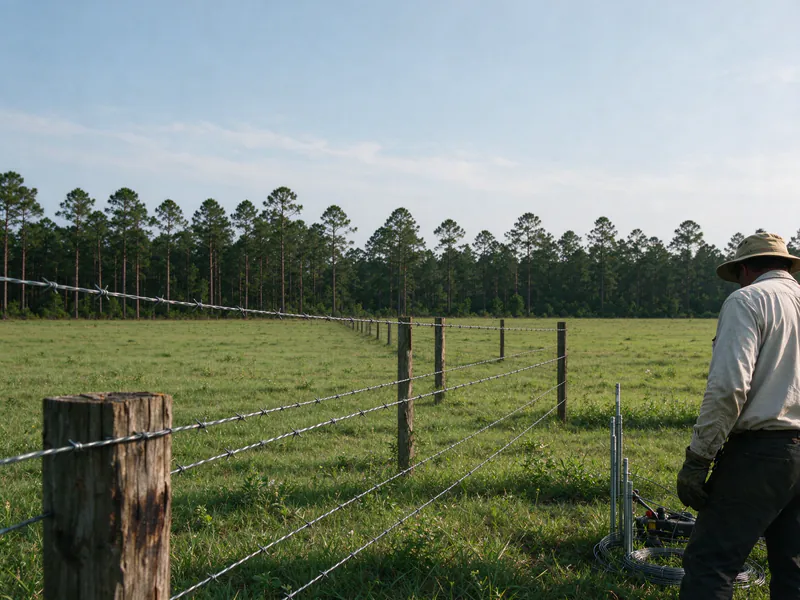
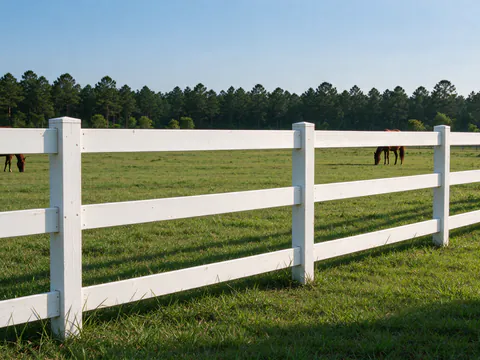
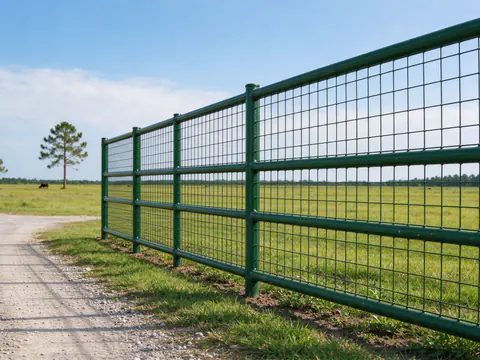
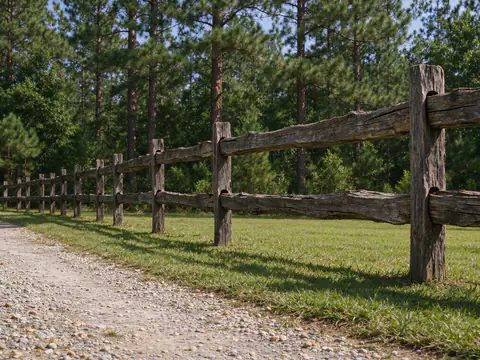
North of Hammond toward Independence, Amite and Loranger, and east toward Folsom, fences are measured in acres rather than feet. Palisades Hammond Fence installs farm fence in the Hammond area: woven field fence, barbed wire and high-tensile wire for cattle, goats, sheep and mixed stock, on braced corners and posts set for the ground they stand in. Installation is carried out by licensed and insured fence contractors.
A farm fence works differently from a yard fence. A privacy fence is a row of posts holding panels; a wire fence is a row of tensioned wire held tight between strong anchors, with line posts in between to keep it at the right height. If the anchors move, the whole fence goes slack. Horses get their own page under horse fence installation, and heavy-duty entrances and pens are under pipe fence installation.
Matching the wire to the animals
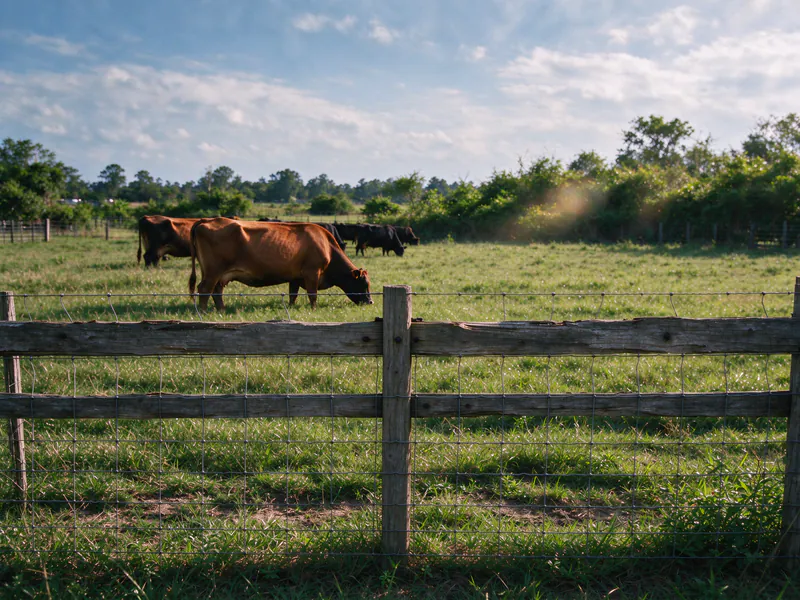
The animal decides the wire. Cattle push and lean; goats climb and look for gaps; sheep and calves go under anything left open at the bottom. One fence rarely suits all of them at once, so the first question is what the pasture holds now and what it may hold later.
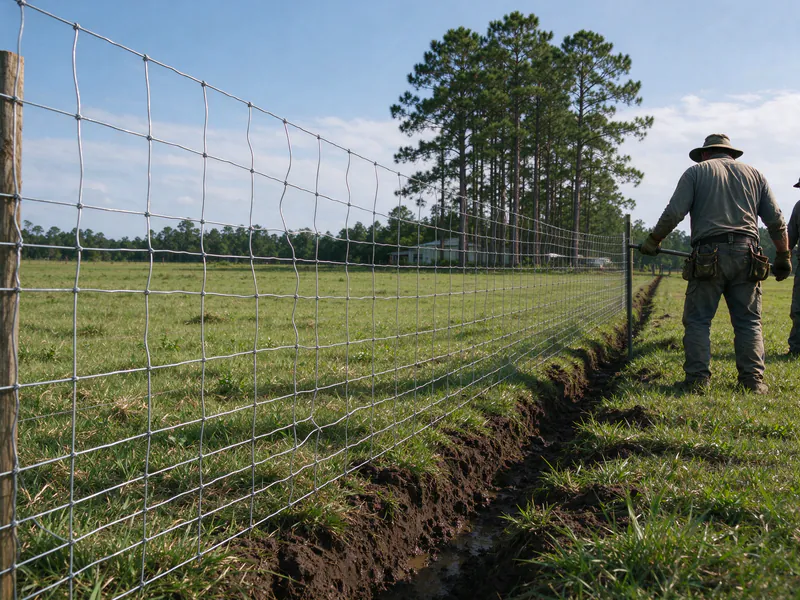
- Woven field fence is a mesh of horizontal and vertical wires, with smaller openings near the bottom. It holds most livestock and is the usual choice for goats, sheep and mixed pastures.
- Barbed wire in several strands is the low-cost perimeter for cattle on large pastures. It is the wrong fence for horses, and inside Hammond it is not allowed in residential districts.
- High-tensile smooth wire runs several strands at high tension on fewer posts. It suits long cattle runs and is often paired with an electric charger by a specialist.
Owners of mixed acreage ask whether one wire type can hold both horses and cattle; the usual answer is to divide the pasture so each animal gets a fence built for it. The horse fence types guide covers the options on the horse side.
Braced corners and ends hold the fence
Woven and high-tensile wire are stretched hard before they are tied off, and that pull has to go somewhere. It goes into the braced assemblies at every corner, every end and both sides of every gate. The common form is the H-brace: two heavy posts set a few feet apart, joined by a horizontal brace rail.
A diagonal tension wire is then twisted tight from the top of one post to the bottom of the other, and the assembly works as a single frame, so the wire pulls against the whole brace instead of tipping one post.
Without proper bracing, the corner post leans toward the run within a season, the wire loosens all the way down the line, and the line posts start leaning in to follow it. Once a woven fence goes slack, livestock push through the low spots. Long straight runs also get intermediate braces, so a failure in one stretch doesn’t loosen the entire line.
Plan the corners first
Send a sketch or a parcel map with the corners, the gates and the low spots marked. The braced assemblies are placed from that.
Posts in wet bottomland
Most of the farm ground around Hammond is wet for long stretches. NOAA’s 1991-2020 normals put the Hammond station at about 64 inches of rain a year and the Amite station at about 64 inches as well, and USDA soil data for Hammond maps mostly poorly drained silt loams with a seasonal water table close to the surface. Homeowners setting pasture corners report hitting water at about 3 ft and asking whether the bottom of the post will simply rot.
Soils vary across the area. USDA sampling around Loranger and Folsom found mostly moderately well drained loams, and around Kentwood more well-drained ground, while Hammond, Tickfaw and Natalbany sampled mostly poorly drained. The site walk notes which kind each part of the line crosses, because it changes the post plan:
- Corner and gate posts in wet soil are set deeper and wider, in treated wood rated for ground contact, so the bottom of the post can sit in wet soil without rotting quickly.
- Line posts can be treated wood or steel T-posts. T-posts drive easily into soft ground but give little stiffness, so a wood post is often added every few T-posts.
- Spacing tightens in soft ground, low spots and slopes, where the wire would otherwise pull posts out of line.
The wet clay post guide covers post setting in more detail.
Ditches, creek crossings and low spots
Flat, wet land is laced with drainage ditches, and a farm line crosses them. Louisiana Civil Code article 686 presumes a ditch between two properties to be common to both, so a fence along a boundary ditch involves the neighbor as well. In recorded subdivisions, plat notes forbid any fence that interferes with a drainage or utility servitude.
Where the fence crosses a ditch or creek, a fixed run of wire catches debris in high water and gets pulled down. The usual approach is a separate crossing section that can swing or be lifted with the water while the braced posts on either bank hold the main fence tight. FEMA flood mapping around Independence and Holden places much of the sampled ground in a Special Flood Hazard Area, so those crossings matter. The fence drainage easement guide has more on servitudes.
Field gates and access
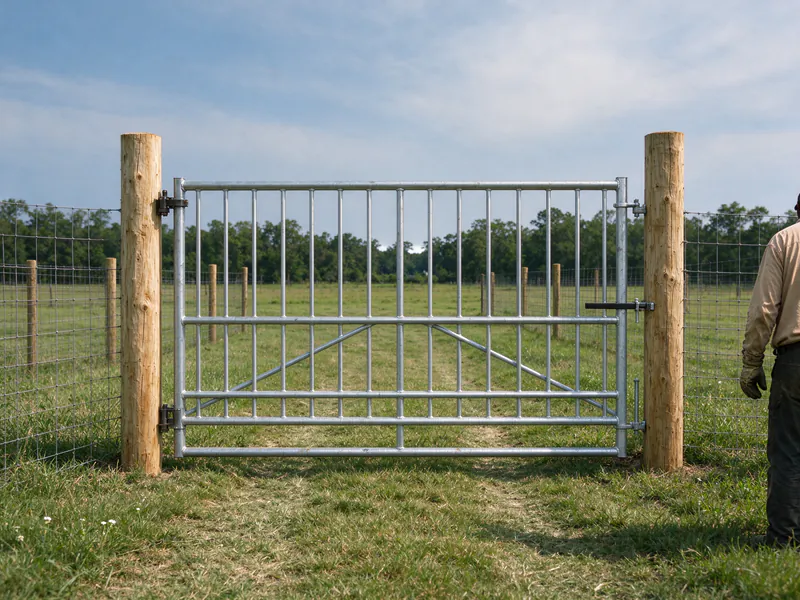
Every gate interrupts the wire, so each one sits between two braced assemblies. Field gates are sized to the largest thing that drives through: a tractor with a bush hog, a hay trailer, a stock trailer. They are hung so they can be swung fully open and tied back without dragging in mud. Pipe or tubular steel gates are the usual choice. The gate installation page covers hanging and hardware.
Rules, boundaries and the line itself
Under Civil Code article 684, a landowner has the right to enclose his land. A fence on the boundary is presumed common to both neighbors under article 685, which brings shared repair duties. When neighbors fix a boundary outside court, article 790 splits the cost equally unless they agree otherwise. The Louisiana fence law guide walks through those choices.
Inside the City of Hammond, wire fences need galvanized pipe supports at least 1.5 inches across set no more than 7 ft apart, woven wire cannot sit in front of the house, and the fence permit costs $10 residential. Most farm ground lies outside city limits, where the parish rule is confirmed per address; Tangipahoa Parish’s own permit records show very few fence permits. Every dug or augered post hole follows an 811 locate.
What a farm fence costs
There is no published Hammond-area price range for farm fence, so it is priced from the specifics: the wire type and gauge, the post type and spacing, how many braced corners, ends and gates the line needs, the total length, wet ground and crossings, clearing brush or trees from the line, and the number of field gates. The farm fence cost guide explains each of those, and for split rail along a road frontage, see split rail fence installation.