A horse fence has a different job from a cattle fence or a yard fence. Palisades Hammond Fence installs horse fencing across the Hammond area, from pasture perimeters to small turnout paddocks, in painted or treated board, rail and no-climb mesh, on braced corners and posts set for wet ground. Installation is carried out by licensed and insured fence contractors.
Horses are large, quick and curious. They lean on a fence to reach grass on the other side, rub against it, chew it, and sometimes run into it when spooked or playing. Equestrian fencing is built so those contacts load the posts rather than the fasteners, the horse can see the fence clearly, and there is nothing to catch a hoof, leg or halter. No fence makes a horse injury-proof or escape-proof; a well-planned one reduces the ways things go wrong.
Pasture, paddock and turnout pen
The first decision is what each area is for, because the loads differ.
A pasture perimeter encloses a large area where horses spread out to graze. They touch the fence occasionally, but when they do it is often at speed. The perimeter is long, so cost per foot matters, and it often runs along tree lines where a falling limb in a storm is a real load.
A paddock or turnout pen is small, near the barn, and in constant use. Horses stand at the fence, lean over it toward each other and rub on it. Contact is constant rather than occasional, so the posts are closer, the rails heavier and the corners stiffer. Pipe fencing is common for these pens; see pipe fence installation.
Fence types for horses
Horse fencing comes in a few families, compared in depth in the horse fence types guide:
- Board fence, three or four boards of treated pine, painted or stained. Highly visible and rigid, and the classic look of a horse farm. Boards break rather than flex, and need checking.
- Ranch rail, the same idea in a heavier rail profile, often used along a drive or frontage as well as around a pasture. A lighter split rail fence marks a line but is not built to hold horses.
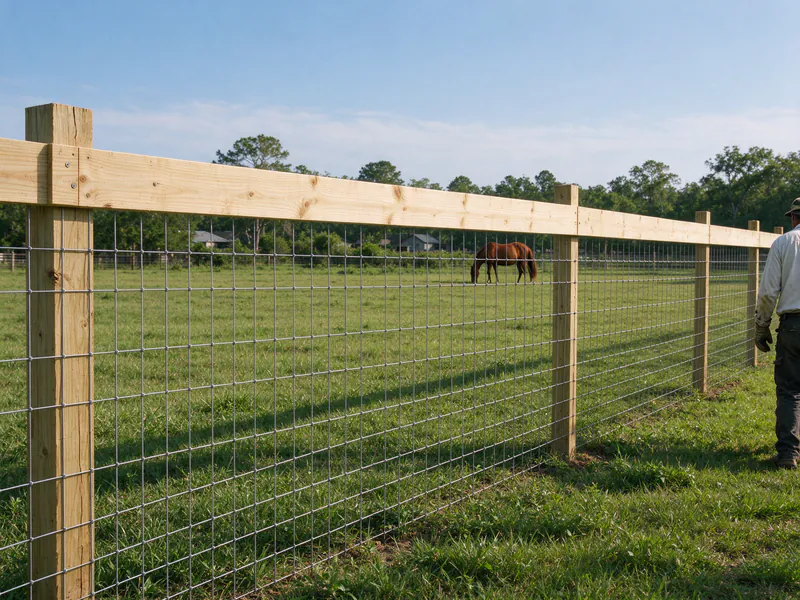
- No-climb mesh, woven wire with small openings that a hoof can’t pass through, topped with a board or rail so horses can see the line and don’t push down the top of the mesh.
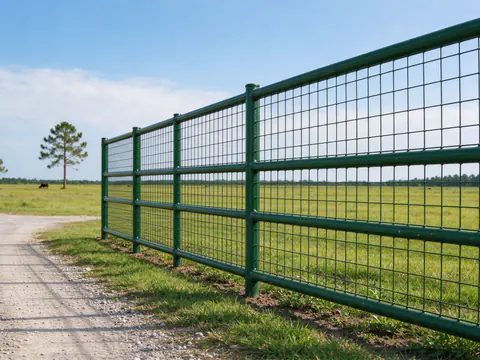
- Pipe, steel pipe posts and rails for pens, alleys and high-traffic corners.
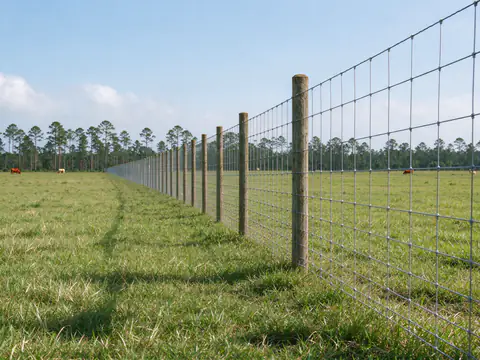
Standard field fence and barbed wire are built for cattle. Field fence openings are large enough for a hoof, and barbs cut. Owners of mixed stock ask whether one fence can serve both, and the answer is usually to give horses a fence of their own. The general farm fence page covers the cattle side.
Braced corners and mesh tension
No-climb mesh and the wire behind board fences only stay tight if their anchors stay put. Every corner, end and gate gets a braced assembly: two heavy posts with a horizontal brace and a diagonal tension wire that turns them into one rigid frame. The mesh is stretched against those assemblies and then attached to the line posts.
When bracing is undersized, the corner post leans in, the mesh loses tension, and a slack fence bellies outward where horses lean. A belly is more than a cosmetic problem: it puts the mesh at a height and shape where a hoof can catch. Attachment matters too. Mesh is fastened to the inside face of the posts with staples or clips set so the wire holds without being crushed, and the top board or rail covers the top strand.
Rubbing, leaning and the posts behind them
Horses rub on posts and lean through the gaps between boards to reach grass. Each of those is a sideways load on the posts, the boards and the fasteners. Boards and mesh go on the horse side of the posts, so leaning pushes them against the posts rather than pulling them off. Fastener heads are set flush, and board ends are cut back so nothing sharp sticks out.
The posts carry all of this in ground that stays wet much of the year. USDA soil data around Hammond maps mostly poorly drained silt loams with a shallow seasonal water table, so posts are ground-contact treated wood (AWPA UC4A or UC4B), set with footings that drain, as the wet clay post guide describes.
Homeowners setting pasture corners report hitting water about 3 ft down; corner and gate posts in that ground are set deeper and wider. The post rot and termite guide explains what attacks posts at the grade line.
Map the pasture before pricing it
A sketch or aerial photo with the pasture, paddocks, gates and low spots marked is the best place to start.
Gaps, transitions and where escapes start
Most problems on a horse fence start at a break in the pattern rather than in the middle of a run:
The ground line
A horse that rolls next to the fence or reaches under for grass can get a leg or head under a bottom board set too high. A bottom board set too low sits in wet grass and rots. The gap is set for the horses, foals included, and held consistent through dips, where it tends to open up as the line crosses lower ground.
Transitions
Where board meets mesh, where the fence meets a barn wall, where a ditch crossing interrupts the line, and on both sides of every gate, gaps open up. Each transition is closed so there is no opening a head or hoof fits into.
Gates
A gate left hanging a few inches off its latch post, or hung with a wide gap at the hinge side, is an easy gap to miss. Gates are hung tight to their posts with a consistent bottom gap.
Gates for horses and gates for equipment
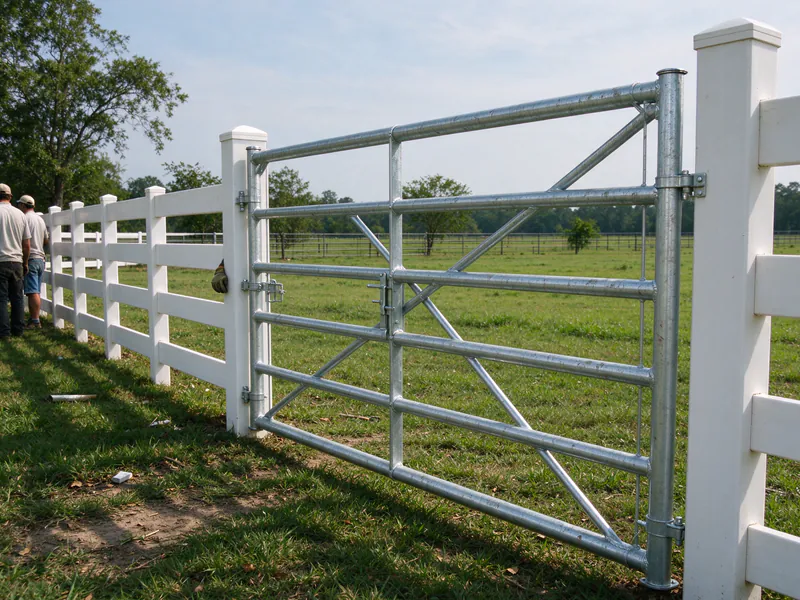
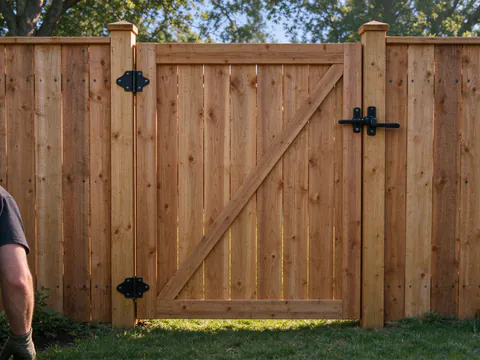
A horse gate and a vehicle gate do different jobs. A horse gate is opened several times a day by someone leading a horse, so it should be wide enough to lead a horse through without crowding, light enough to swing with one hand, and latched with a hardware type a horse can’t nudge or lip open. The latch sits where the handler can reach it from horseback or the ground but a horse can’t play with it.
A tractor, mower or trailer gate is wider and opened less often. Its width follows the equipment: a tractor with a bush hog or a hay trailer needs far more than a person and a horse. The approach matters as much as the width: a gate set at the end of a narrow alley, or right beside a ditch, is hard to drive through. Many pastures need both kinds, each hung between braced posts. The gate installation page covers hanging and hardware.
Inspection after storms and isolating damage
Storms reach this area often enough that a horse owner should plan for them: FEMA has declared major disasters covering Tangipahoa, Livingston and St. Tammany parishes for storms from Katrina in 2005 through Francine in 2024. After a storm, walk the full line before turnout. A broken board, a limb on the mesh or a loosened gate is closed off with a temporary panel or by moving horses to a sound area until the section is repaired. Fence repair handles the fix, and wider damage falls under storm-damaged fence repair.
Electric offsets, rules and cost
An offset electric wire on brackets keeps horses from leaning on and chewing a fence. It is a specialist add-on and is not part of the work described here; if you plan one, say so at the estimate so the posts leave room for it. Mandeville’s land use code, as quoted in city planning reports, prohibits electric fences inside city limits, so the rule is confirmed per address; see the Mandeville page.
Inside the City of Hammond, barbed wire is not allowed in residential districts, and woven wire can’t go in front of the house. Most horse property lies outside city limits, where the parish rule is confirmed per address. There is no published Hammond-area price for horse fencing; board count or mesh specification, the top board, paint, post spacing, line length and the number of gates set the cost. The farm fence cost guide explains each.