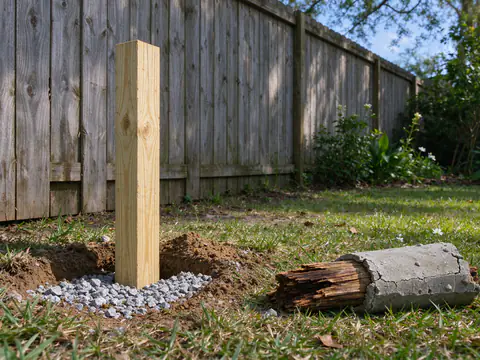
Fence posts rot at ground level because that is where wood stays wet but still gets air. Decay fungi need moisture, oxygen, warmth and the wood itself, and the band from a few inches below the soil to a few inches above it is where all four meet. Around Hammond, frequent rain and long warm seasons keep that band in decay conditions much of the year.
Palisades Hammond Fence replaces rotted posts and rebuilds failing fence lines in Hammond and across Tangipahoa Parish, western St. Tammany and eastern Livingston Parish. This guide explains why rot and termites go after the same few inches of a post, how to tell them apart, how to test a post without digging it out, and what fence post replacement or a rebuild should change.
Where rot starts and why
Wood-decay fungi are living organisms with simple needs. They feed on the wood itself and need water, oxygen and a workable temperature. Wood kept below roughly 20 percent moisture is generally too dry for them; wood well below the water table has too little oxygen. A fence post passes through both conditions, and the transition between them is at the ground line.
That is why a post can look solid from the yard while the inch just under the grass is soft. Moisture wicks up from wet soil, rain runs down the post into the soil around it, and grass, mulch and leaves hold the surface damp. The local climate adds to it: NOAA’s normals for the Hammond station record 64.17 inches of rain a year and 86 days at or above 90 F (NOAA NCEI). Warm, damp wood decays fastest.
How rot reads on a pine post
Pine and other softwood posts usually suffer brown rot, which strips the wood’s strength early. Decayed wood turns darker, shrinks and cracks across the grain into small cube-like pieces, and crumbles when pressed. Because strength goes before the look changes much, a post can snap in a modest wind while still appearing intact above the soil.
Why treated posts still rot
Pressure treatment slows decay; it doesn’t make wood immune. Homeowners report a treated gate post set in concrete rotting through in six years, and others report cedar posts rotting off at ground level within a few years in poorly draining clay. Several things explain failures like these:
- Wrong treatment level. Lumber treated for above-ground use carries less preservative than ground-contact stock. A post needs a ground-contact rating (AWPA Use Category UC4A, or UC4B for harsher exposure), and the end tag says which it is.
- Untreated wood exposed. Preservative doesn’t reach the center of larger posts evenly, and a field cut or a drilled hole exposes that core. A cut end belongs at the top, capped, not in the ground.
- A footing that holds water. Concrete finished flat or cupped at grade traps water against the post, and a hairline gap opens as the wood shrinks and swells.
- Heartwood versus sapwood. Cedar and cypress heartwood resist decay; their sapwood does not, and posts cut from younger trees carry more sapwood.
The wet clay soil guide covers how footings are built to drain and shed water.
Termites in fence posts
Termite damage leads to wood deterioration that can look like rot from the yard, and the two often show up together because damp, partly decayed wood is easier for termites to work. Subterranean termites live in the soil and reach wood by direct contact or through mud tubes built up the side of a post or footing.
Inside the post they follow the softer earlywood between growth rings and leave the harder layers, so an infested post can keep a sound-looking shell over hollow, layered galleries packed with soil. The Formosan subterranean termite gets particular attention because its colonies are large and can nest above ground where wood stays wet. Public data doesn’t measure how active termites are on a given street, so the evidence that counts is on the fence.
Rot or termites?
| What you find | Points toward | Why |
|---|---|---|
| Soft, dark wood that crumbles into cubes | Rot (brown rot) | Fungi break down the wood structure |
| Layered galleries along the grain, packed with soil | Subterranean termites | They eat softer wood between growth rings |
| Mud tubes on the post, footing or boards | Subterranean termites | Tunnels keep them moist in open air |
| Wet, spongy surface with fungal growth | Rot | Active decay in damp wood |
| Hollow sound with a firm outer shell | Termites, or rot inside | Both can hollow the core |
A fence close to the house deserves extra attention, since the same colony can reach a sill plate. Replacing posts fixes the fence, not the colony; a licensed pest control operator handles the house.
Posts soft at the ground?
Describe how many posts are soft or leaning and how old the fence is, and start an estimate for post replacement or a rebuild.
Testing a post without pulling it
- Pull soil and mulch back two to three inches from the base.
- Probe the post with an awl or screwdriver at grade and just below. Sound wood resists and splinters; decayed wood lets the tip sink in.
- Tap along the post with a hammer handle and listen for a dull or hollow note near the ground.
- Push the post at shoulder height. Movement with the footing still tight points to a break in the wood; movement of the whole footing points to soil.
- Look for mud tubes, frass or galleries where wood is exposed.
Check several posts, not just the one that leans. Posts set on the same day in the same soil tend to fail close together.
What to do once rot is found
The fix depends on how many posts are affected. One or two soft posts in an otherwise sound line can be replaced: the old post and footing come out, or a new post is set in a fresh hole beside it, and the rails and boards are refastened. Steel repair spikes driven beside a rotted post can hold a fence temporarily, but they leave decayed wood in place and rely on the same soil.
When most posts are soft at grade, replacing them one at a time keeps chasing the next failure. That is a fence replacement decision, and the repair or replace guide works through it. The fence repair cost guide explains what moves the price of post work.
Preventing rot on a new or rebuilt fence
- Ground-contact treated posts, or galvanized steel posts carrying a wood face
- Crushed stone under the post end and concrete crowned above grade
- Cut ends at the top of the post, sealed and capped
- Boards held off the ground so they aren’t sitting in wet soil
- Soil, mulch and leaves kept clear of post bases
- Sprinklers aimed away from the fence
- Sealer or stain on boards to slow weathering, while remembering it doesn’t protect the buried part of a post
The pine vs cedar guide covers how wood choice affects all of this, and the how long does a fence last guide covers what to expect over time.
Call Palisades Hammond Fence at (985) 866-3827 or request an estimate to have the posts on your fence line checked and replaced where they’ve failed.
Replace rotted posts before the next storm
Share how many posts are soft or leaning and what the fence is made of, and start an estimate for the repair.