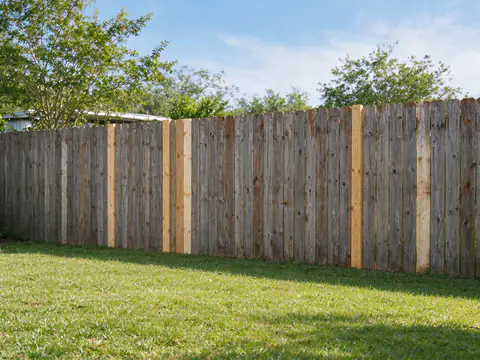
Repair a fence when the failure is local, such as one rotted post, a broken section or a storm-damaged bay, and the rest of the line is sound at the ground. Replace it when the same failure is showing up all along the run, because every post set that day has spent the same years in the same soil, and patching just moves the next failure along.
Palisades Hammond Fence repairs and replaces wood, vinyl, chain link and metal fences across Hammond, Tangipahoa Parish, western St. Tammany and eastern Livingston Parish. Installation is carried out by licensed and insured fence contractors. This guide works through the decision: the check that tells a local failure from a system-wide one, the middle options, costs on each side, and the rules, neighbor questions and insurance steps that change the answer. See fence repair and fence replacement for how each job is done.
The one question that settles most cases
Is the problem in one place, or everywhere? A fence is a system of posts, rails and a face, built at the same time from the same materials. When one part fails from a cause that is specific to it, such as a car backing into a post, a limb landing on one bay or a gate post set too light for its gate, a repair addresses the cause. When parts fail because of conditions every part shares, a repair addresses only the first part to give way.
Around Hammond, the shared conditions are hard on posts. The soil is mostly poorly drained, the seasonal water table sits near the surface, and NOAA’s normals for the Hammond station record about 64 inches of rain a year (NOAA NCEI). If one post has rotted at grade, it is worth finding out how close the others are.
Walk the line before deciding
A simple walk tells you most of what you need:
- Push every post at shoulder height and note which ones move, not just the worst.
- Probe at the ground with a screwdriver on three or four posts across the run, including ones that look fine.
- Look at rail ends where they meet the posts; soft or split rail ends along the whole run point to system-wide wear.
- Note the pattern. Failures clustered in a low spot or by a downspout suggest a local cause. Failures spread evenly suggest age.
- Check the gate last; a sagging gate on a sound fence is usually a hinge-post or frame problem, not a reason to replace.
The fence assessment tool walks through the same questions. The why fences fail guide explains what each symptom usually means.
When repair is the right call
Repair makes sense when the damage has a specific cause and the rest of the fence is sound at the grade line. Typical cases are one or two posts rotted from a wet spot, a bay knocked down by a falling limb, boards broken by impact, rails pulled loose at their fasteners, or a gate that sags because its hinge post is moving. Fence post replacement and gate repair cover the first and last of those jobs.
Repairs also make sense when the fence is relatively new and something went wrong early, such as a post set from above-ground lumber or a footing that holds water. Fixing the detail that failed, not just the part, is what keeps a repair from repeating.
When replacement is the right call
Replacement makes sense when the failure is everywhere: most posts move or are soft at the ground, rails are rotting at every connection, chain link posts are rusted thin at grade, or vinyl panels keep pulling out along a whole run. At that point, each repair buys only until the next post goes, and those repairs add up.
A few other conditions point to replacement regardless of condition. A fence that no longer meets the rules, such as a solid fence taller than 4 ft in front of a Hammond home, can’t simply be rebuilt as it was. A fence on the wrong line, or one blocking a drainage servitude, is a chance to fix the location. And a style you no longer want is a fair reason on its own.
The middle options
The choice isn’t always a patch or a full rebuild:
- Replace one run. A side along a ditch or facing open ground can wear out years before a sheltered side. Replacing just that run keeps sound sections in service.
- Re-set posts under sound panels. Where boards and rails are fine but posts are failing, new posts can sometimes be set and the existing panels rehung.
- Steel posts behind a wood face. Galvanized steel posts can be set beside or in place of failing wood posts on some fences, keeping the wood face.
- New boards on sound posts. Where posts are solid but boards are weathered or broken, re-boarding renews the face.
Each one depends on what is still sound, which is why it is worth knowing the condition of every post first. The how long does a fence last guide explains why posts of the same age fail together.
Costs on each side
Replacement is priced like a new fence plus removal. Typical Hammond-area ranges for budgeting, installed: 6 ft pine privacy $15 to $45 per foot, vinyl privacy $20 to $60, residential chain link $10 to $30. Tearing out and hauling away the old fence typically adds $2 to $8 per foot, more where old posts sit in concrete. A walk gate adds $150 to $600.
Repairs have no single published range. They are priced from the post material, how the old footing comes out, access to the line, matching the boards or panels, and the trip itself. A run of repairs on an aging fence can approach the cost of replacing that run. The fence repair cost guide covers those drivers, and the fence cost estimator gives a replacement range for your length.
| Situation | Usually points to | Why |
|---|---|---|
| One or two soft posts, rest solid | Repair | Local cause; the rest of the line is sound |
| A bay down from a falling limb | Repair, then check the neighboring posts | Impact damage is local, but posts may be cracked |
| Most posts move or are soft at grade | Replace the run | Every post shares the same age and soil |
| Rails rotting at every connection | Replace | The frame is worn out, not one part |
| Vinyl profile discontinued | Replace the affected run | Matching parts aren’t available |
| Fence breaks current height or material rules | Replace to code | It can’t be rebuilt as it was |
Shared fences, storms and permits
A fence on the boundary is presumed common to both owners under Louisiana Civil Code article 685, and where both lots are enclosed a landowner may compel the neighbor to contribute to making and repairing it. Talk to the neighbor before either repair or replacement. The Louisiana fence laws guide covers how that works.
After a storm, photograph the whole line and every break before anything is moved, and ask your insurer about coverage before work begins. Policies generally treat sudden wind or tree damage differently from rot, so sound wood at the breaks supports a claim. The storm-damaged fence insurance guide covers the steps.
Inside the City of Hammond, a rebuild needs a fence permit before the fence is placed: $10 for a home, doubled if work starts first (City of Hammond). Every new post hole also needs a Louisiana 811 locate 48 to 120 hours ahead, excluding weekends and holidays. To have the whole line assessed, call Palisades Hammond Fence at (985) 866-3827.
Repair it or start over?
Describe what's leaning, broken or soft and how long the fence has stood, and get both options priced side by side.