Wood fence installation around Hammond is mostly a question of what happens below the grass. Palisades Hammond Fence installs pressure-treated pine, cedar and cypress fences across Hammond and the towns around it, from 6 ft dog-ear privacy runs to 4 ft front-yard pickets, and plans each one from the posts up. Installation is carried out by licensed and insured fence contractors.
Pine is the local default because it is the lowest-cost way to put up a solid screen and the easiest fence to repair one board at a time. Its weak point here is the ground: soil that stays wet for much of the year, a long warm season, and posts that spend their whole life in both.
This page covers the choices that decide how long a wood fence stands in Tangipahoa Parish: the species and grade of the boards, how the posts are set, which style suits a yard that takes storm wind, and what the City of Hammond requires before the first hole is dug. If you are still choosing a material, the wood vs vinyl fence guide sets the two side by side.
What happens on the first visit
The first visit is a walk of the line. The run is measured, corners and gate openings are marked, and grade changes are noted, because Hammond measures fence height from the lower side of the fence. A fence along a raised bed or a ditch bank loses usable height on the high side.
The walk also records what shapes the post plan: where water stands after rain, how close the line runs to a drainage swale or a boundary ditch, whether an old fence and its concrete footings are coming out, and where the gates will hang.
Property questions come up before the price is final. An old fence is not proof of where the line is, and the City approves a fence’s location from a survey or parcel map, so that document is part of the job from the start. A fence built on the boundary is presumed common to both neighbors under Louisiana Civil Code article 685, which affects who shares its repair; a fence set just inside the line stays yours. The Louisiana fence law guide explains that choice.
Once the permit is in hand, the utility locate request goes in: Louisiana law treats an augered post hole as excavation and requires notice at least 48 and no more than 120 hours ahead, weekends and holidays excluded.
Pine, cedar or cypress
Pressure-treated southern pine is strong, holds fasteners well and takes a stain, and the preservative is forced deep into the wood under pressure. What matters is the rating on the end tag. Posts need lumber treated for ground contact (AWPA Use Category UC4A, or UC4B for heavier exposure such as a post standing in wet soil), while rails and pickets above ground can carry a lighter treatment. A post cut from above-ground stock looks identical on delivery day and rots years sooner.
Cedar boards resist decay and insects through natural compounds in the heartwood, move less as they dry and weather to an even gray. Most cedar fences still stand on treated pine or galvanized steel posts, because no untreated species performs as well buried in wet soil as a ground-contact treated post. Knotty grades vary from board to board, and pale sapwood carries little of the heartwood’s resistance.
Cypress is the regional wood, and its heartwood has a long reputation for resisting rot. Much of the cypress sold today is younger growth with a larger share of sapwood, so grade decides more than the species name. Supply, grade and board width set its price, which is why it is priced job by job rather than from a published range. The pine vs cedar guide goes deeper on the first two, and the table further down compares all three.
Posts in wet ground: where wood fences fail here
Most wood fences around Hammond fail at the posts, in a band a few inches above and below grade. USDA soil survey data for Hammond maps mostly poorly drained silt loams, with the seasonal high water table as shallow as 5 inches and around 9 inches at the median point sampled. NOAA’s 1991-2020 normals for the Hammond station average 64 inches of rain a year and 86 days at or above 90°F. Wood that stays wet at the bottom and warm above is exactly what decay fungi need.
Freezes come about 31 nights a year but are brief and shallow, so frost heave does not set post depth here. Wind, soft soil and water do.
A post set in a concrete collar that ends at the grass tends to hold water against the wood where the two meet. The better pattern is a footing that drains at the bottom, with gravel under the post end, and concrete finished above grade and sloped away from the post so rain runs off instead of pooling.
Depth and diameter follow the fence height, how solid the face is, the gate loads and the soil at that address; no single number suits every fence. The wet clay post guide walks through footing options.
Termites in the line
Termites are the second threat. Subterranean termites live in the soil and reach wood that touches it. Treated posts resist them, but every field cut exposes untreated wood at the core, so cut ends get a brushed-on preservative and are kept above ground where possible. Untreated landscape timbers, mulch heaped against posts and scrap wood left in the line give them an easy start. The post rot and termite guide covers how to spot both.
Storm wind on the same weak spot
Wind finishes what water starts. A 6 ft solid panel between posts 8 ft apart presents 48 square feet of face to a storm, and that load levers against the post at the ground line, the same spot rot has been weakening. FEMA has declared major disasters covering Tangipahoa Parish for storms from Katrina and Gustav to Ida in 2021 and Francine in 2024. Solid fences on open lots get heavier posts, closer spacing or a semi-open style. The why fences fail guide and the wind-resistant fence page go further.
Plan the posts before the boards
Send the address, the length, the height and the style. Post size, spacing and footing come first in the plan.
Styles, rails, pickets and caps
Each style changes how many boards go on a foot of fence and how the wind meets it.
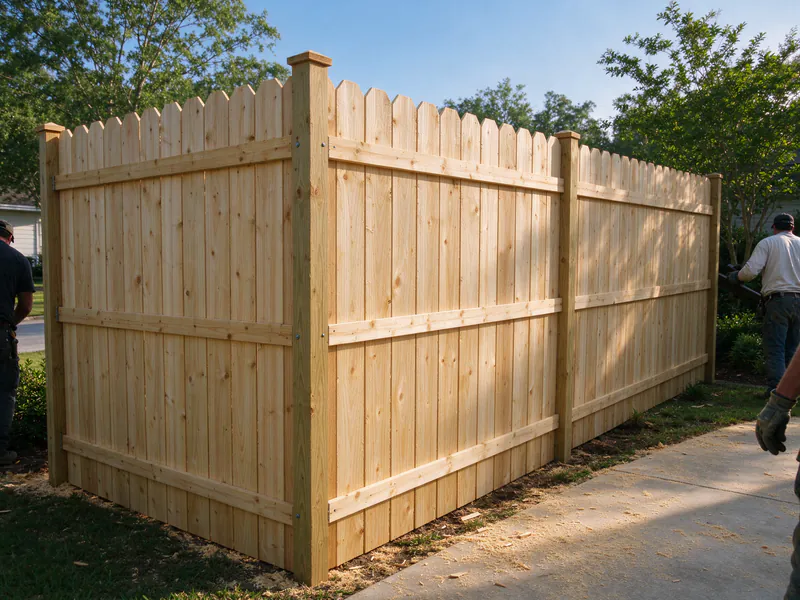
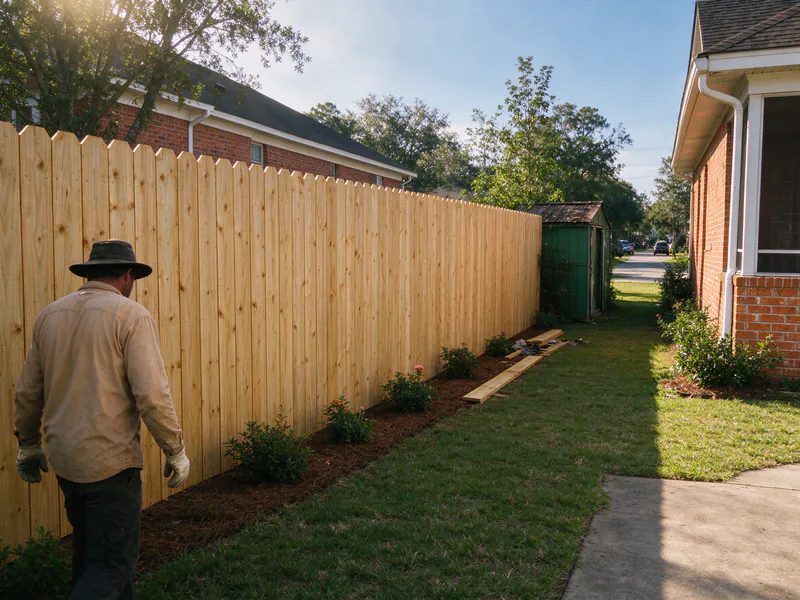
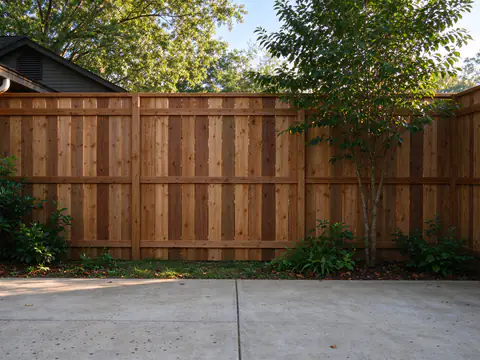
- Dog-ear and stockade. Boards butted edge to edge on three rails, with clipped or pointed tops. The most common privacy fence and the least material per foot; small gaps open as the pine dries.
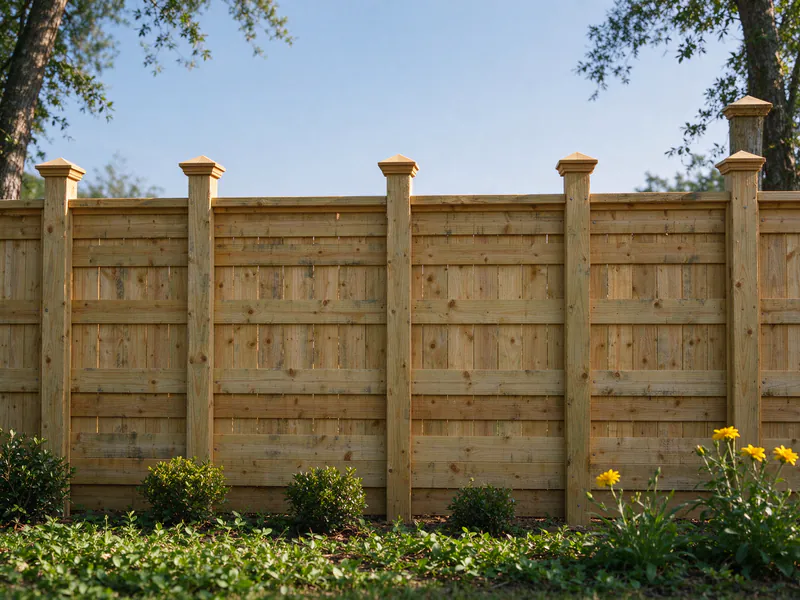
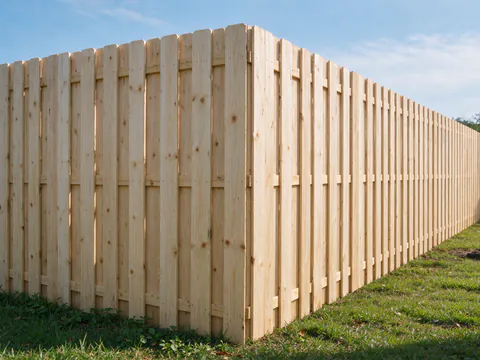
- Board-on-board. Boards overlap on alternating sides of the rails, so no gap shows when they shrink. More boards per foot and fully solid to wind; see board-on-board fences.
- Shadowbox. Boards alternate on each side with space between, finished on both faces and letting some air through at an angle.
- Lattice-top. A solid lower section under an open lattice band, adding height with less wind load.
- Picket. Spaced boards on a low fence, the usual front-yard choice; see picket fences.
- Horizontal. Long boards on a stiffened frame with shorter spans so they don’t sag; see horizontal fences.
Every style sits on the same frame. Rails, usually 2x4s, carry the boards between posts; a 6 ft fence gets three, so the boards cannot cup or twist at mid-height. Rails fastened to the face of the post are the simplest attachment, while rails set between posts in galvanized brackets keep the post faces flush with the boards.
Picket spacing has consequences too: butted boards for privacy, an overlap for board-on-board, an even gap on a picket fence, and in every case a gap of an inch or two between the bottom of the boards and the ground so they are not wicking water.
Post caps cover the end grain on top of each post, the part that soaks up rain fastest. Fasteners matter more than they look: the copper in modern pine treatments corrodes plain steel, so nails, screws and hinges are hot-dip galvanized or stainless.
Hammond’s height and permit rules for a wood fence
Inside the City of Hammond, every fence needs a permit from the Building Department before it goes in, and the city approves the design and location shown on a survey or parcel map (UDC 4.1.8). The residential permit fee is $10 and the commercial fee $50, doubled if work starts first.
In front of the house a wood fence can be at most 4 ft; from the front of the house back it can reach 8 ft, measured from the lower side. Within 30 ft of a street intersection nothing may stand more than 3 ft high, and the code calls for weatherproofed wood.
The Hyer-Cate overlay and the Historic District add their own review, and recorded subdivision restrictions can be stricter than the code. Outside city limits, the parish or town rule is confirmed per address. The fence permit guide has the details, and Covington’s separate permit and historic rules are on the Covington page.
Stain, seal and upkeep
A stain protects the boards, not the posts. Treated pine has to dry before it takes a finish, and a penetrating stain with UV-blocking pigment then slows graying and checking in this sun, renewed every few years. No stain reverses rot that has started. Staining is its own line on the estimate and has its own fence staining page. How long a fence lasts depends far more on the post detail than on the finish, as the fence lifespan guide explains.
What a wood fence costs around Hammond
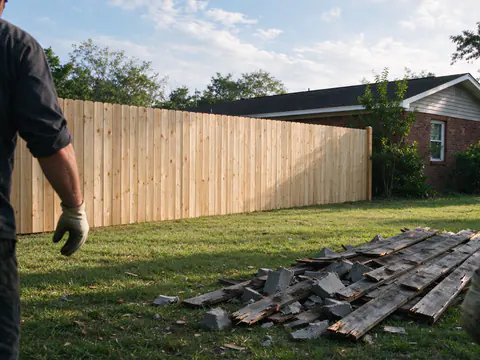
A typical Hammond-area range for a 6 ft pressure-treated pine privacy fence, installed, is about $15 to $45 per linear foot; cedar privacy runs about $22 to $55. Flat, open lines with one gate sit low. Board-on-board, shadowbox and taller fences, wet or root-filled ground, heavier posts for wind and slopes push toward the top. Walk gates typically add $150 to $600 each, and taking out an old fence $2 to $8 per foot, covered under fence replacement. These are budgeting ranges, not quotes.
Labor costs less here than nationally. BLS does not publish a fence-erector wage for the Hammond metro; statewide, Louisiana fence erectors earn a mean $19.92 an hour, about 18% below the $24.29 national mean, and construction laborers in the Hammond metro average $19.63 against $25.02 nationally (BLS OEWS).
A wage is not a billing rate: an installed price also carries materials, insurance, licensing, vehicles, disposal and overhead. A residential job above $7,500 also requires the contractor to hold at least a home improvement registration from the Louisiana State Licensing Board for Contractors. The fence cost estimator turns length, height and gates into a range, and the fence installation cost guide breaks it down further.