A privacy fence in Hammond is mostly a sightline problem with a wind problem attached. Palisades Hammond Fence installs wood and vinyl privacy fences across Hammond, Tangipahoa Parish and the nearby towns of western St. Tammany and eastern Livingston Parish, from a 6 ft dog-ear run along a back line to an 8 ft screen between a yard and a busy road. Installation is carried out by licensed and insured fence contractors.
The goal is a fence that blocks what you need blocked, stands up to storms and doesn’t hold water against its own posts. That starts with knowing where full height is allowed, where it is needed, and how much solid face the posts can carry in this ground.
What happens on the first visit
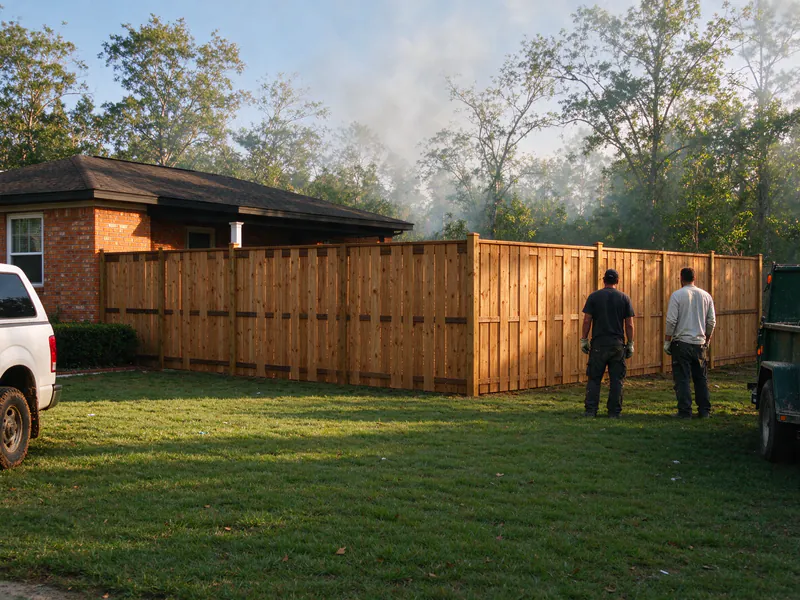
The first visit walks and measures the line, and for a privacy fence the views matter as much as the footage. Where does a neighbor’s patio, a second-story window or a road look into the yard? A screen only needs full height where it breaks a sightline, so a long run can step down to 6 ft or to a semi-open style where nothing is being hidden. That choice saves boards and takes load off the posts.
The walk also records gates, slopes, the soil and where water goes after rain. A solid fence placed across a drainage path dams it, so the line is checked against swales, ditches and any drainage servitude before the plan is drawn. The drainage easement guide explains why a recorded servitude can rule out a fence entirely.
Where a privacy fence can go in Hammond
Hammond’s development code draws the line at the front of the house. Forward of the front building line, a fence may be wood, metal or masonry and no taller than 4 ft, and chain link is not allowed. From the front building setback line or the front of the house, whichever is farther back, solid fences of wood, vinyl, stone or similar materials can rise to 8 ft. Within 30 ft of a street intersection nothing may stand above 3 ft.
The code measures height as the greater of the two measurements from the ground on each side. A fence at the top of a 1 ft bank toward the neighbor is measured from the low side, so 8 ft by the code may leave only 7 ft facing your yard. On a lot that falls toward the back line, that detail decides whether a 6 ft or an 8 ft fence actually does the job.
Every fence in the city needs a permit before work starts: $10 for a home and $50 for a commercial property, doubled if work begins first, with the location approved from a survey or parcel map. The Hyer-Cate overlay and the Historic District add review, and recorded subdivision restrictions can be stricter than the code. The fence permit guide covers each step.
Outside Hammond city limits
Covington’s fence permit form asks you to declare, for each yard, whether the fence is privacy or 50% open, and its historic district keeps solid board fences to back yards at 6 ft. Mandeville’s code, as quoted in city staff reports, allows 7 ft in side and rear yards and 4 ft along a street-facing side yard; the current text is confirmed per address. In unincorporated parish areas the rule is checked for the parcel before anything is drawn. The Covington page and the Mandeville page cover both cities.
Solid styles: stockade, dog-ear and board-on-board
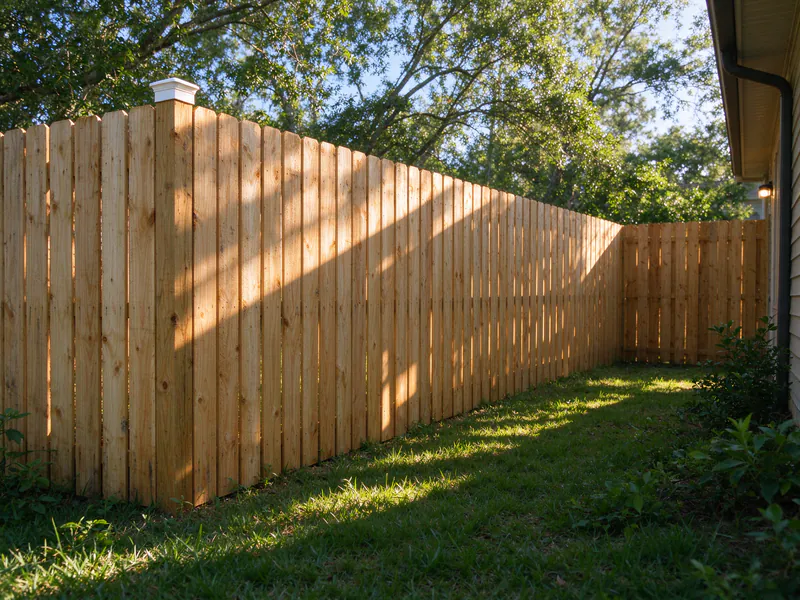
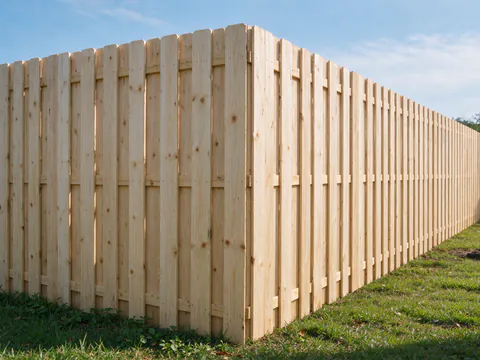
A stockade fence is the plainest privacy screen: boards butted edge to edge on two or three rails, often with pointed tops. Dog-ear is the same idea with clipped corners. Both use the fewest boards per foot, and both show their rails on one side. As pressure-treated pine dries in the first summer, each board shrinks across its width, and the tight joints open into thin gaps you can see light through.
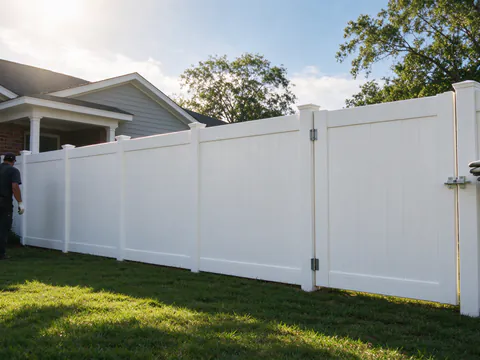
Board-on-board solves that by overlapping a second layer over the gaps, so the screen stays closed as the wood moves. It costs more because it uses more boards and heavier rails carry them. Vinyl privacy panels close the face with interlocking boards and don’t shrink, which is one reason owners comparing the two read the wood vs vinyl guide before choosing.
Semi-privacy: shadowbox and lattice-top
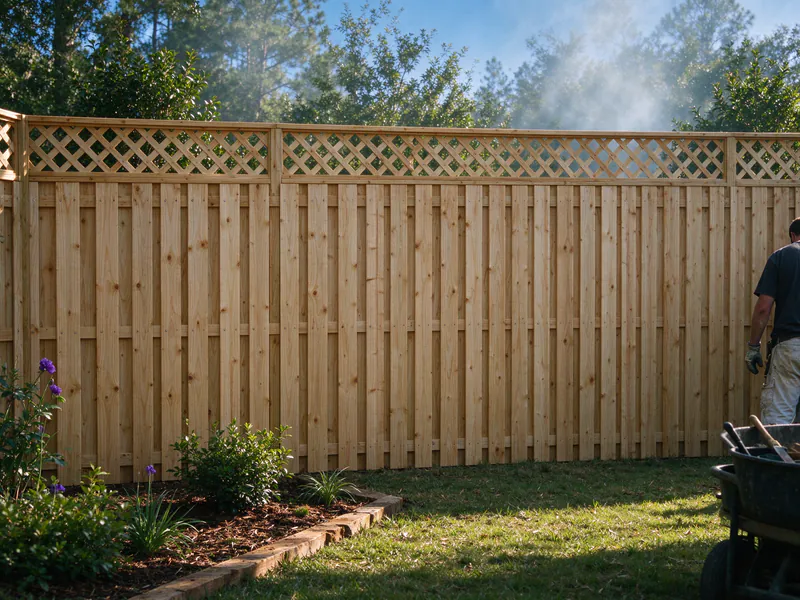
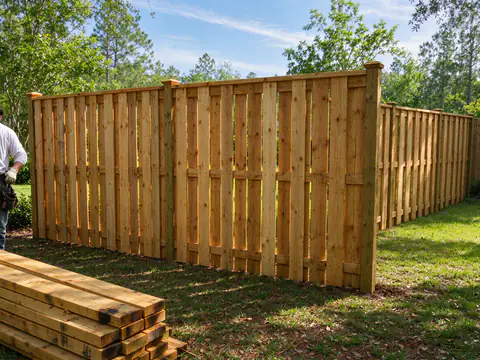
A semi-private fence trades a little screening for air, light and less wind. Shadowbox alternates boards on each side of the rails with space between them, so a person looking straight at it sees a solid wall, while light and air pass on the diagonal. Lattice-top puts an open band over a solid lower section, adding height for screening at eye level without adding a full solid face at the top, where wind pushing on the face has the longest lever on the post.
The trade-off is real. Openings reduce wind load, though not in proportion: a face that is half open still carries a large share of a solid face’s load. They also let the ground along the line dry out between rains, which matters in soil this wet. What they give up is angled privacy, so they work best where the view to block is straight across, not from above.
Decide where full height earns its place
Send the address and a sketch of the run with what you want hidden. Full height, semi-open sections and the gates are planned together.
Posts for a solid face in wet ground
A privacy fence works its posts harder than any other fence. A 6 ft solid face between posts 8 ft apart gives each post about 48 square feet of wind catch, levering against it at the ground line. That band sits in soil that stays wet much of the year: USDA soil survey points around Hammond are mostly poorly drained silt loams with a seasonal water table about 9 inches down at the median point, and NOAA’s normals put Hammond’s rain at about 64 inches a year.
So the posts carry the plan. Taller or more exposed runs get heavier posts, closer spacing or galvanized steel posts with wood facing, and footings that drain at the bottom and shed water at the top. No single depth fits every fence; height, face, gate loads and the soil set it. The wet clay post guide explains footing choices, and the wind-resistant fence page covers runs that face open ground.
Gates in a privacy run
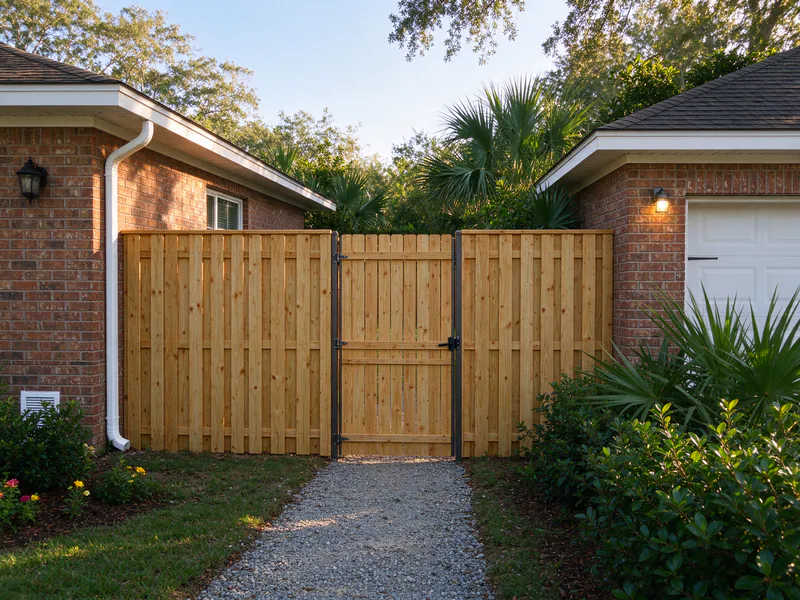
A privacy gate is a heavy solid leaf hanging from one post. The hinge post gets more size and depth than a line post, the frame gets a diagonal brace running up from the bottom hinge corner, and wide openings become double gates with a drop rod. Gate installation covers wide and driveway openings.
Dogs, pools and shared lines
Privacy fences often go in for a dog as much as for a view. A solid face removes the visual trigger that sets some dogs barking at the fence, but a diggable bottom gap undoes the rest; the best fence for dogs guide covers dig guards and heights. A fence that encloses a pool falls under the state pool-barrier rules, covered under pool fences.
A fence built on the boundary is presumed common to both owners under Louisiana Civil Code article 685, which shapes who shares its repairs. Setting it just inside your line keeps it yours. An old fence is not proof of where the line runs, so the survey decides; the Louisiana fence law guide explains the trade-offs.
What a privacy fence costs around Hammond
Typical Hammond-area ranges for a 6 ft privacy fence, installed, run about $15 to $45 per linear foot in pressure-treated pine, $22 to $55 in cedar and $20 to $60 in vinyl. Walk gates typically add $150 to $600 each, and tearing out an old fence $2 to $8 per foot. An 8 ft fence, board-on-board, heavier posts for an exposed run and wet or root-filled ground push toward the top. These are budgeting ranges, not quotes.
There are no rebates or incentives for fences. The privacy fence cost guide breaks the numbers down, and the fence cost estimator turns your length, height and gates into a range. For the wider choice of materials, start at wood fence installation.