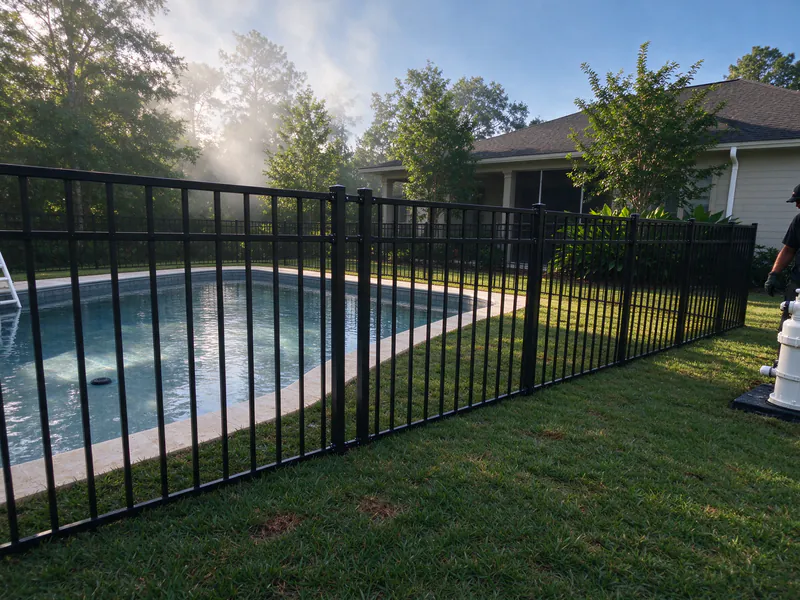
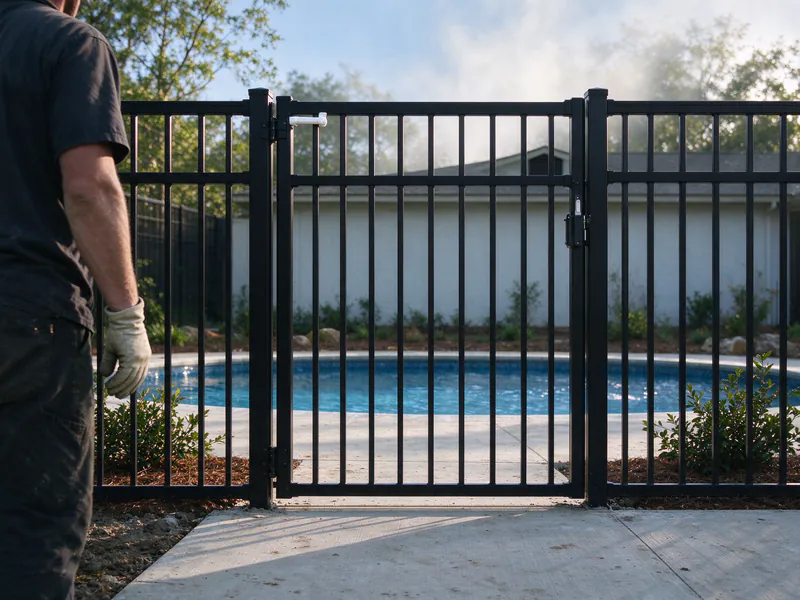
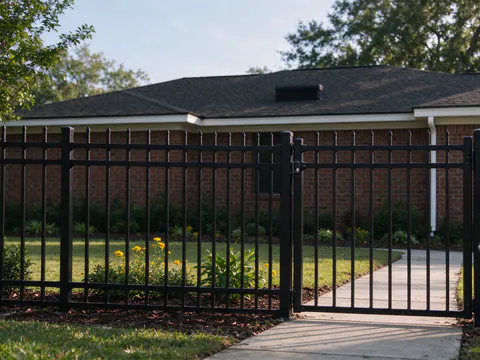
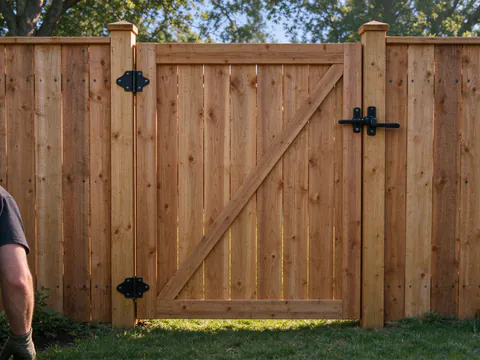
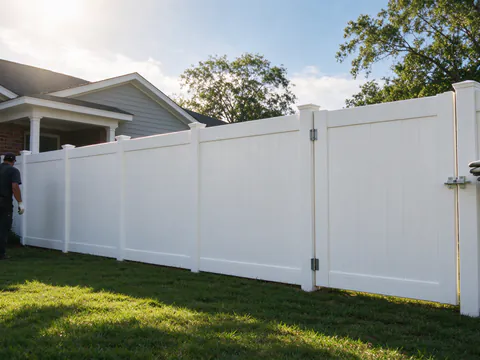
Pool fence installation is the one fence job where the gate matters more than the look. Palisades Hammond Fence installs pool barriers across Hammond and the surrounding towns of Tangipahoa, St. Tammany and Livingston parishes, in ornamental aluminum, steel, vinyl and wood, with self-closing, self-latching gates. Installation is carried out by licensed and insured fence contractors.
No fence comes with automatic code compliance, and no page can promise a pool inspection result. What a pool fence can do is follow the barrier rule confirmed for your address, closely and in writing, and keep working after years of use. This page explains where that rule comes from, what it usually asks for and how the barrier is built to meet it.
Where pool barrier rules come from in Hammond
Hammond’s development code requires a swimming pool permit separate from the fence permit, but it contains no pool barrier rules. Barriers fall to the state. The Louisiana State Uniform Construction Code adopts the 2021 International Residential Code along with the standards it references, and Louisiana’s amendments leave its pool section, R326, unchanged. That section points to the International Swimming Pool and Spa Code (ISPSC), whose Section 305 covers barriers.
That chain means the rule is applied through the pool permit and its inspection, so the building official is the final word on what applies to your address. Louisiana moves to the 2024 editions of these codes on January 1, 2027, which can change details. Covington keeps its own swimming pool checklist with its building permits, and its fence permit rules are on the Covington page.
What the model barrier rule usually asks for
The ISPSC barrier section and the U.S. Consumer Product Safety Commission’s barrier guidelines share a core set of requirements. Each is confirmed against the edition and local reading for your address before the layout is final.
- Height. The top of the barrier at least 48 in above grade, measured on the side away from the pool.
- Bottom gap. No more than 2 in between the ground and the bottom of the barrier on the outside.
- Openings. Nothing a 4 in sphere can pass through.
- Rails. Where horizontal rails are less than 45 in apart, they sit on the pool side and the gaps between pickets narrow to 1-3/4 in, so the rails can’t serve as a ladder.
- Gates. Opening outward, away from the pool, self-closing and self-latching.
- Latches. A release lower than 54 in from the bottom of the gate goes on the pool side, at least 3 in below the top, with no opening over 1/2 in within 18 in of it.
- House walls. Where the house forms part of the barrier, doors opening toward the pool need added protection, such as an alarm.
What happens on the first visit
The walk traces the barrier line rather than the property line. It marks the pool, the deck edge, the equipment pad and every door and window that opens toward the water, then plans where people will enter and where the gates go. Fewer gates make a safer barrier, and each one is placed so it can swing outward without hitting a step, a planter or the deck edge.
It also checks the ground the posts will stand on. Some posts go in soil and some may be anchored to the deck, and the deck slab, its edge and the drainage around the pool shape that choice. Then come the fence permit drawing, coordinated with the pool permit, and the Louisiana 811 request. The utilities mark public lines but not private ones, so pool pump circuits, lighting runs and gas lines to a heater are found from the pool plans or a private locate before any digging.
Building the barrier
Posts and wet ground
A pool barrier has to hold its shape for years, because a leaning post shifts the gate until the latch misses. USDA soil survey data for Hammond maps mostly poorly drained silt loams with a shallow seasonal water table, and ground near a pool is often wetter still from splash and backwash. Posts are set in concrete finished above grade and sloped to shed water, and the wet clay post guide explains the options.
Choosing the material
Aluminum is the usual choice: it doesn’t rust near pool water, its pickets come at barrier spacing with the rails arranged on the pool side, and it leaves the water visible from the house. Steel works the same way and resists climbing but needs more upkeep. Vinyl and wood privacy fences can serve when their face is smooth and their rails face the pool. Chain link qualifies only where its mesh is small enough for the rule. The comparison on this page sets out the trade-offs.
A solid privacy barrier also takes the full force of storm wind. Homeowners report new privacy panels around pools flexing and their anchors loosening in the first strong wind, so a solid barrier gets closer post spacing and stiffer rails, as the wind-resistant fence page describes. Open aluminum avoids most of that load.
Send the pool layout
A photo or sketch of the pool, the house doors and the equipment pad is enough to start the barrier plan.
The gate is the barrier
A pool barrier is only as good as its gate on its worst day. Self-closing hinges pull the gate shut from any open position, and the latch catches without anyone touching it. That only works while the hinge post stays plumb and the leaf stays square, which is why the gate hangs on a stiff post set deeper than the line posts.
Hinge tension needs adjusting as the hardware settles. A good habit, also urged in the CPSC guidelines, is to open the gate partway and fully and let it go, confirming it closes and latches each time. A gate that drags or bounces off the latch gets fixed promptly; see gate repair and gate installation.
Fence rules still apply
A pool barrier is still a fence. Inside Hammond it needs a fence permit, $10 for a residence and doubled if work starts first, and it follows the city’s height and placement rules: 4 ft in front of the house, 8 ft behind, measured from the lower side. The fence permit guide covers the application, and the Louisiana pool fence requirements guide goes deeper on the barrier rules. If the barrier is aluminum, the aluminum fence page covers finishes and grades.
What a pool fence costs around Hammond
A typical Hammond-area range for an aluminum pool barrier, installed, is about $25 to $55 per linear foot. Short barriers close around a deck sit higher per foot than long yard enclosures, and pool-rated gates, deck anchoring, slopes and taller panels push toward the top. Walk gates typically add $150 to $600 each, and the self-closing, self-latching hardware a barrier needs is part of that line. These are budgeting ranges, not quotes. The fence cost estimator turns your length and gates into a range.