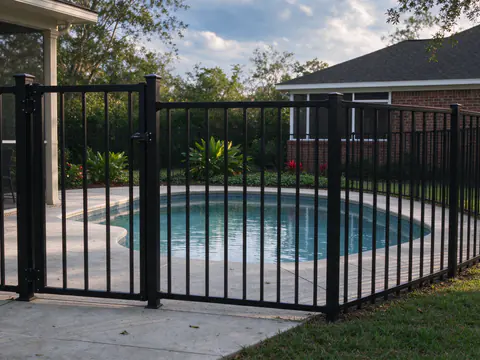
Louisiana has no stand-alone pool fence statute. Residential pool barriers fall under the state construction code, which adopts the 2021 International Residential Code and the swimming pool code it references, and the local building official applies it. In practice that means a barrier at least 48 inches tall, openings too small for a 4 inch sphere, and gates that close and latch themselves.
Palisades Hammond Fence installs pool fences in Hammond and across Tangipahoa Parish, western St. Tammany and eastern Livingston Parish, and pool fence installation starts with the barrier rules that apply at the address. Installation is carried out by licensed and insured fence contractors. This guide explains where the rules come from, the dimensions barriers are built to, and why the gate gets the most attention.
Where the pool barrier rule comes from
The Louisiana State Uniform Construction Code adopts the 2021 International Residential Code along with the standards it references. The IRC’s section on swimming pools, spas and hot tubs (R326) points to the International Swimming Pool and Spa Code for barrier details, and the state’s amendment list contains no change to that section (LUCCC). That chain of references is how the barrier rules reach a backyard pool here.
Because the rule is applied through the code rather than written out in a Louisiana statute, the building official who inspects the pool is the final word on details for a given address. The figures below are the federal safety guidelines that pool barrier codes broadly follow, not a quotation of local law.
At the city level, Hammond lists a swimming pool permit separately from the fence permit, and its development code has no pool barrier text of its own (Hammond UDC). Covington publishes a swimming pool checklist with its building permit forms (City of Covington). The fence around the pool is usually planned and inspected along with the pool itself.
The barrier dimensions
The U.S. Consumer Product Safety Commission’s Safety Barrier Guidelines for Residential Pools (CPSC Publication 362) are written around three ways a young child gets past a barrier: over it, under it or through it. CPSC notes that the guidelines are not a mandatory standard, and that some states and towns require 60 inches rather than 48.
| What the barrier controls | Guideline | Why that number |
|---|---|---|
| Height | At least 48 inches above grade | Keeps the top out of a small child’s reach |
| Gap at the bottom | No more than 4 inches over a hard surface; 2 inches over grass or gravel | Stops a child crawling under |
| Any opening | Must not pass a 4 inch sphere | Based on a young child’s head breadth and chest depth |
| Horizontal members less than 45 inches apart | Rails on the pool side; vertical spacing no more than 1¾ inches | Removes footholds on the outside |
| Horizontal members 45 inches or more apart | Rails may face out; vertical spacing no more than 4 inches | The rails are too far apart to climb |
| Chain link | Mesh no larger than 1¼ inches square, or 1¾ inches with slats | Limits toeholds in the diamonds |
| Lattice or diagonal members | Openings no more than 1¾ inches | Limits footholds |
| Solid walls | No indentations or protrusions | A ledge is a step |
The bottom gap is the one that changes over time here. With about 64 inches of rain a year at Hammond (NOAA), runoff along a fence line can wash out the soil under the bottom rail, and a 2 inch gap on day one can become a larger gap after a wet season. Check it after heavy rain.
Pool gates: closing and latching
Pool gate use is the reason the gate rules are stricter than the fence rules. A barrier that meets every dimension is still open whenever its gate is propped, drags on the ground or bounces back off its latch. The guidelines answer that with three requirements for pedestrian gates:
- Open outward, away from the pool. If the gate is left slightly open, a child pushing on it to get to the water pushes it closed instead of open.
- Self-closing. Spring hinges or a closer pull the gate shut from any open position.
- Self-latching. The latch engages on its own when the gate closes, with no one setting it.
Latch height matters because children reach. When the latch release is less than 54 inches above the bottom of the gate, CPSC places it on the pool side, at least 3 inches below the top, and calls for no opening larger than ½ inch within 18 inches of the release so a small hand can’t reach through. Vehicle gates in a pool barrier should also self-latch.
Why a sagging gate defeats the barrier
Self-closing hardware only works if the gate swings freely and lands on its latch. When a hinge post leans in soft, wet ground, the latch side of the gate drops, the gate rubs, and the closer no longer has the force to pull it into the latch. The gate looks shut and isn’t.
That makes the hinge post the most important post in a pool fence. A heavier post, a deeper footing sized for wet ground (the wet clay soil guide explains why) and a light gate frame keep the swing true, and testing the gate from several open positions, monthly and after storms, catches drift early. The gate repair page covers how a sagging gate is corrected, and gate installation covers sizing a new one.
Planning a pool fence?
Send the pool type, the length of barrier needed and where the gates go. The barrier is drawn to the rules your building official applies.
When the house is part of the barrier
Many pool barriers use a wall of the house as one side. The guidelines then call for one of three protections at doors that open onto the pool area: an alarm on each door that sounds when it opens (meeting UL 2017), a power safety cover on the pool meeting ASTM F1346, or another measure giving equal protection, such as self-closing, self-latching doors.
Above-ground pools follow the same logic. The pool wall can be the barrier if it is tall enough, or a barrier can be mounted on top with no more than 4 inches between the pool and the barrier, and the ladder or steps must lock, lift out or be fenced.
Choosing a pool fence material
| Material | How it meets the guidelines | What to watch here |
|---|---|---|
| Aluminum | Pool-style panels with narrow picket spacing and rails on the inside | Rust-free; hardware and fasteners still need wet-rated finishes |
| Steel or wrought iron | Same picket logic as aluminum | Rust at welds and scratches near splash and sprinklers |
| Vinyl | Solid or narrow-gap panels | Panel and post strength in wind; keep the outside face smooth |
| Wood privacy | Solid face works if rails face the pool | Rot at grade, warping that opens gaps, climbable trim |
| Chain link | Only with small mesh or slats | Standard residential mesh is larger than the guideline |
Aluminum is the most common pool barrier for good reason: it doesn’t rot or rust, it stays open to view, and pool-style panels are made to the spacing limits. Around Hammond, aluminum pool barrier typically runs $25 to $55 per linear foot installed, before the self-closing gate hardware; the aluminum fence cost guide has the details.
Common reasons a pool barrier fails inspection or fails a child
- A gate that opens toward the pool or swings back without latching
- Rails, trim or a cap board on the outside face that work as a ladder
- An air conditioner, planter, bench or woodpile placed against the outside of the fence
- A bottom gap that grew as soil washed out
- A latch release low on the outside of the gate
- A second gate, such as a side yard gate, without self-closing hardware
Permits and the next step
Pool fencing is usually reviewed with the pool permit, and the fence permit guide covers which city or parish office handles your address. In Hammond, the fence also has to follow the city’s height limits for the yard it sits in. Rebates or incentives for pool fencing were not found locally, so budget without one.
Call Palisades Hammond Fence at (985) 866-3827 or request an estimate for a pool barrier planned around your building official’s requirements.
Get a pool barrier quoted
Share the pool size, the barrier length and the number of gates to start an estimate for a self-closing, self-latching layout.