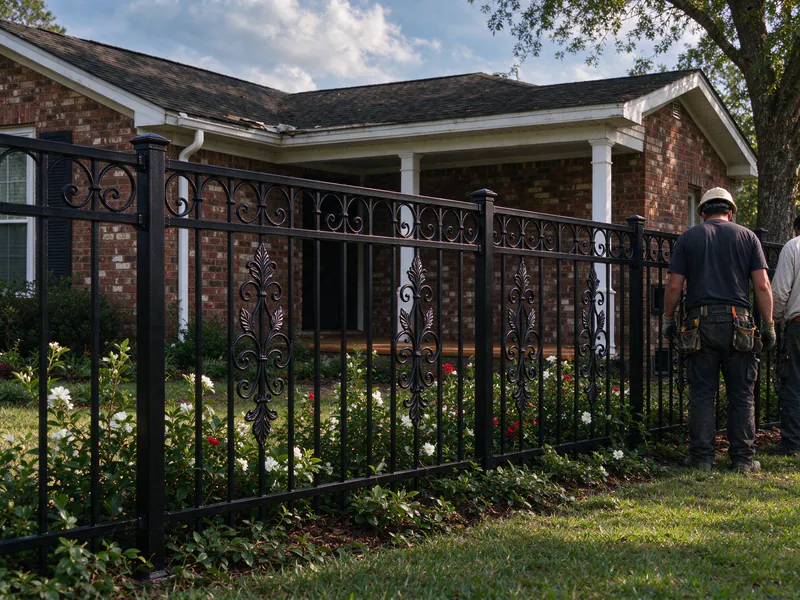
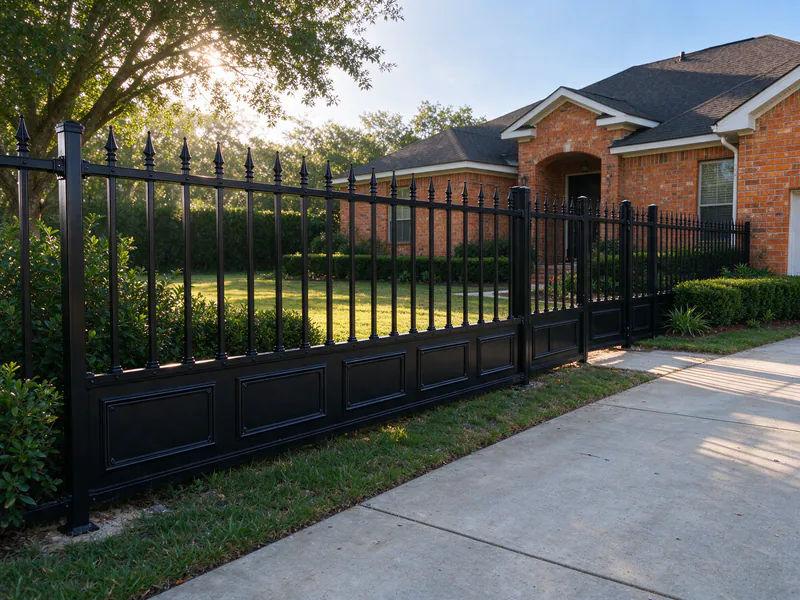
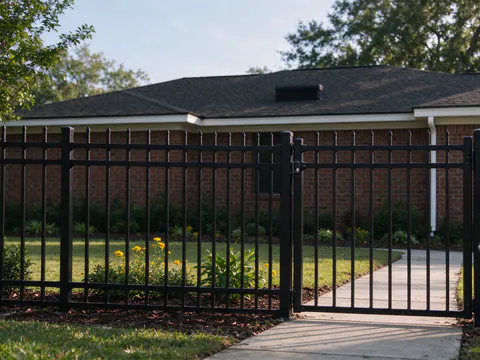
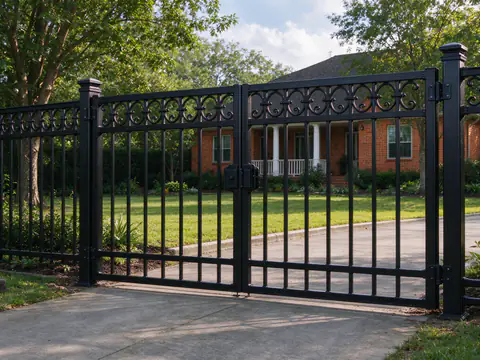
Wrought iron fence installation today means ornamental steel: the look of hand-forged iron, built from galvanized and powder-coated steel or fabricated to a custom design. Palisades Hammond Fence installs ornamental steel fences and gates across Hammond and the towns around it, from 4 ft front-yard borders on older houses to tall security fences and drive gates. Installation is carried out by licensed and insured fence contractors.
Steel is the strongest, heaviest and most formal of the open fences. It also rusts, and in a place with about 64 inches of rain a year, per NOAA’s 1991-2020 normals for the Hammond station, the details that keep water off the steel decide how it looks in ten years. This page covers those details, the prefab-or-custom choice, gates and the local rules that apply to front yards and historic streets.
What happens on the first visit
The walk measures more precisely than for a wood fence, because steel panels and fabricated sections are made to length. The line is measured and corners, slopes and gate openings marked, and any existing ironwork, columns or walls the fence must meet are photographed and measured.
The visit also settles purpose and setting. A decorative border, a security fence and a fence matched to an older house’s ironwork lead to different products. It notes whether the address is in the Historic District or the Hyer-Cate overlay and whether the fence sits in front of the house. If the design includes brick or stucco columns, that masonry is its own scope with its own schedule.
After the visit come the permit drawing from your survey or parcel map and the Louisiana 811 locate request, filed at least 48 and no more than 120 hours before digging.
What wrought iron means now
True wrought iron is a low-carbon iron with fibrous slag running through it, worked hot by a smith. It resisted corrosion well, and fences made of it still stand on old streets. It is no longer produced at commercial scale. What is sold as wrought iron fencing is mild steel, in two broad forms.
- Prefab tubular steel panels. Square tube pickets and rails, galvanized and then powder coated at the factory, in catalog styles and heights. ASTM F2408 covers this type of ornamental steel fence.
- Custom fabricated steel. Solid bar, tube and castings cut and welded into a specific design, such as scrollwork, a matched pattern or an arched gate, then finished.
Older houses may also have cast iron or genuine wrought iron. Where it is sound, restoring it usually beats replacing it, and the repair or replace guide explains the trade-off.
Rust in a wet climate: where steel fences fail
Steel rusts where water reaches bare metal, and a fence has more bare spots than it appears. The galvanizing on a factory panel is a zinc layer that corrodes first and protects the steel underneath, and the powder coat over it keeps water off both. Each weld, field cut, drilled hole and scratch breaks those layers.
The weak points
- Welds. Heat burns off galvanizing near a weld. Field welds need a zinc-rich primer and a top coat.
- Hollow tubes. Water gets into tube rails and pickets at joints and fastener holes. Drain holes at the low points let it out instead of rusting from the inside.
- Post bases. A post in a concrete collar finished flush with the grass sits in water after every rain. Concrete finished above grade and sloped away from the post sheds it.
- The bottom rail. Kept clear of mulch, wet grass and sprinkler spray, it lasts far longer.
Maintenance is a matter of catching chips early: wash the fence, touch up scratches with matching paint before rust lifts the finish around them, and repaint fully when the coating dulls and chalks. No coating makes steel rust-proof; it makes rust slower and easier to stop.
Choose prefab or custom with the line measured
Send the address, length, height and a photo of the style. Gates and columns set the rest.
Weight, gates and impacts
A steel gate leaf is heavy, and it hangs off one post. That post works as a lever, and in the poorly drained silt loams USDA maps around Hammond, a light post rotates in its footing until the gate drags. Hinge posts for steel gates are larger and set deeper than line posts, and wide openings become double gates with a drop rod. The gate installation page covers hinges and latches, and the driveway gate page covers vehicle openings and the swing vs sliding gate guide the choice between them.
Steel resists impact better than any other common fence, but a car strike still bends it. Repair then means cutting out and welding in new sections and refinishing them, which is fabrication work rather than a panel swap; see fence repair.
Front yards, historic streets and Mandeville’s taller limit
Hammond’s code allows decorative and simulated wrought iron in front yards, up to 4 ft. Within 30 ft of a street intersection, nothing may stand above 3 ft. In the Historic District, any fence fronting a street or alley needs Historic District Commission review, with plans showing appearance, color, texture and materials, on top of the fence permit. The Hyer-Cate overlay holds front-yard fences to 4 ft.
Mandeville is more generous: its code allows decorative wrought iron in front setbacks up to 5.5 ft, with columns to 6.5 ft and no more than 15% opacity above 2 ft. Those figures come from the city’s planning records and are confirmed per address; the Mandeville page has more. Covington’s historic guidelines keep new front metal fences under 3 ft, as the Covington page explains. The fence permit guide covers each office.
What a wrought iron fence costs around Hammond
A typical Hammond-area range for ornamental steel or iron fencing, installed, runs from about $30 to $100 or more per linear foot. Standard prefab panels on flat ground start near the bottom. Custom scrollwork, heavier bar, columns, slopes, fabricated gates and site welding open the top end, which is why the range has no fixed ceiling. Walk gates in a prefab line typically add $150 to $600 each; fabricated and drive gates are priced from their design.
For many yards, aluminum fence installation gives the same look for less and never rusts. The fence cost estimator gives a range for your length and style.