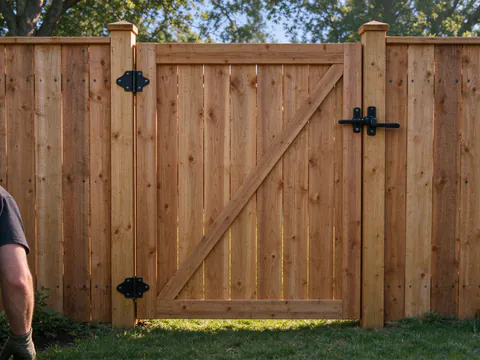
A swing gate is simpler and usually costs less, but it needs a clear, fairly level arc to open into. A sliding gate needs no swing space but needs a straight, clear run of fence beside the opening to roll back along. On a sloped or ditched driveway, or one that opens toward a parking pad, a slide often fits where a swing won’t.
Palisades Hammond Fence installs walk gates, driveway gates and automatic gates for homes, farms and businesses across Hammond, Tangipahoa Parish, western St. Tammany and eastern Livingston Parish. Installation is carried out by licensed and insured fence contractors. This guide compares swing and sliding gates on the space each needs, how they handle slopes, wet ground and wind, and what drives the price. The gate installation and driveway gate installation pages cover how each is built.
How much room a swing gate needs
A swing gate’s travel envelope is the quarter circle each leaf sweeps as it opens. A single 12 ft leaf needs a clear arc with a 12 ft radius on the side it opens toward. Splitting the opening into a double gate of two 6 ft leaves cuts that radius in half, which is why double gates suit wide driveways where the yard behind the gate is tight.
Anything inside that arc is in the way: a parked car, a planter, a slope that rises toward the gate, a meter box, or a vehicle that has pulled in and stopped. Measure the arc on the ground with a string before deciding. Also check where the leaf rests when open; it needs a stop or a holdback so wind doesn’t swing it into a car.
Sloped driveways and swing clearance
Driveway grade can rule out a swing gate on its own. If the driveway rises from the gate line into the property, a leaf swinging inward hits the rising ground partway through its arc. The bottom of the gate would need to sit high above the drive at the hinge to clear it, which leaves a gap dogs and children can pass under.
There are several ways around it. A gate can swing toward the lower side, often outward, when there is room to set it back from the road. Hinges that lift the leaf as it opens help on gentle grades. A double gate with shorter leaves clears more slope than a single wide one. When none of those work, a sliding gate that moves parallel to the fence line ignores the grade across the opening.
How much room a sliding gate needs
A sliding gate doesn’t sweep an arc; it rolls sideways and parks beside the opening. That means it needs a runback: a straight, reasonably level stretch of fence line alongside the opening, at least as long as the opening itself, kept clear of trees, steps, posts and buildings. A 14 ft opening needs at least 14 ft of clear runback, and more for a cantilever gate.
The runback must also be straight. A fence that turns a corner or curves within that distance can’t take a slide on that side. Where a lot has a long straight frontage beside the drive, a slide fits easily; where the house, a tree or a property line sits close to the opening, a swing gate may be the only option.
Cantilever or track
Sliding gates come in two kinds. A track gate rolls on wheels in a V-groove rail laid across the driveway. It is the simpler and usually cheaper design, but the track has to stay clean and level: gravel, leaves, mud and standing water all stop the wheels or wear them out. A track across a drive that holds water after rain is a maintenance job waiting to happen.
A cantilever gate has no track. It hangs from enclosed rollers mounted on two posts beside the opening, with a counterbalance tail behind the gate frame that keeps it level as it rolls across the gap. Nothing touches the driving surface, so gravel, mud and debris don’t matter. The trade-off is a longer gate panel, heavier posts and footings, and a runback that has to hold the tail as well as the gate.
The street, the ditch and sight lines
Where a driveway crosses a roadside ditch on a culvert before reaching the property line, a gate set right at the front line leaves a car stopped on the culvert or in the road while the gate opens. Setting the gate far enough back for a vehicle to pull off the road clears that, and it often settles the swing direction too.
Sight lines matter at the drive. Hammond’s code requires a clear sight triangle where a driveway meets the street, and within 30 ft of a street intersection no fence or plant may stand more than 3 ft above the street centerline (UDC 4.1.8 and 10.1.2, City of Hammond). A solid driveway gate and its columns have to sit outside that triangle. The fence planning guide covers layout around the street.
Wind on a gate
A solid gate leaf is a sail on a hinge. In a gust, a swing leaf left unlatched slams into its stop or a car, and a closed leaf loads its hinge post and latch hard. A double swing gate needs a drop rod into a ground socket to hold the center steady. A sliding gate presents its face to the wind as well, but it is guided along its full length by rollers or a track and has no free edge to slam.
Picket or open-frame designs in aluminum or wrought iron pass much of the wind and lighten every part of the gate. A solid privacy gate across a wide opening needs heavier posts, a stiff frame and hardware rated for the leaf. The why fences fail guide explains how wind loads a solid face, and gate repair covers a leaf that has already started to sag.
Automation
Both types can be automated. Swing operators push or pull each leaf on an arm, so they need room beside the hinge post and a sound, plumb post. Slide operators drive a chain or rack along the gate and suit long, heavy gates. Any automatic gate needs entrapment protection, such as photo eyes and safety edges, set up for the gate’s path, and power run to the operator. The automatic gate installation page covers that scope.
What moves the cost
A standard walk gate typically runs $150 to $600 installed in the Hammond area. Driveway and sliding gates have no published local range, so they are priced from their drivers: opening width, gate material and weight, single or double leaf, track or cantilever, post and footing size, hinge and latch hardware or rollers, and, for automatic gates, the operator, the power run and the access controls. The gate cost guide explains each.
| Swing gate | Sliding gate | |
|---|---|---|
| Space needed | A clear arc as deep as each leaf | A straight runback beside the opening |
| Sloped drive | Struggles if the drive rises toward the swing | Unaffected by grade across the opening |
| Gravel, mud, water | No issue for the gate itself | Track gates suffer; cantilever gates don’t |
| Wind | Free edge can slam; needs stops and drop rods | Guided along its length |
| Posts | Heavy hinge posts | Heavy roller posts (cantilever) |
| Relative cost | Usually lower | Usually higher, especially cantilever |
To work out which fits your entrance, call Palisades Hammond Fence at (985) 866-3827 or request an estimate with a photo of the driveway from the street.
Not sure your driveway has room for a swing gate?
Send the opening width, a photo of the drive and the fence beside it, and get both options checked for fit.