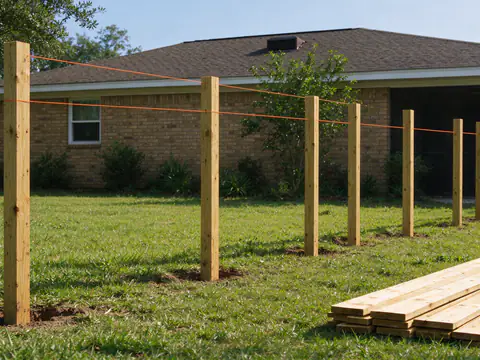
In wet clay or silt, fence posts need a footing that resists rotation and keeps water off the post: a hole sized for the fence height and face, crushed stone at the base so water drains, and concrete crowned above grade so rain runs away. The depth follows the fence and the soil, not a single number.
Palisades Hammond Fence installs fences in Hammond and across Tangipahoa Parish, western St. Tammany and eastern Livingston Parish, where most of the mapped ground is poorly drained and wet near the surface. This guide explains what that ground does to a post, how a fence installation chooses post depth and footing type, and what happens when a hole fills with water.
What the ground is actually like here
People call it clay, and some of it is. The USDA NRCS soil survey maps the ground around Hammond as mostly Guyton and Brimstone-Guyton silt loams, with Abita silt loam and Myatt fine sandy loam, and classes eight of nine sampled points as poorly drained (USDA NRCS Web Soil Survey). Silty clay loam shows up near Covington and Madisonville. What these soils share with clay is the part that matters for posts: fine particles, slow drainage and a weak grip when saturated.
The water table is the bigger issue. Point samples show how close it comes to the surface across the area.
| Area | Main drainage class at sampled points | Seasonal water table, median of points |
|---|---|---|
| Hammond | Poorly drained (8 of 9) | 23 cm (about 9 in) |
| Ponchatoula | Poorly and somewhat poorly drained | 23 cm |
| Covington | Mostly poorly drained | 20 cm |
| Madisonville | Very poorly drained at 4 of 9 | At the surface |
| Killian | Somewhat poorly drained | 30 cm |
| Loranger | Moderately well drained | 33 cm |
| Folsom | Moderately well drained | 52 cm |
These are point samples, not findings for any one lot. They explain why a post hole dug in a wet month around Hammond often has water at the bottom before anything goes into it. The Covington page covers the sandier ground there.
Why posts lean in wet soil
A fence post works as a lever fixed in the ground. Wind or a gate pushes the top one way; the soil near the surface pushes back on the front of the post and the soil near the bottom pushes back on the rear. When those two zones hold, the post stays plumb.
Water weakens both. Saturated fine soil carries load poorly because water in the pores takes pressure off the contact between grains. Push on a post in that state and it moves a little, leaving a small void the soil doesn’t refill. Rain then finds the void. Homeowners report fences on soft ground starting to lean during a storm’s rain, at the posts that carry the most load, such as a double gate.
Why shallow posts are the first to go
Improper post depth turns that soil weakness into instability quickly. A shallow post has a short lever below ground and depends on the top layer of soil, which is the layer that saturates first and dries last. A deeper post engages more soil over a longer lever, so each square inch has less work to do.
How post depth is chosen
There is no single right depth, and a quote that applies one number to every post on every lot is skipping steps. Depth comes from four things:
- Height. A taller fence puts its load higher, lengthening the lever on the footing.
- Face. A solid privacy fence face catches far more wind than open pickets, chain link or aluminum.
- Gates. Gate hinge posts carry the gate’s weight as a constant sideways pull, so they get more depth and a larger footing than line posts.
- Soil and water. Softer, wetter ground needs more depth, more footing width, or both.
Frost is not the driver here
In cold climates posts go below the frost line so freezing soil can’t lift them. NOAA’s climate normals for the Hammond station record about 31 nights a year at or below freezing, with a winter mean low near 40 F (NOAA NCEI). No local frost-depth design value was found, and those freezes are brief and shallow. Wind, soft soil and water set post depth around Hammond.
Wet spots along your fence line?
Point out where water stands after rain. The first visit notes soil and drainage along the whole run before the post plan is set.
Footing options compared
Homeowners report conflicting advice on whether to set posts in dirt, gravel or concrete, and each answer is right somewhere. In wet ground the trade-offs look like this.
| Footing | How it holds | Where it fits | What to watch |
|---|---|---|---|
| Tamped native soil | Friction and soil bearing only | Light, open fences in firm, drained ground | Loosens fast when saturated |
| Compacted crushed stone | Interlocking stone, drains freely | Wood posts on better-drained lots; farm lines | Less grip in very soft soil; needs firm compaction |
| Concrete over a stone base | Concrete spreads load; stone drains the post end | Most residential privacy and picket fences here | Finish must be crowned, not flat or cupped |
| Concrete with a steel post | Rot-free post, stiff section | Wind-exposed runs, gate posts, wet lots | Coating at grade; footing still sized for soil |
| Driven steel posts | Friction along the driven length | Farm and agricultural lines | Limited hold in soft, wet ground for tall faces |
The concrete detail at the surface matters more than most people expect. Concrete finished flat or cupped at the grass line holds a ring of water against a wood post after every rain, which is where a post rots. Concrete brought slightly above grade and sloped away sends that water out into the yard.
Setting posts in a wet hole
When the hole fills, the method changes:
- Bail or pump out standing water just before setting the post.
- Place several inches of compacted crushed stone at the bottom so the post end can drain.
- Set and brace the post plumb.
- Place concrete from the bottom up, letting it push water ahead of it out of the hole.
- Crown the top above grade and slope it away from the post.
- Let the concrete cure before rails, panels or gates load the post.
Homeowners report crews pouring dry mix into holes and adding no water. Some dry-set mixes are designed to draw moisture from the ground, but in a hole holding standing water, loose dry mix can separate and set weak. Ask how wet holes will be handled before work starts.
Choosing the post itself
The post matters as much as the hole. Wood posts need lumber treated for ground contact, not above-ground stock; the post rot and termites guide explains why. Hammond’s code requires wire fences to use galvanized pipe at least 1.5 inches across, spaced no more than 7 ft apart, and requires weatherproofed wood for wood fences (Hammond UDC 4.1.8).
Vinyl and aluminum systems use hollow posts that rely entirely on their footing; aluminum or steel inserts stiffen them at gates and on windy runs. On wood fences in the wettest spots, galvanized steel posts with a wood face remove the rot problem at grade altogether. A wind-resistant fence combines these choices with closer spacing.
Signs your posts are moving
- A ring of open soil or a crack around the footing at the surface
- A post that rocks when pushed at shoulder height
- Water standing at the base of a post days after rain
- A gate that has started to drag or miss its latch
- Rails pulling away from a post at one end
One moving post can often be reset or replaced; a whole run moving together points to a wider problem. The fence post replacement page covers the repair, and the why fences fail guide covers the other causes.
Call Palisades Hammond Fence at (985) 866-3827 or request an estimate for a post plan matched to the ground on your lot.
Get posts set for the ground they're in
Share the fence height, style and where the yard stays wet, and start an estimate with the footing plan spelled out.