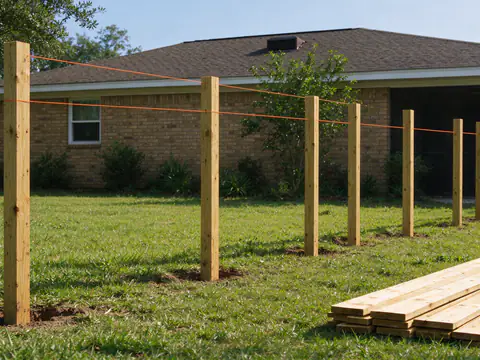
Usually only if the fence does not interfere with what the easement is for. In Louisiana an easement is called a servitude, and Hammond’s subdivision plats carry a standard note that no fence may be built within or over a servitude in a way that prevents or interferes with its purpose. A fence that blocks a drainage ditch or utility access can be ordered out or cut through.
Palisades Hammond Fence installs and replaces fences in Hammond and across Tangipahoa Parish, western St. Tammany and eastern Livingston Parish, on ground where ditches, swales and low spots are part of most lots. This guide covers what a drainage or utility servitude means for a fence installation, who maintains a ditch on the line, and how fences are planned where water needs to move.
Easement, servitude and right-of-way
Louisiana’s Civil Code uses “servitude” where most states say “easement.” A predial servitude is a charge on one property for the benefit of another (art. 646). On a residential lot, the ones that matter for a fence are usually:
- Drainage servitudes along rear or side lines, holding a ditch, swale or pipe that carries water through the subdivision.
- Utility servitudes for power, water, sewer, gas or communications lines, often along the back or front of the lot.
- Street rights-of-way, the public strip along the road, which in Hammond a fence may not extend into at all.
The servitude does not change who owns the strip. You still own it and can use it, but not in a way that defeats the right someone else holds over it.
Finding servitudes before you plan
Servitudes are shown on the recorded subdivision plat and on a boundary survey, and some are created by separate recorded acts. The parish clerk of court keeps the conveyance and plat records. A survey that shows servitude lines makes the fence layout straightforward: posts stay outside the strip, or the fence is designed to coexist with it.
The burden of knowing is on the owner. Covington’s fence permit form says the property owner is solely responsible for locating property, right-of-way and easement lines, and that encroaching improvements may have to be removed at the owner’s expense (City of Covington). The fence planning guide shows where this fits before the permit.
What Hammond’s plat note means for a fence
Hammond’s Unified Development Code gives a standard note for subdivision plats: no building, fence, structure or improvement may be built within or over any servitude or right-of-way so as to prevent or interfere with the purpose for which it was granted (Hammond UDC, Appendix D).
The test is interference, not presence. A drainage servitude exists so water can flow and so equipment can reach the ditch to clean it. A fence that leaves both possible may be tolerated; a fence that blocks the flow or walls off access is exactly what the note prohibits. When the servitude holder needs in, a fence in the way can be removed or cut, and the cost of putting it back is a fair question to settle before building there.
Gates and removable sections
Where a fence has to cross or enclose a servitude, a wide gate or a removable panel at the access point keeps the strip usable without taking the fence down. A gate is only useful if it lines up with how a mower, excavator or utility truck actually reaches the ditch or line. The gate installation page covers sizing wide openings.
Ditches on the line
Boundary ditches are common on flat, wet ground. Civil Code article 686 presumes a ditch between two estates to be common unless proven otherwise, and makes the adjoining owners responsible for its maintenance. A fence that makes the ditch hard to clean from either side shifts that shared job onto one neighbor.
Posts set on a ditch bank are also posts set in the wettest, softest soil on the lot, on ground that erodes. Setting the fence back from the top of the bank keeps posts in firmer soil and leaves room to mow and clean. Trees on the line raise their own questions under articles 687 and 688; the Louisiana fence laws guide covers those.
Fence line running along a ditch or swale?
Send the address and a photo of the back line. The first visit measures the line and notes where water stands and flows.
Natural drainage and solid fences
Louisiana law protects natural runoff. Land that sits lower must receive the surface water that flows naturally from higher land, unless an act of man created the flow (art. 655). The owner below may not do anything to prevent the flow, and the owner above may not make the burden worse (art. 656).
A solid privacy fence with boards to the ground across a slope can act as a dam. Homeowners report new fences pooling water on the uphill side or pushing runoff into a neighbor’s garden. Beyond the drainage articles, article 667 can make an owner answerable for work that damages a neighbor when the harm was foreseeable and preventable with reasonable care.
The fix is in the design:
- Leave a clear gap between the bottom of boards and the ground along flow paths.
- Use an open style, such as chain link, aluminum or spaced pickets, where the fence crosses a swale.
- Keep posts and footings out of the low line of the swale itself.
- Avoid kickboards or buried barriers that change where water goes.
Fences in a flood zone
Flood mapping matters here. FEMA’s National Flood Hazard Layer puts 12 of 25 points sampled around Hammond inside a special flood hazard area, and the share is higher near Holden, Walker and Robert. In parts of St. Tammany Parish the federal map service returned no data for the sampled points, so the parish’s own flood maps are checked for those addresses (FEMA Flood Map Service Center).
In mapped floodplains, floodplain or drainage rules may limit solid fences that obstruct flow; that is confirmed with the permit office for the address. Beyond the rules, flood-prone lines favor open designs that let water and debris pass, galvanized or coated hardware, and posts that tolerate standing water. The wet clay soil guide covers footings for that ground.
Utility servitudes and 811
Utility servitudes carry buried lines as well as access rights. Mandeville’s code, as quoted in a 2023 city staff report, bars fences in a utility servitude without the written approval of the affected utilities, and says the utilities bear no obligation to replace a fence they remove; current text is confirmed per address. Every post hole also requires a Louisiana 811 locate 48 to 120 hours before digging, excluding weekends and holidays (La. R.S. 40:1749.13).
Common situations and what to do
| Situation | Practical approach |
|---|---|
| Drainage servitude along the back line | Fence at the servitude line, or across it only with a gate or open section and the holder’s terms checked |
| Boundary ditch shared with a neighbor | Set the fence back from the top of the bank on your side; agree on ditch maintenance |
| Swale crossing the yard | Open design or raised bottom where the fence crosses the flow path |
| Utility servitude with buried lines | Locate first; keep posts clear of the lines; expect access needs |
| Lot in a mapped flood zone | Open style, wet-rated hardware and posts, and the local floodplain rule confirmed |
| Fence near the street | Stay out of the right-of-way and within front-yard height limits |
The fence permit guide covers which office reviews the location. Call Palisades Hammond Fence at (985) 866-3827 or request an estimate to plan a fence line around the water and the servitudes on your lot.
Plan a fence that works with the drainage
Share your plat or survey and where water runs on the lot, and start an estimate for a line that stays clear of trouble.