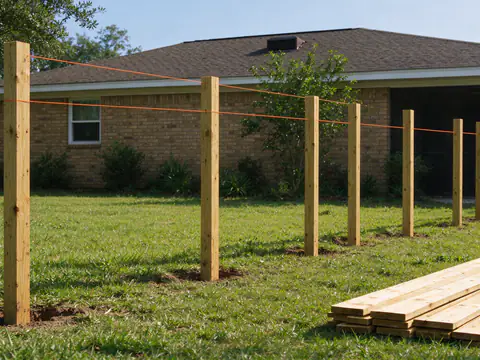
Louisiana has no single fence statute. The rules come from two places: the Civil Code, which covers enclosing land, fences on a shared boundary, boundary ditches and trees, and how boundaries are fixed; and city or parish codes, which set permits, heights, materials and front-yard limits. Both apply to every fence, and the line itself comes first.
Palisades Hammond Fence installs and replaces fences in Hammond and across Tangipahoa, western St. Tammany and eastern Livingston parishes, and every fence installation starts with where the line is. This guide summarizes what the statute text says, quoted from the Louisiana State Legislature site. It is legal information, not legal advice: a boundary dispute belongs with a licensed surveyor and, where needed, an attorney.
The right to enclose and the common fence
Article 684 is one sentence: a landowner has the right to enclose his land. Article 685 then deals with the fence most neighbors argue about, the one on the line. A fence on a boundary is presumed to be common unless there is proof to the contrary (art. 685).
“Common” means both owners share it. The article goes on to say that when adjoining lands are enclosed, a landowner may compel his neighbors to contribute to the expense of making and repairing the common fences that separate them. When the adjoining lands are not enclosed, that contribution can be compelled only as local ordinances prescribe. Whether a local ordinance does so is confirmed for each address.
Which side faces out?
Homeowners report hearing that the smooth side belongs to the neighbor, or that whoever sees the posts owns the fence. Nothing in article 685 ties ownership to which face points where. The presumption turns on location: a fence on the boundary is presumed common, and a fence wholly inside one lot is ordinarily that owner’s. Local codes or recorded subdivision restrictions can still dictate which face points to the street.
On the line or just inside it
This is the main legal decision in fence placement, and it is worth making on purpose.
| Choice | What the Civil Code presumption means | Practical effect |
|---|---|---|
| Fence on the boundary | Presumed common to both owners | Repair and rebuild costs can be shared where both lots are enclosed; changes are easier with the neighbor’s agreement |
| Fence a few inches inside your line | Ordinarily yours alone | You decide the style and timing and carry the cost; the strip outside it is still your land |
| Fence inside the neighbor’s line | Not yours, and an encroachment | Can be ordered removed; avoided by surveying first |
Setting a fence a little inside the line keeps ownership simple, but it leaves a strip on the far side to maintain and reach. Homeowners report disputes when two neighbors each build a few inches inside their own lines, leaving a gap neither can easily close. Talking to the neighbor before layout prevents most of these.
Is there a “10 year fence law” in Louisiana?
Not in the way the phrase suggests. No Civil Code article makes a fence the legal boundary after ten years. The ten-year figure comes from acquisitive prescription, the rules by which ownership of land can be acquired through possession.
Under article 3473, ownership of immovables may be acquired by the prescription of ten years. Article 3475 lists what it takes: possession of ten years, good faith, just title, and a thing that can be acquired by prescription.
Those requirements are demanding:
- Just title is a juridical act such as a sale, exchange or donation that would transfer ownership, written, valid in form and filed in the parish conveyance records (art. 3483). A fence is not a title.
- Good faith means the possessor reasonably believes, in light of objective considerations, that he is the owner (art. 3480).
- The possession must be continuous, uninterrupted, peaceable, public and unequivocal (art. 3476).
Without a just title or good faith, the period is thirty years (art. 3486), and possession then extends only to what was actually possessed (art. 3487).
Boundary law ties this to fences directly. When a party proves acquisitive prescription, the boundary is fixed by the limits of that prescription rather than by titles, and if a party and his predecessors possessed more land than their title called for for thirty years without interruption, within visible bounds, the boundary is fixed along those bounds (art. 794). A fence can be a visible bound. Whether it has become one legally is a fact question for a surveyor and an attorney, not something a fence installer can decide.
Boundaries, markers and surveys
The Civil Code defines a boundary as the line of separation between contiguous lands, and a boundary marker as a natural or artificial object that marks that line on the ground (art. 784). Fixing a boundary can mean deciding where an uncertain line runs, placing markers where none exist, or replacing markers that were wrongly placed or can no longer be seen.
A few articles matter directly to a fence project:
- A boundary can be fixed judicially or extrajudicially; it is fixed extrajudicially when the neighbors sign a written agreement setting the line (art. 789).
- When neighbors fix it outside court, the costs are divided equally unless they agree otherwise (art. 790).
- Anyone who removes markers without court authority is liable for damages and can be made to restore them (art. 791).
- The right to compel the fixing of a boundary never prescribes (art. 788).
- A court fixes the boundary by ownership, and only if neither side proves ownership, by possession (art. 792).
Why the survey comes before the fence
A fence installation and a property survey are linked steps. The fence crew works to marks on the ground; the survey is what makes those marks reliable. Inside Hammond, the city approves a fence’s location as shown on a survey or parcel map (Hammond UDC 4.1.8). Covington’s permit form states that the owner alone is responsible for locating property, right-of-way and easement lines, and that encroaching work may have to be removed at the owner’s expense.
An old fence, a hedge row or a mowing line is evidence of how someone used the land, not proof of where the line is. The fence planning guide shows where the survey fits in the project order.
Ditches, trees and roots on the line
Three neighboring articles cover the other things that sit on boundaries here. A ditch between two estates is presumed common, and adjoining owners are responsible for maintaining it (art. 686). Trees, bushes and plants on the boundary are presumed common, and a neighbor may demand removal of ones that interfere with his enjoyment, at his own expense (art. 687).
A landowner may also demand that a neighbor’s branches or roots extending over or into his property be trimmed at the neighbor’s expense, but only where they interfere (art. 688). The drainage easement guide covers fences along boundary ditches and servitudes.
Front-yard fences: where city codes take over
The Civil Code says nothing about height. Front-yard limits come from local codes, and they are where most front fence plans get redrawn.
| Jurisdiction | Front-yard rule |
|---|---|
| City of Hammond | 4 ft maximum; wood, metal other than chain link or barbed wire, decorative or simulated wrought iron, or masonry; no woven wire beyond the front building line |
| Hyer-Cate overlay, Hammond | Same 4 ft limit, with open wire and chain link expressly barred in front |
| Hammond Historic District | Street- or alley-facing fences need Historic District Commission review |
| Covington Historic District | Guidelines favor a painted wood picket of 3 ft or less, or a metal fence under 3 ft |
| Mandeville | A 2023 city staff report quotes a 4 ft limit in front, with ornamental iron to 5.5 ft; current text confirmed per address |
That is why front runs here are usually picket, aluminum or wrought iron. Hammond also keeps fences out of street rights-of-way and caps anything within 30 ft of an intersection at 3 ft. The fence permit guide covers heights behind the house and the permit steps.
When a surveyor or attorney is the right call
- You don’t know where the line is, or the markers are missing.
- The neighbor disputes the line or claims land up to an old fence.
- You want to share the cost of a fence on the line and need it in writing; the fence installation cost guide helps size the number.
- An old fence turns out to sit on the neighbor’s side and a fence replacement needs a new line.
For the fence itself, call Palisades Hammond Fence at (985) 866-3827 or request an estimate. Layout follows the survey, and a fence on the line can be planned with both owners in the conversation.
Plan a fence that sits where it should
Share your survey or parcel map and where you want the fence, and start an estimate built around the line.