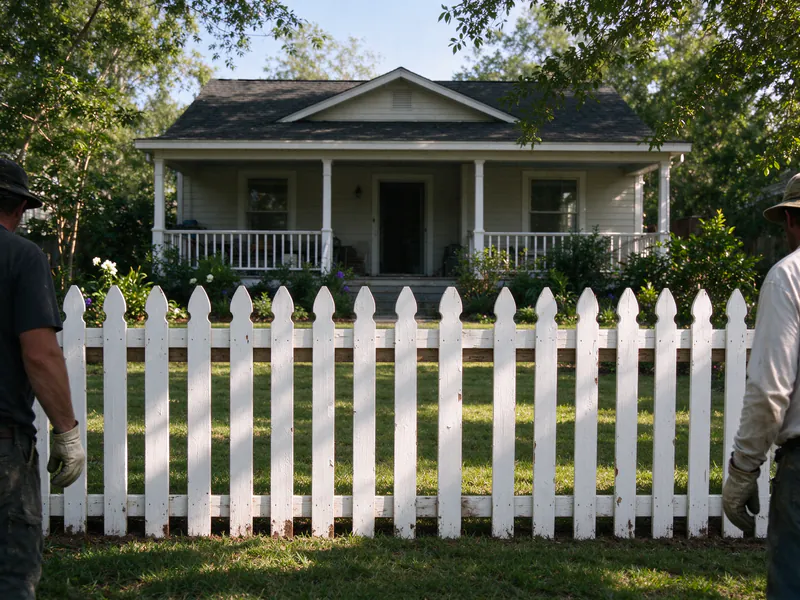
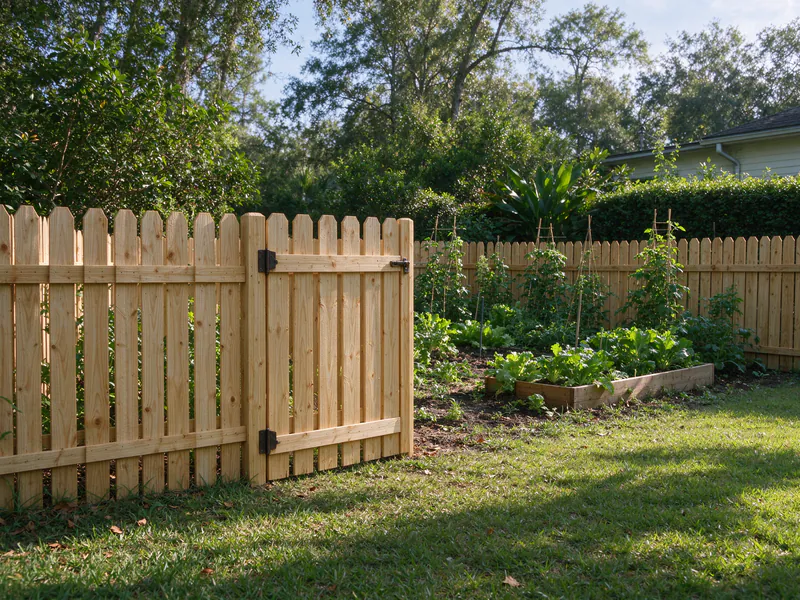
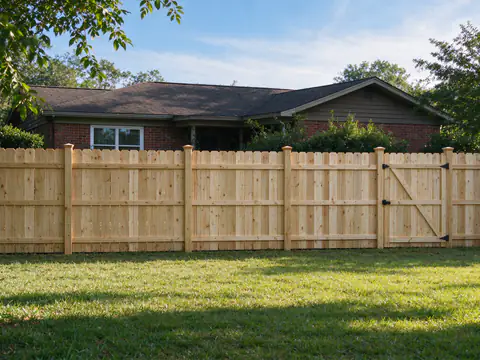
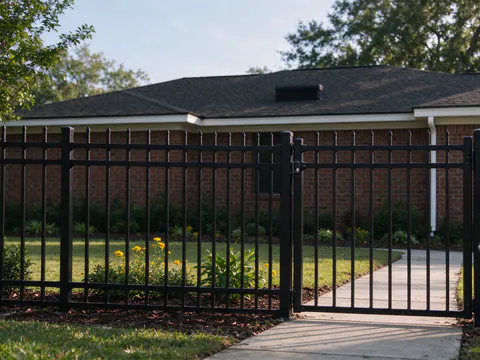
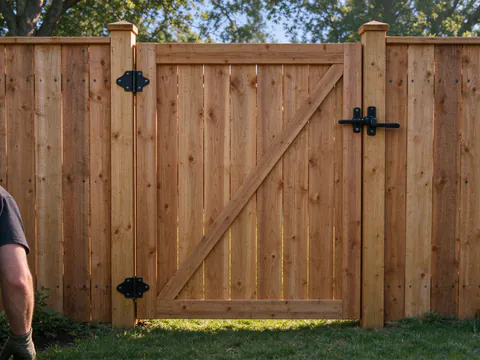
A picket fence is a front-yard fence, and the front yard is where fence rules get specific. Palisades Hammond Fence installs wood picket fences across Hammond, Tangipahoa Parish and the nearby towns of western St. Tammany and eastern Livingston Parish, from a 4 ft painted run along a Hammond sidewalk to a 3 ft cottage fence in Covington’s historic district. Installation is carried out by licensed and insured fence contractors.
This page covers what sets a picket fence apart from the wood privacy fences behind the house: the height and material limits in front, the historic district guidelines, the spacing and paint choices, and the details that keep a short, open fence standing in wet ground.
What happens on the first visit
The first visit walks and measures the front line and notes the gates, slope, soil and drainage, as on any fence. In front, it also finds where the property ends and the street right-of-way begins, since Hammond’s code bars any fence from extending into the right-of-way. The front property line can sit well back from the curb, so the edge of the grass is not necessarily the line. The survey or parcel map decides, and the City approves the location from it.
The walk marks the walk and the drive, any culvert or roadside ditch, and whether the lot is a corner. It also checks whether the address sits in the Hyer-Cate overlay, Hammond’s Historic District or Covington’s historic district, because each adds a step before the permit. The fence permit guide covers the Hammond process.
Hammond’s front-yard rules
In front of the house, Hammond allows a fence of wood, metal (not chain link or barbed wire), decorative wrought iron, simulated wrought iron or masonry, up to 4 ft. Woven wire is prohibited beyond the front building line. Height is the greater of the two measurements from the ground on each side, so on a front yard that slopes toward the street, the street side sets the limit.
Corners and driveways
Within 30 ft of a street intersection, no fence, shrub or planting may stand more than 3 ft above grade at the street centerline. Driveway-street intersections and corner lots also need a clear sight triangle. A picket fence on a corner lot usually steps down near the corner or stops short of it; the layout is drawn with that triangle on it.
Hyer-Cate and the Historic District
The Hyer-Cate Preservation Overlay, bounded by W Dakota St, W Morris St, NW Railroad Ave and Arnold’s Creek, limits front-yard fences to wood, metal or masonry at 4 ft and bars chain link beyond the front building line. Inside the Hammond Historic District, any fence on property fronting a street or alley goes to the Historic District Commission with plans showing its appearance, color, texture and materials. Both steps come before the permit.
Covington’s historic district picket
Covington’s historic district guidelines are unusually specific about fences. A wooden front fence there is no taller than 3 ft, with pickets less than 4 in wide spaced less than 3 in apart, painted to complement the house. New metal front fences stay under 3 ft, and historic fences are kept rather than replaced. The Historic District Commission issues a Certificate of Appropriateness before the city’s $5 fence permit.
Built to those numbers, a 3.5 in picket with a 2.5 in gap gives two pickets per foot, a dense, traditional look that goes into review already matching the guidelines. The Covington page covers the city’s permit form, and Mandeville’s front-yard limit of 4 ft, as quoted in city staff reports, is confirmed per address on the Mandeville page.
Check the address before choosing a style
Send the address and a photo of the front of the house. Overlay, historic district and corner rules are checked before the layout is drawn.
Pickets, tops and spacing
A picket fence is mostly air, so the details that would be hidden on a privacy fence are on display. The layout starts from the picket width and gap and is adjusted so each bay ends evenly at its posts and gates, rather than with a sliver picket at the end.
Top shapes are more than looks. A flat-cut top exposes end grain that soaks up rain like a straw; pointed, rounded and gothic tops shed water faster, and a flat-top picket under a cap rail is protected entirely. The bottoms stop an inch or two above the grass, because a picket sitting in wet turf rots from the bottom up. On a yard that slopes, the pickets are racked to follow the grade, which keeps that gap even along the run.
Dogs and small children
A picket fence marks a boundary more than it contains. Gaps wide enough to look pleasing are often wide enough for a small dog’s head, and horizontal rails on the inside can act as a ladder. The best fence for dogs guide covers spacing and height for pets.
Paint, stain and wet ground
Front fences are usually painted, and paint is the finish most likely to fail early here. Hammond averages about 64 inches of rain a year (NOAA), and water that gets behind a paint film at a cut end or a picket bottom lifts it from behind. Priming all faces and cut ends before the pickets go up, and painting once the wood is dry enough to take it, slows that. A penetrating stain doesn’t peel at all, and renewing it is simpler; fence staining explains both finishes.
The posts face the same wet ground as any fence, even though an open picket face carries little wind. USDA soil survey points around Hammond map mostly poorly drained silt loams, so front-yard posts are ground-contact treated, set on footings that drain and capped on top. Sprinkler heads and mulch beds piled against posts keep the base wet longer; the wet clay post guide covers footings.
The walk gate
The front gate is the most-used part of the fence. It hangs from a hinge post heavier than the line posts, gets a diagonal brace from the bottom hinge corner up to the latch side, and swings clear of the walk. Gate installation covers wider openings and arbors.
What a picket fence costs
No regional range is published for wood picket fences alone, so none is quoted here. Front runs are short, so gates and fixed costs weigh more per foot than on a long back-yard fence. The main drivers are the picket count (width and gap), decorative tops and post caps, priming and painting versus staining, the number of gates, slope and tear-out of an old fence, typically $2 to $8 per foot. A walk gate typically adds $150 to $600.
For a metal front fence, typical Hammond-area ranges run about $25 to $55 per foot for aluminum and $30 to $100 or more for steel or wrought iron. The fence cost estimator gives a first range, and the fence planning guide helps settle the layout before pricing.