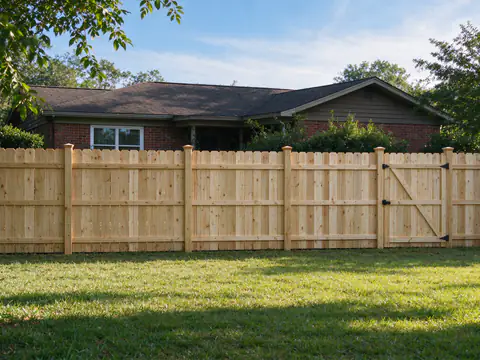
Around Hammond, the better wood is usually pressure-treated pine for the posts and either pine or cedar for the boards. Cedar boards resist decay naturally, move less and weather evenly, while ground-contact treated pine holds up better buried in wet soil. A 6 ft pine privacy fence typically runs $15 to $45 per foot installed, and cedar $22 to $55.
Palisades Hammond Fence installs pine, cedar and cypress fences across Hammond, Tangipahoa Parish and the towns of western St. Tammany and eastern Livingston Parish. Installation is carried out by licensed and insured fence contractors. This guide explains what protects each wood, how each one ages in this climate, where redwood and cypress fit, and how to choose. The wood fence installation page covers how the whole fence is planned and built.
Where the protection comes from
Pressure-treated pine is southern yellow pine loaded with a waterborne preservative under pressure in a closed cylinder. Modern residential treatments are copper-based, which is why new boards often have a green or brown cast. The preservative reaches deep into the sapwood, so the wood resists decay fungi and termites from the inside rather than just on the surface.
How much preservative goes in depends on the intended use, and that is printed on the end tag. Lumber treated for ground contact (AWPA Use Category UC4A, or UC4B for harsher exposure) carries more than lumber rated for above-ground use. The two look the same on delivery day. A post cut from above-ground stock is the cheapest mistake in a pine fence and one of the most expensive to fix later.
Cedar carries no added preservative. Its heartwood, the darker center of the log, contains natural extractives that slow decay fungi and discourage insects. The pale sapwood near the bark has little of that protection, and knotty fence grades mix the two. A cedar picket that is mostly heartwood behaves very differently from one with a wide sapwood edge, even though both are sold as cedar.
Why the posts decide the answer
The boards of a privacy fence hang in the air and dry between rains. The posts sit in soil that, around Hammond, is mostly poorly drained, with a seasonal water table that reaches within about 9 inches of the surface at the median point sampled by the USDA NRCS soil survey (Web Soil Survey). A post spends months of the year in damp, warm ground, and that is where the species question gets settled.
Untreated cedar’s natural resistance is real, but it was never meant for wood buried in wet soil for years. Homeowners report whole runs of cedar 4x4 posts rotting off at or near the ground, and that is the expected result when the post is cedar and the ground stays wet. A ground-contact treated pine post, or a galvanized steel post with a wood face, is what most cedar fences here should stand on.
Even a correctly rated pine post has limits. Field cuts expose wood the preservative never reached, and a concrete collar that ends flat at the grass holds water against the post. Cut ends go up, not in the hole, and footings are crowned so water runs off. The post rot and termites guide and the wet clay soil guide cover both.
How the boards age in sun and humidity
Treated pine is often sold wet from treatment. As it dries over the first weeks and months, boards shrink across their width, gaps open on a butted privacy fence, and some boards cup, twist or split. Kiln-dried-after-treatment lumber has done most of that drying before it arrives and moves less, at a higher material cost. Either way, pine takes stain well once it is dry enough to absorb water instead of beading it.
Cedar is lighter, more stable and far less prone to cupping, so a cedar privacy fence tends to stay flatter and tighter. Both woods gray in the sun: ultraviolet light breaks down lignin in the surface fibers, rain washes the loose fibers out, and the face turns silver. Homeowners report a new fence starting to gray in less than a year. That is the surface weathering, not decay, and a pigmented stain slows it.
Humidity adds a second surface problem. Dark mildew spots can appear on new treated pine in damp weather, and they wash off with a wood cleaner. They need to be cleaned before any stain goes on. The fence staining page covers timing and products for both woods.
Redwood and cypress
Redwood grows on the Pacific coast and, like cedar, owes its decay resistance to heartwood extractives. It is stable, takes finish well and has a deep red color, but around Hammond it travels a long way to reach a fence line, and there is no published local price range for it. It is quoted from the grade and the lumber available at the time, and it still belongs on treated or steel posts.
Cypress is the regional wood, and old-growth cypress heartwood has a long reputation for resisting rot. Much of what is sold now is younger growth with more sapwood, so the grade matters more than the name. Homeowners still ask whether a cypress post or a treated pine post lasts longer in wet ground; the treated post has the rating for ground contact, and the cypress post depends on how much heartwood it holds.
The two side by side
| Pressure-treated pine | Cedar | |
|---|---|---|
| Decay protection | Preservative through the sapwood; rated by use category | Natural extractives in the heartwood; sapwood has little |
| As a post | Ground-contact rating made for this use | Not recommended in wet soil |
| Movement as it dries | Shrinks, can cup and split | More stable, stays flatter |
| Termites | Treated wood resists; cut ends are the weak spot | Heartwood resists somewhat; not immune |
| Weight | Heavier | Lighter |
| Finish | Stain once dry; color is a choice | Weathers evenly gray or holds stain well |
| Typical 6 ft privacy range | $15 to $45 per foot | $22 to $55 per foot |
What each costs around Hammond
These are typical Hammond-area ranges for budgeting, installed, for a 6 ft privacy fence: pressure-treated pine about $15 to $45 per linear foot, and cedar about $22 to $55. Both ranges assume the posts are treated pine or steel. Board-on-board and shadowbox styles, wet or root-filled ground, extra gates and tear-out of an old fence, handled under fence replacement, move a job toward the top. A walk gate typically adds $150 to $600.
Cypress and redwood have no published local range; supply, grade and board width set their price. The privacy fence cost guide breaks down styles, and the fence cost estimator gives a range for your length and options.
Local rules that touch the choice
Hammond’s code requires wood fencing to be weatherproofed wood, and in front of the house a wood fence can be at most 4 ft (UDC 4.1.8, City of Hammond). Treated pine meets the first requirement through its treatment; untreated cedar is usually finished to meet it. In Covington’s historic district, the design guidelines call for wooden front fences no taller than 3 ft, painted to complement the house, and solid board fences in back yards only, up to 6 ft. The Covington page covers that review.
Choosing between them
- Choose pine for the lowest cost per foot, for any part of the fence that touches the ground, and for a fence you plan to stain a color.
- Choose cedar boards for a flatter, more stable face, an even natural gray if left bare, and a lighter gate leaf.
- Mix them where it helps: cedar pickets and trim on treated pine or steel posts is the common pairing.
For a closer look at the boards against other materials, see the wood vs vinyl guide. To price pine and cedar on the same line, call Palisades Hammond Fence at (985) 866-3827 or request an estimate.
Pine posts, cedar boards, or all pine?
Send the length, height and style, and get both woods priced on posts sized for your ground.