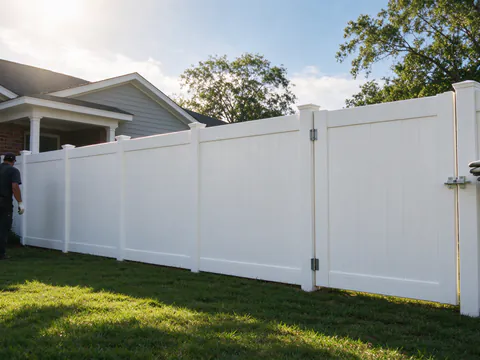
For most Hammond yards, the choice between wood and vinyl comes down to budget, appearance and how you want to handle repairs, because the posts decide the fence’s life either way. A 6 ft pine privacy fence typically runs $15 to $45 per foot installed and vinyl privacy $20 to $60. Vinyl won’t rot or feed termites; wood costs less and repairs one board at a time.
Palisades Hammond Fence installs wood and vinyl privacy fences across Hammond, Tangipahoa Parish and the nearby towns of western St. Tammany and eastern Livingston Parish. Installation is carried out by licensed and insured fence contractors. This guide compares the two materials where it matters in this climate and covers composite boards as the third option people weigh. The service pages for wood fence installation and vinyl fence installation go further into how each is built.
Why the climate matters more than the brochure
Both materials are sold on how long they last, but the conditions here decide which weakness shows up first. NOAA’s 1991-2020 normals for the Hammond station record 64.17 inches of rain a year and 86 days at or above 90°F (NOAA NCEI). The soils mapped around the city are mostly poorly drained, with a seasonal water table that sits within about 9 inches of the surface at the median point sampled (USDA NRCS).
That combination works on wood through moisture and on vinyl through heat and wind. A wood post stays damp at the grade line, which is where decay fungi and subterranean termites do their work. A vinyl fence doesn’t care about the damp, but long hot afternoons make PVC expand along its length, and the storm season loads every solid panel like a sail.
How a wood privacy fence wears out here
A pine fence nearly always loses its posts before its boards. Ground-contact treated posts resist decay, but the band from a few inches below grade to a few inches above stays wet after every rain and warm most of the year. Cut ends expose untreated wood, and a concrete collar that holds water against the post speeds things up. The post rot and termites guide covers how to test one.
Above ground, the boards shrink as they dry, gaps open, and some boards cup or split in the sun. Those are cosmetic until fasteners loosen, and a stain or sealer slows them. The upside is that every part of a wood fence is ordinary lumber: a broken picket, a split rail or a rotted post can be cut out and replaced the same week, and nobody needs to track down a matching product line.
How a vinyl privacy fence wears out here
Vinyl is extruded PVC with ultraviolet inhibitors mixed into the outer layer. It doesn’t rot, swell with water or give termites anything to eat, which removes the main failure point of a wood fence in wet ground. Its weak points are different: rails and panels that pull out of their post routes in high wind, pickets that crack when a limb or mower hits them, and hollow posts that lean if the footing below them moves.
Heat matters too. PVC grows measurably longer on a hot day and shrinks back at night, so a well-built system leaves room in the post routes for that movement. Panels cut tight on a cool morning can bow by August. Shaded north faces in this humidity also grow a green or black film of mildew; it washes off with mild soap and water and doesn’t damage the vinyl, but it is regular upkeep that buyers don’t always expect.
Wind and storm damage
A solid 6 ft panel catches the same wind whether it is pine or PVC. FEMA has declared major disasters covering Tangipahoa, Livingston or St. Tammany Parish for storms from Katrina in 2005 to Francine in 2024 (OpenFEMA), so a privacy fence here should expect several hard blows in its life. What differs is how each material lets go.
Wood usually fails at a weakened post, and the bay folds over with the boards still attached. Vinyl more often fails at the connections: rails bow and slip out of their routes, or a whole panel pops free and ends up in the next yard. The fix for vinyl is in the build, with aluminum stiffeners in gate and end posts, reinforced bottom rails and deeper footings on exposed runs. The wind-resistant fence page explains how solid faces are built to take storm load.
Repairs after the damage is done
How a fence comes back after a storm or a fallen limb is one of the clearest practical differences:
| After damage | Wood privacy | Vinyl privacy |
|---|---|---|
| Broken picket or board | Cut a new board to fit; stain to blend | Replace the picket or panel from the same product line |
| Rail cracked or pulled loose | New rail fastened to the posts | New rail slid into the post routes; may need the panel out |
| Post snapped or leaning | Dig out the footing and set a new post | Same, plus a new sleeve and often a new stiffener |
| Color match | New wood stands out until stained or weathered | New panels can look brighter than weathered ones |
| Parts availability | Any lumber yard | The same maker and profile, or a close match |
Keep the product name, profile and color of a vinyl fence with your house papers. A discontinued profile is the main reason a small vinyl repair turns into replacing a whole run. The fence repair page covers how either kind is put right.
Hammond’s front-yard rule
Inside the City of Hammond, a fence in front of the house can be at most 4 ft and must be wood, metal other than chain link or barbed wire, decorative or simulated wrought iron, or masonry (UDC 4.1.8.C, City of Hammond). Vinyl is not on that list. A white vinyl picket in front of a Hammond home is a question for the Building Department before anything is ordered.
From the front of the house back, the code allows solid fences of wood, vinyl and other listed materials up to 8 ft, measured on the lower side. The permit is $10 for a home and doubles if the work starts first. Other towns set their own rules: the fence permit guide covers the details, and the Louisiana fence laws guide covers boundary and shared-fence questions.
Composite: the third option
Composite fence boards blend wood fiber with plastic and are made to look like painted or stained wood. They resist rot and termites far better than wood because most of each fiber is wrapped in plastic, and they don’t need staining. In exchange, they are heavy, they can sag over long spans, and most systems sit on aluminum or steel posts and rails designed by the maker rather than on ordinary lumber.
Against vinyl, composite feels and looks more like wood and is stiffer in a given profile, while vinyl is lighter, cheaper to move and easier to source in replacement parts. Both can fade in strong sun, and both grow surface mildew in damp shade. No published local price range exists for composite, so it is priced from the product and the frame it needs.
Price side by side
These are typical Hammond-area ranges for a 6 ft privacy fence, installed, for budgeting:
| Material | Typical range per linear foot | What pushes it up |
|---|---|---|
| Pressure-treated pine | $15 to $45 | Shadowbox or board-on-board styles, wet or root-filled ground, tear-out |
| Cedar | $22 to $55 | Board grade, heavier posts, both-sides finish |
| Vinyl | $20 to $60 | Heavier profiles, decorative caps, aluminum stiffeners |
| Composite | No published range | Product line, metal frame, panel count |
Tearing out and hauling away an old fence typically adds $2 to $8 per foot, and a walk gate $150 to $600. Over the years, wood carries staining and board-level repairs; vinyl carries washing and the occasional panel. The vinyl fence cost guide and the privacy fence cost guide break both down further.
Which yards suit which
- Wood suits a lower budget, a fence you expect to repair yourself, a stained or painted look, and front-yard pickets inside Hammond city limits.
- Vinyl suits owners who want no staining, a clean white or tan finish, and a backyard privacy run with decent shelter from the worst wind.
- Either needs posts sized for the face and the soil; a fence on an open, exposed lot needs a wind plan whichever material it is.
If you are weighing both for the same line, call Palisades Hammond Fence at (985) 866-3827 or use the fence cost estimator to compare a range for each before a site walk.
Pricing wood and vinyl for the same fence line?
Send the length, height and gates, and get both options scoped from the posts up.