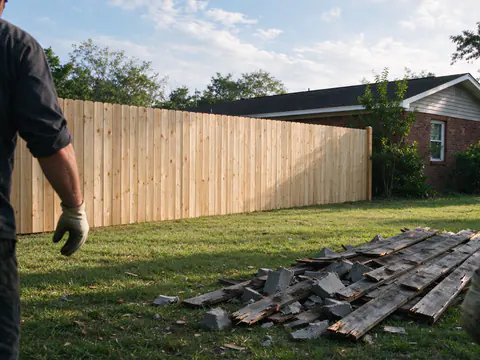
There is no single number for how long a wood fence lasts here, and a figure promised without seeing the posts is a guess. Around Hammond, a wood fence’s life is set at the ground line: the treatment rating of the posts, how the footings drain, how wet the soil stays, and what storms and termites do to it. The boards usually outlast the posts.
Palisades Hammond Fence installs, repairs and replaces fences across Hammond, Tangipahoa Parish, western St. Tammany and eastern Livingston Parish. Installation is carried out by licensed and insured fence contractors. This guide explains which parts of a fence wear out first in this climate, how sun weathers each material, why published lifespan figures don’t transfer well to a Hammond yard, and the signs that a fence is near the end. The fence replacement page covers what happens next when it is.
Why published lifespans don’t fit your yard
Lifespan figures for wood, vinyl or chain link are usually national averages built from fences in many climates. A pine post in dry, well-drained ground ages very differently from one standing in poorly drained silt loam. Around Hammond, the USDA NRCS soil survey maps mostly poorly drained soils, with the seasonal water table within about 9 inches of the surface at the median point sampled (Web Soil Survey).
Rain keeps that ground wet. NOAA’s 1991-2020 normals for the Hammond station record 64.17 inches a year, with about 20 days of an inch or more, and a mean annual temperature of 66.8°F (NOAA NCEI). Warmth and moisture are the two conditions decay fungi and subterranean termites need most. A number borrowed from a cooler, drier region overstates what a wood post sees here.
The posts set the clock
A wood fence is only as old as its weakest post at the grade line. That is where all four needs of decay fungi meet: wood, water, oxygen and warmth. Deeper in a waterlogged hole there is little oxygen; higher up, the wood dries between rains. The inch just below the dirt is where a post goes soft while still looking solid from the yard.
Three building details shift that clock more than anything else:
- Treatment rating. Posts need lumber treated for ground contact (AWPA UC4A, or UC4B for harsher exposure). Above-ground stock looks identical and decays far sooner in soil.
- Footing shape and drainage. Concrete that ends flat or cupped at the grass holds a ring of water against the wood. Gravel at the base and a crowned top let water leave.
- Cut ends. Every field cut exposes wood the preservative never reached. Cut ends belong at the top, capped, not in the hole.
Homeowners report a treated gate post rotting through after six years, while similar fences nearby still stand. Differences like these are the likeliest reason. The post rot and termites guide explains how to test a post, and the wet clay soil guide covers footings.
Sun and UV: fading and weathering
Ultraviolet light is the main reason a fence looks old long before it is weak. In wood, UV breaks down lignin, the compound that binds the surface fibers together. Rain then washes the loosened fibers away, leaving a gray, slightly fuzzy face. Repeated heating and drying adds fine surface cracks, called checks, and makes boards cup. Homeowners report a new pine fence starting to gray in under a year.
That weathering is shallow. It changes how a fence looks and lets water into the surface faster, but it doesn’t make a board fall off. A penetrating stain with UV-blocking pigment slows it, and clear finishes slow it least because they let the light through. Renewing the finish when water stops beading keeps the boards tighter. The fence staining page covers products and timing.
Other materials weather in their own way. Vinyl carries UV inhibitors in its outer layer, but over time a white or tan profile can chalk, fade and grow more brittle, especially on faces in full sun. Powder-coated aluminum and steel fade and lose gloss before the coating fails. Galvanized chain link isn’t harmed much by sun, but vinyl-coated fabric fades and can crack with age.
Termites and storms
Subterranean termites live in the soil and reach a fence wherever wood touches it. They favor damp, partly decayed wood, so they tend to show up in the same posts rot has already softened, and they can hollow a post from inside while the shell looks sound. Mud tubes on a post or footing, or wood that sounds hollow when tapped, are the signs to look for.
Storms decide when a weak fence finally goes. FEMA has declared major disasters covering Tangipahoa, Livingston or St. Tammany Parish for Katrina, Gustav, Isaac, the 2016 floods, Ida and Francine, among others (OpenFEMA). A fence with one soft post may stand for years in calm weather and fold in the first strong gust. The storm-damaged fence repair page covers what to check after one.
What fails first, by material
| Material | What usually wears out first | What stretches its life |
|---|---|---|
| Pressure-treated pine | Posts at the ground line; boards cup and gray | Ground-contact posts, crowned footings, stain on the boards |
| Cedar on treated posts | The posts; cedar boards weather slowly | Same post detail; stain if you want the color kept |
| Vinyl | Connections in wind, impact cracks, fading on sunny faces | Stiffened posts, deeper footings, occasional washing |
| Galvanized chain link | Zinc at grade, then rust and loose fabric | Fabric kept off the soil, tension maintained |
| Aluminum or steel | Hardware, coating at scratches and welds | Touching up scratches, rated fasteners |
Signs a fence is near the end
A few signs mean a fence has moved from upkeep to decisions:
- Several posts move when pushed at shoulder height, not just one.
- A screwdriver sinks into posts at or just below the dirt.
- Rails are soft or split where they meet the posts all along a run.
- Gates keep sagging after the hinges are tightened.
- Chain link posts are rusted thin at the ground, or vinyl panels keep popping loose.
When only one or two posts show these signs, fence post replacement often fixes the actual problem. When most of a run does, the repair or replace guide walks through the decision. The why fences fail guide explains each failure in depth.
Stretching the years you get
Most of what extends a fence’s life here is about keeping its bottom dry. Keep mulch, soil and leaves pulled back from boards and posts so they can dry after rain. Aim sprinklers away from the line. Leave an inch or two between the bottom of the boards and the ground. Clear vines, which hold moisture and add weight in wind.
After every big storm, walk the line and push each post. Catching one moving post early is cheaper than replacing a run later. If you’d like the whole line looked at before deciding what to do, call Palisades Hammond Fence at (985) 866-3827 or use the fence assessment tool to sort what you’re seeing.
Wondering how much life your fence has left?
Tell us its age, its material and what the posts are doing, and start with an assessment of the whole line.