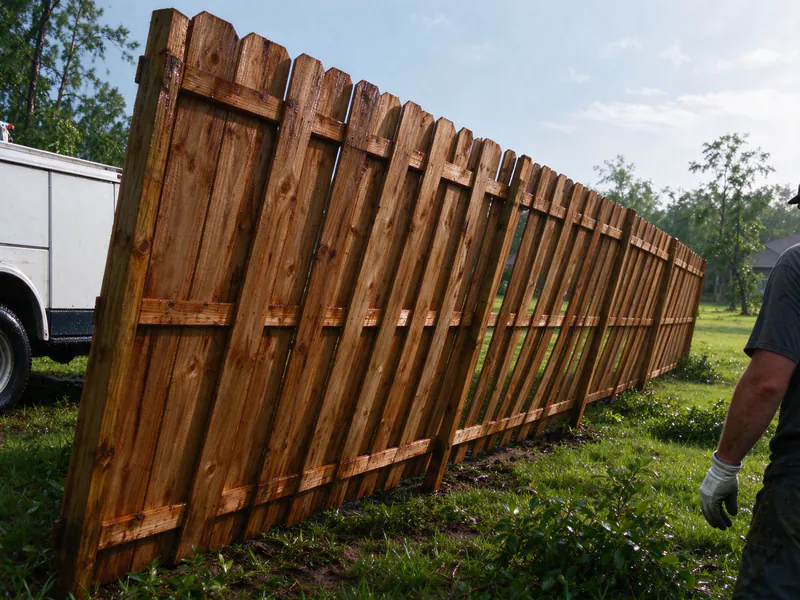
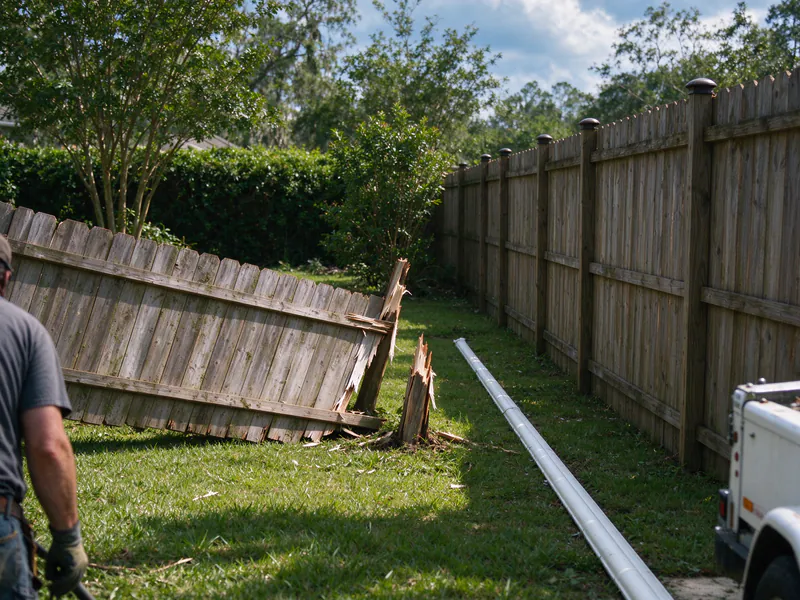
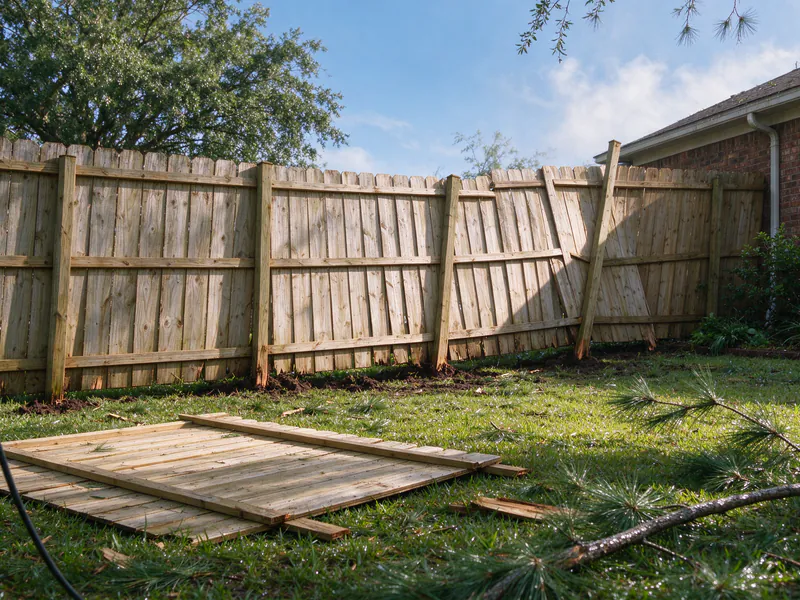
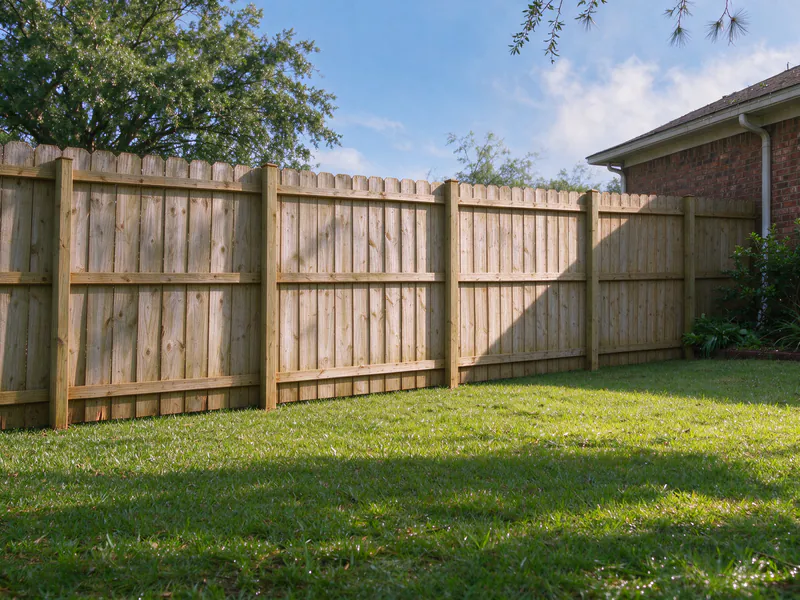
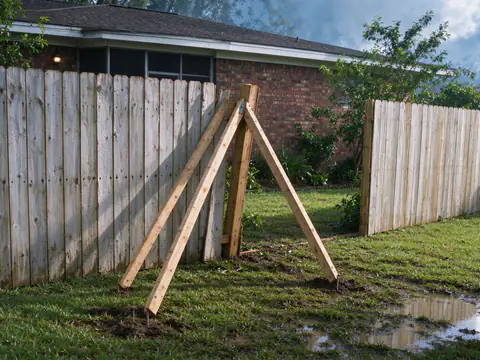
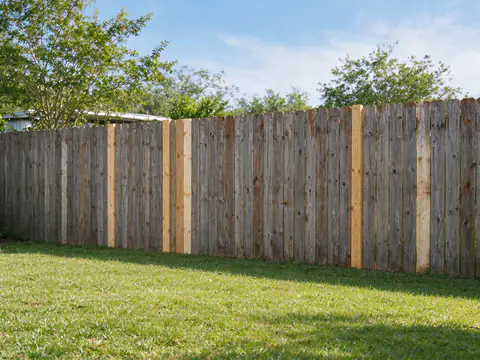
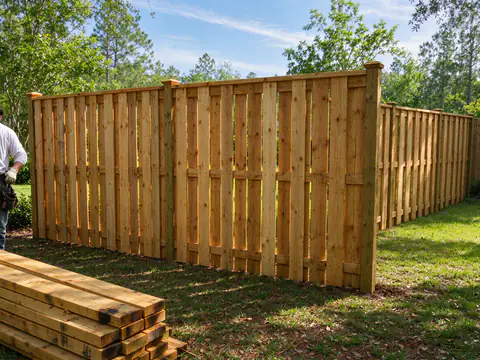
A storm-damaged fence needs more than the fallen section put back. Palisades Hammond Fence repairs and rebuilds fences blown down, pushed over or struck by trees across Hammond and the nearby towns of Tangipahoa, western St. Tammany and eastern Livingston parishes. Installation is carried out by licensed and insured fence contractors. Emergency fence repair is offered when a fence is down, blocking access or leaving a pool or animals unsecured, with no arrival time promised. After a regional storm, homeowners report long waits for fence contractors of every kind.
The work here has its own order: safety, documentation, a post-by-post assessment of the whole line, then a rebuild that addresses why the fence went down.
The first steps after the wind drops
Before calling anyone, a few steps protect you and any claim:
- Stay clear of downed power lines. A fence touching a line can carry current; report it to the utility and keep away until it is cleared.
- Photograph before moving anything. The whole line from each end, then each break close up, then whatever caused it.
- Measure the damage. Note the length that is down, the length that is leaning and the date of the storm.
- Keep a couple of broken posts. The break face shows whether the wood was sound or rotted through.
- Secure pets and pools. Use temporary measures that do not lean on damaged posts.
- Contact your insurer before hauling away anything that may need to be inspected.
Storms here tend to arrive wet. Tropical systems often bring rain before the strongest wind, so the soil around posts is soft when the gusts arrive, and the posts rotate in their footings instead of holding. That is why a fence can look fine at one post and be lying flat two bays over.
Documenting the damage for a claim
Good photos settle most questions an adjuster will ask. Wide shots show how much of the line is affected and how the fence relates to the house and the property line. Close-ups of each break show whether the wood was sound. If a tree or limb came down, photograph the trunk, the root ball or the break in the limb, and where it came from.
The question insurers raise most is pre-existing condition. Homeowners policies generally treat sudden wind or tree damage differently from rot and wear. Photos of clean, sound breaks support a storm claim; photos of posts rotted through at grade tell you, and the adjuster, that the storm finished what decay started. Either way, a written scope that separates storm damage from older wear helps both sides.
Check whether your policy carries a separate hurricane or named-storm deductible, which can be larger than the standard one and can make a small fence claim not worth filing. No rebate or grant program covers rebuilding a fence. The storm-damaged fence insurance guide goes through the claim step by step.
Shared fences and fallen trees
Storm damage often lands on a fence two households share. A fence on the boundary is presumed common to both owners under Louisiana Civil Code article 685, and where both lots are enclosed, either owner can compel the other to contribute to repairing it. A short written agreement on the split, and on access to both sides, keeps the rebuild moving. The Louisiana fence laws guide explains common fences in more detail.
Trees raise their own questions. Under Civil Code article 688, a landowner may demand that a neighbor trim branches extending over the line that interfere, at the neighbor’s expense, which is worth doing before the next storm. When a tree from a vacant or absentee-owned lot comes down on a fence, the parish assessor’s records list the owner of record, which is the starting point for reaching them.
How the assessment separates storm damage from old rot
Every post on the run is checked, not only the ones on the ground. Each is pushed at shoulder height, probed at and just below grade, and looked at for a ring of open soil around the footing that shows it has rotated. Broken posts are read at the break: clean, fibrous wood points to wind or impact, while soft, dark or hollow wood points to rot or termites that were already there.
The result is a scope with three parts: sections that only need boards and rails, posts that need new footings, and runs where the whole system is near the end of its life. That last group is where a repair turns into a fence replacement, and the repair or replace guide helps with that call.
Rebuilding footings that held
A post that leaned in a storm has almost always disturbed its footing, even if the wood is sound. Pushing it back upright and packing soil around it leaves a loose footing in soft ground, ready to go over in the next blow. The post is either reset in a new footing or replaced with a new post set beside the old hole, in undisturbed soil.
Soil is the reason this matters here. USDA soil survey data around Hammond maps mostly poorly drained silt loams, with a seasonal water table around 9 inches below the surface at the median point sampled. A rebuilt footing drains at the bottom, with gravel under the post end, and its concrete is finished above grade and sloped so water runs off.
Changes worth making in a rebuild:
- Heavier posts at gates, corners and ends, and galvanized steel posts where a run keeps failing.
- Closer spacing on tall, solid runs, so each post carries less face.
- A more open face on exposed runs, such as shadowbox or a lattice top over a shorter solid section.
- Rated fasteners and hardware, hot-dip galvanized or stainless, so boards stay on in the next gust.
The wind-resistant fence page covers these designs in depth, and the wet clay post guide explains footing options.
Rebuild the footings, not only the boards
Send photos of the damage and the posts at the ground line. The scope separates storm damage from older wear.
Permits and the locate before rebuilding
A rebuilt fence is a new fence as far as the rules go. Inside the City of Hammond a fence permit comes before a fence is placed, at $10 for residential work and doubled if work starts first, and the rebuild must meet today’s height and material limits, such as 4 ft in front of the house. Covington and other towns have their own permit; the fence permit guide covers each. New post holes need a Louisiana 811 notice 48 to 120 hours before digging, weekends and holidays excluded.
Storms here are a pattern, not a fluke
FEMA has declared major disasters covering Tangipahoa, Livingston or St. Tammany Parish for more than a dozen events since 2005, among them Hurricanes Katrina, Gustav, Isaac, Ida and Francine and the 2016 floods (OpenFEMA). A fence rebuilt here will see another storm. The why fences fail guide explains how wind, wet ground and rot combine, and the storm-season checklist covers what to check before the next one.
What storm repair costs
Storm repairs range from re-boarding one bay to rebuilding a whole run, so they are priced by scope. Where a rebuild is a new fence, typical Hammond-area ranges apply: about $15 to $45 per foot for 6 ft pine privacy, $22 to $55 for cedar and $20 to $60 for vinyl privacy, plus about $2 to $8 per foot to remove and haul away the damaged fence. These are budgeting ranges, not quotes. The fence repair cost guide covers what drives smaller repairs.