Some fence damage can wait for an estimate and some can’t. Palisades Hammond Fence offers emergency fence repair in Hammond and the nearby towns of Tangipahoa, western St. Tammany and eastern Livingston parishes, for a fence that is down across a driveway or walk, a pool barrier that is open, or a line that lets dogs or livestock get out. Installation is carried out by licensed and insured fence contractors.
The phone line is answered Monday to Friday, 8 AM to 6 PM, and Saturday and Sunday, 9 AM to 2 PM. Outside these hours, the line takes emergency calls only. No arrival time is promised. It depends on how many calls are waiting and where they are, and after a regional storm every trade in the area is called at once.
An emergency visit has a narrow job: make the line safe and close the opening. The permanent repair is scoped, priced and scheduled afterward, the same way as any other fence repair.
What counts as a fence emergency
A fence emergency is damage that leaves someone at risk or something unsecured right now. These are the situations that qualify:
- A fence down across a driveway, sidewalk or walk, blocking a car or a way out of the house.
- A pool barrier breached: a fallen section, a gate that no longer latches, or a gap a child could get through.
- Dogs, horses or livestock able to get out, worst where the line runs along a road.
- A vehicle impact that left posts snapped and rails hanging into the yard or the street.
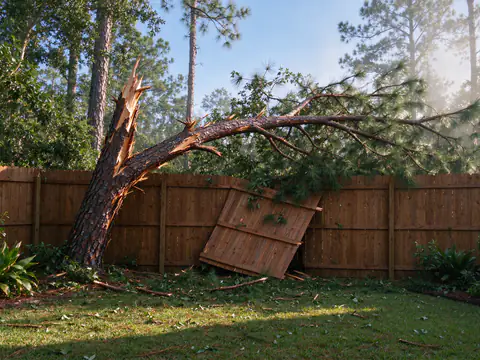
- A tree or large limb on the fence, with bays pinned or bent under it.
- A security gap on a commercial lot, such as an opening in a perimeter fence around equipment, stock or a closed site.
Plenty of fence damage looks bad without being urgent. A section that leans but stands in calm weather, loose or missing boards, a gate that drags but still closes, and finish wear all go through ordinary repair or gate repair. The same leaning section moves into the urgent group when it sits beside a play area, a pool or a busy walk and the wind is picking up.
Safety comes before the fence
Power lines and utilities
If a line is down on or near the fence, treat the whole fence as live. Metal fences conduct, and so does wet wood. Keep people and animals away, call 911 and the electric utility, and don’t touch the wire or the fence until the utility has cleared it. A tree that took down a fence may have taken down a service drop too. If a vehicle struck the fence and someone is hurt, or a gas meter was hit, call 911 first and the fence can wait.
Leaning sections in wind
A 6 ft solid privacy bay 8 ft wide puts about 48 square feet of face into the wind. With its posts snapped or loose in the footing, a gust can drop it without warning, and it falls in whichever direction the wind pushes. Keep children, pets and yourself out of the fall zone on both sides, at least the height of the fence. Don’t try to lift, push back or hold panels in wind. A panel that catches a gust can knock an adult down.
What to do while you wait
These steps keep people safe and keep the evidence intact for the repair and any claim:
- Keep pets and children in. Use a leash, a crate or a room indoors rather than trusting the remaining fence.
- Close off the pool. Lock the house doors that open toward it, keep the cover on if it has one, and keep anyone from swimming until a barrier is back.
- Photograph before anything moves. Wide shots of the line from each end, close-ups of each broken post at the ground line, and whatever caused it.
- Move only what blocks a way out, and only in calm conditions. A section lying flat across the drive can be dragged clear once photographed. Leave hanging and leaning sections alone.
- Note the basics. Rough length down, material, height, whether a gate is involved and whether the fence is shared with a neighbor.
If a claim is likely, those first photos carry more weight than anything gathered later, because they show the damage before cleanup changed it. Keep a broken post or two. The storm-damaged fence insurance guide explains what adjusters look for and what to keep.
What the emergency visit does
The visit makes the line safe and closes the gap. It is deliberately not the rebuild.
Brace what can stand, take down what can’t
Sections with sound posts that are only racked or loosened get temporary braces, angled from the rails to stakes driven into firm ground, so they can’t swing over in the next gust. Sections hanging from a snapped post, rails dangling at one end and posts broken at grade are taken down, laid flat or stacked clear of the drive and walk. Anything that stays up is checked by pushing at shoulder height.
Close the opening
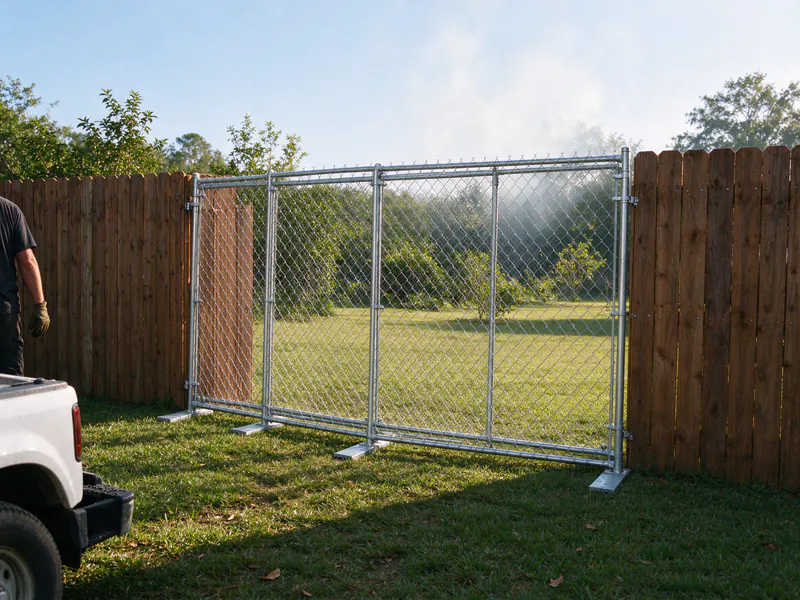
The gap is closed with whatever holds without leaning on damaged posts: freestanding temporary panels on weighted stands, wire or panels fixed to sound posts on either side, or a damaged gate tied shut. For horses or cattle, the closure has to be visible and strong enough to stop an animal that leans on it, which is a different job from keeping in a small dog. The aim is a closed line, not a pretty one.
Restore a pool barrier temporarily
Where a pool fence or gate has failed, a temporary barrier goes across the gap, and a gate that survived is latched or tied shut. That is a stopgap. The permanent barrier has to meet the pool barrier rules Louisiana’s residential code adopts by reference, covered in the pool fence requirements guide and handled through pool fence installation. Keep supervising the pool until the permanent barrier is back.
Clear broken material
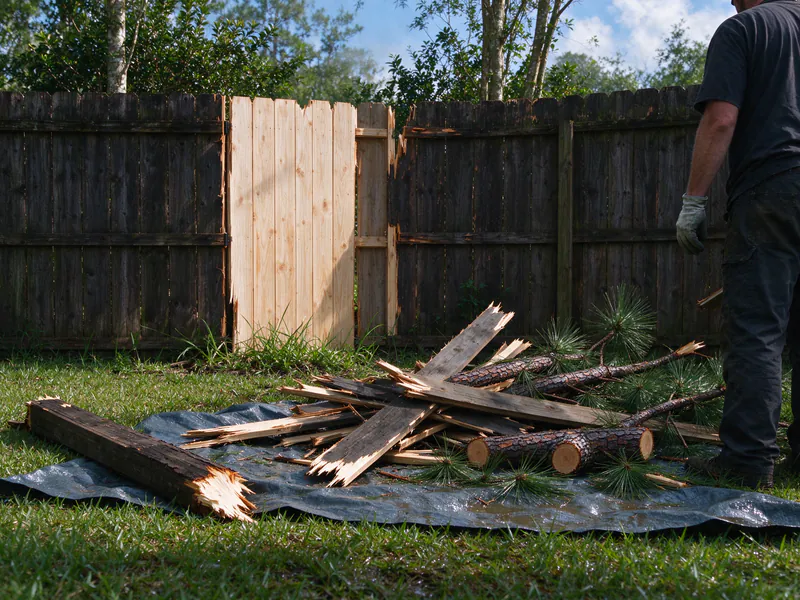
Splintered boards with exposed nails, snapped posts and twisted chain link come out of drives, walks and lawns where people and mowers will hit them. If a claim is open or a neighbor shares the fence, the broken material is kept on site until it has been seen. It is hauled away when that is part of the quote.
A fence down, a pool open or animals loose
Call with the address and what is happening. The line is made safe first, and the permanent repair is planned separately. No arrival time is promised.
Why the permanent repair is planned separately
An urgent call is the worst moment to decide how a fence should be rebuilt. The ground is often wet, the light may be poor, an insurer may need to see the damage, and a shared fence needs a word with the neighbor. Rushing new posts into soft soil the night of a storm builds the same weakness back in.
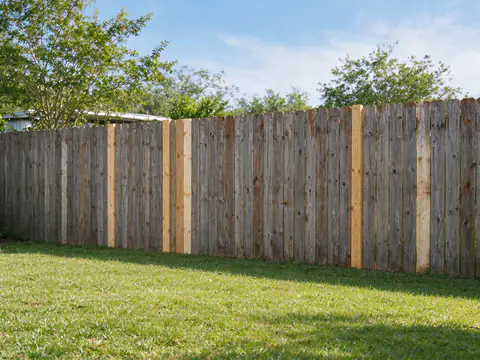
The permanent repair starts from why the fence failed. Posts rotted or eaten by termites at grade, footings too shallow for wet ground, and tall solid runs carrying more wind than their posts can hold each call for a different fix. The why fences fail guide explains how these combine, and the repair or replace guide helps when the damage is part of a wider decline.
New post holes still need the 811 notice
Louisiana’s damage prevention law, R.S. 40:1749.13, requires notice to Louisiana 811 at least 48 hours and no more than 120 hours before any excavation, weekends and holidays excluded, and it counts hand digging and augering as excavation. That is why an emergency visit braces and closes the line rather than setting new posts. Replacement posts, covered on the fence post replacement page, are set after the locate.
Permits and shared fences
Inside the City of Hammond, a rebuilt section is placed under the same UDC 4.1.8 permit as a new fence: $10 for residential work, doubled if work starts before the permit. The fence permit guide covers Covington and the other towns. A fence on the boundary is presumed common to both owners under Civil Code article 685, so a neighbor may share the cost. The Louisiana fence laws guide explains how.
What drives the cost of an emergency visit
There is no flat figure, because the visit is priced by what it has to do. The main drivers:
- How much line has to be braced, taken down or closed off, and how many posts are broken.
- The material. Tangled chain link fabric, cracked vinyl panels and bent steel take longer to make safe than wood.
- What is lying on the fence. A large tree may need a tree service before fence work can start.
- Temporary panels or a temporary pool barrier left in place until the permanent repair.
- Haul-away. Where the damaged fence is removed for good, tear-out and haul-away runs about $2 to $8 per foot in typical Hammond-area ranges.
- A replacement gate. A walk gate that can’t be saved typically runs $150 to $600 each.
These are budgeting ranges, not quotes. The fence repair cost guide covers what drives the permanent repair.
When a storm caused it
After a hurricane or a line of storms, the emergency visit is the first step, not the whole job. The storm-damaged fence repair page covers what follows: a post-by-post assessment of the whole line, documentation that separates storm damage from older wear, and footings rebuilt for wet ground and wind. For a business, commercial fence installation covers perimeter fencing and gates built for the site.