A hurricane-resistant fence is a fence whose posts were planned for the storm rather than the calm. Palisades Hammond Fence builds wind-resistant wood, vinyl and metal fences across Hammond and the towns of Tangipahoa, western St. Tammany and eastern Livingston Parish, sizing posts, spacing and connections to each run’s exposure. Installation is carried out by licensed and insured fence contractors.
Nothing here is a wind rating. No fence is sold against a storm category, and no published design wind speed for this area is quoted on this page. What a good build controls is how much face meets the wind, how firmly each post holds in wet ground, and how the parts stay fastened together when the load arrives.
Why storms matter here
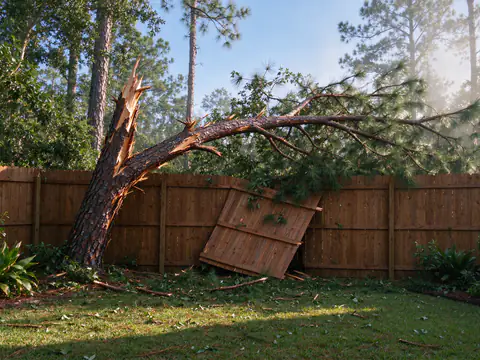
FEMA has declared major disasters covering Tangipahoa, Livingston or St. Tammany Parish for Katrina and Rita in 2005, Gustav and Ike in 2008, Isaac in 2012, Barry in 2019, Laura and Delta in 2020, Zeta and Ida in 2021, and Francine in 2024, along with flood and winter storm declarations. The list shows major storms returning every few years, and they tend to arrive with heavy rain that soaks the ground first.
That combination is the problem. USDA soil survey points around Hammond map mostly poorly drained silt loams with a seasonal water table about 9 inches down at the median point. Wet soil holds a post less firmly than dry soil, so the wind arrives exactly when the ground is weakest. The why fences fail guide explains that ratchet in detail.
How wind loads a fence
Wind pushes on a fence in proportion to its area and the square of its speed. As a rough illustration, air at 100 mph brought to a stop exerts about 25 lb on each square foot; at 50 mph, about a quarter of that. Across a 6 ft by 8 ft bay of solid fence, 48 square feet, the 100 mph figure works out to more than half a ton, before the factors engineers add for gusts, terrain and shape.
That number is not a design figure; it only shows the scale of the problem.
That load acts at roughly half the fence’s height, so it works as a lever on the post. The post resists by pushing against the soil near the surface on one side and near the bottom of the hole on the other. If either point is soft, or the post is weak where it passes through the grade line, it rotates. A taller fence adds face and lengthens the lever at the same time, which is why going from 6 ft to 8 ft asks much more of each post.
What the wind finds first
Wind doesn’t load a fence evenly, and it doesn’t break the average post. The free end of a run and the outside of a corner take higher pressure than the middle. One shallow or rotted post lets its bay fold, and the rails then drag the next posts with loads they were never sized for. That is how a storm drops several bays at once, with the failure starting at the weakest post.
What the first visit looks at
The first visit walks and measures the line, gates, slopes, soil and drainage like any fence job, and adds one question for each run: what does it face? A run backing onto an open field, a road, a pond or a cleared lot meets wind with nothing to slow it. A run between two houses or under a tree line is sheltered from some directions but exposed to falling limbs, which no fence design resists.
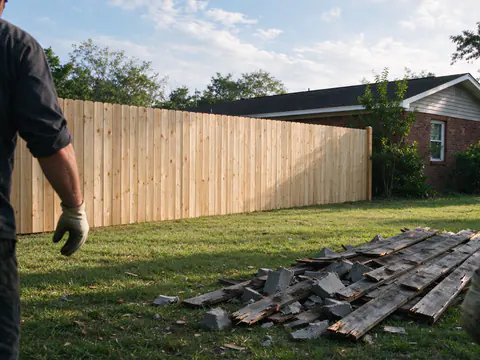
That map of exposure sets the plan. Exposed runs get the heavier details; sheltered ones may not need them. Where an old fence is coming out, fence replacement covers the tear-out. The wet clay post guide covers how the footings are built for this ground.
Map the exposed runs first
Send the address and note which sides face open ground. Heavier posts and shorter bays go where the wind actually arrives.
The details that change the outcome
Posts: size, material and spacing
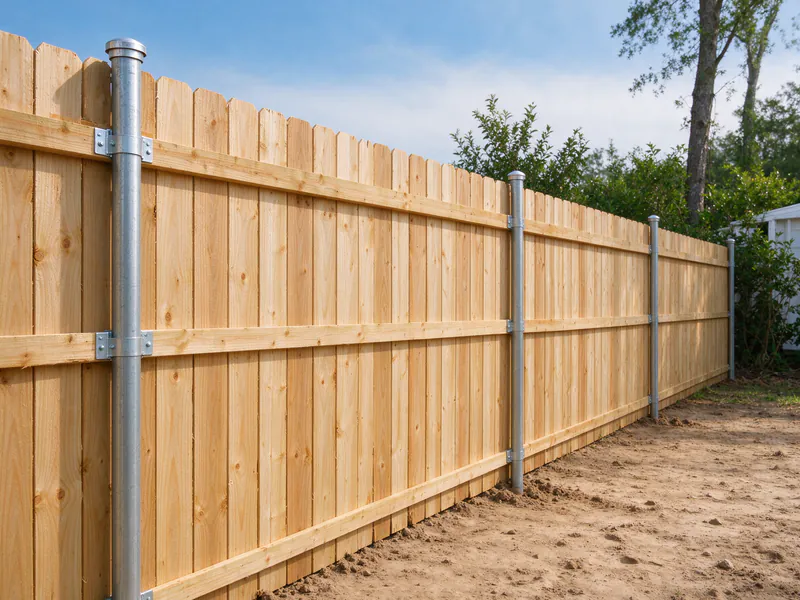
A 6x6 wood post has about four times the bending strength of a 4x4, because strength in bending grows with the cube of the post’s width (5.5 in against 3.5 in actual). Galvanized steel posts are stiffer still for their size and don’t rot at grade, where wood posts give out; wood rails and boards attach to them with brackets. Closer spacing helps too: posts 6 ft apart instead of 8 ft give each post a quarter less face to hold.
Footings that hold in wet soil
Depth and diameter follow the fence height, the face, the exposure and the soil at that address, so no single number is quoted. The footing drains at the bottom and is finished above grade and sloped so water runs away from the post. A post that stays dry at the ground line keeps its strength for the storm.
Rails, fasteners and connections
Many fences shed boards and rails long before a post fails. Face-nailed rails pull off under load, and smooth nails back out of wet wood over a few seasons. Galvanized rail brackets, structural screws and ring-shank nails resist that withdrawal. Two fasteners per board at each rail keep boards from tearing loose one by one. Because the copper in modern pine treatments corrodes plain steel, every fastener is hot-dip galvanized or stainless.
Less solid face where privacy allows
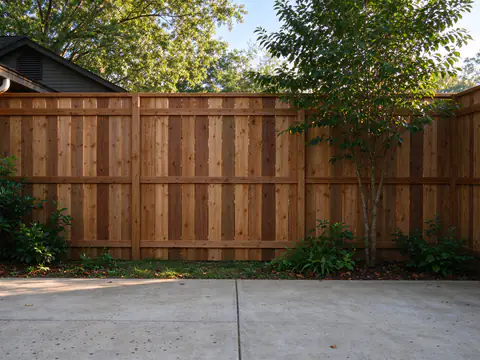
A shadowbox, spaced-board or lattice-top section carries less wind than a closed face, though not in proportion to the openings. Where a run doesn’t need to block a view, an open style is the cheapest way to cut the load. The privacy fence page covers how to decide which runs need full screening.
“Hurricane fence” means chain link here
Locally, many people call chain link a hurricane fence. The name fits only partly. Bare chain link fabric lets nearly all the wind through, so wind alone loads it lightly; falling limbs and debris are its real threat in a storm. Hammond’s code sets a floor for wire fences: galvanized pipe supports at least 1.5 in across and no more than 7 ft apart.
Privacy slats or a fabric windscreen change everything. They turn an open fence into a solid face on posts sized for an open one. If slats are part of the plan, the posts and spacing should be chosen for a solid fence. Chain link fence installation and the chain link vs wood guide cover the trade-offs.
Vinyl in a storm
Vinyl doesn’t rot, which removes the most common failure point, but a solid vinyl panel catches the same wind as solid wood. Hollow posts flex, and panels can pop out of their rails. Aluminum or steel stiffeners inside posts on exposed runs and at gates, with deeper footings, are the vinyl equivalent of heavier wood posts. Vinyl fence installation has the details.
After a storm, and what it costs
When a fence does go down, photos of each failed post at the ground line, the footings and the full run help the insurance claim; the storm-damaged fence insurance guide covers documenting the damage, and storm-damaged fence repair covers the rebuild. Before the season, the storm season prep post lists what an owner can check.
There is no separate published range for wind-resistant construction. The extra cost comes from the details: steel or larger posts, more posts at closer spacing, deeper footings, brackets and extra rails. As a starting point, a typical Hammond-area range for a 6 ft pressure-treated pine privacy fence is about $15 to $45 per linear foot, and heavier posts for an exposed run push a job toward the top. No rebates or incentives apply to fences. The fence cost estimator gives a first range.