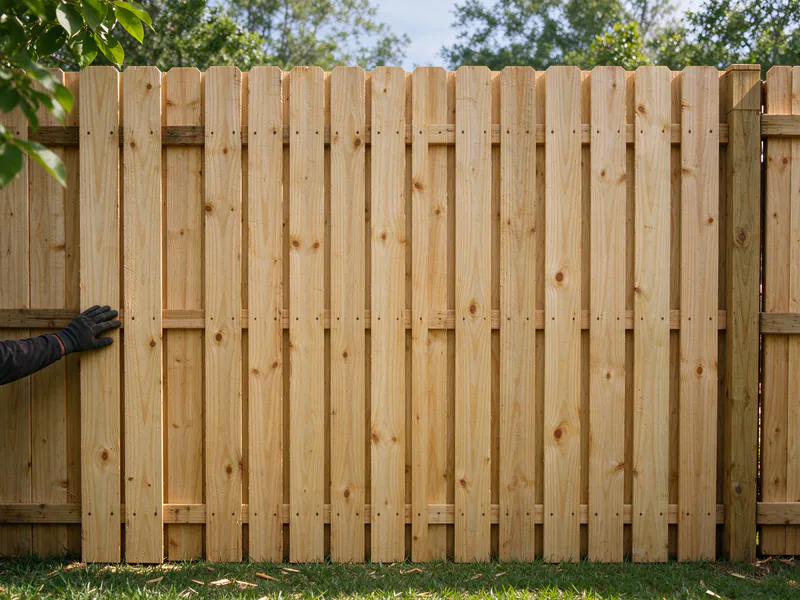
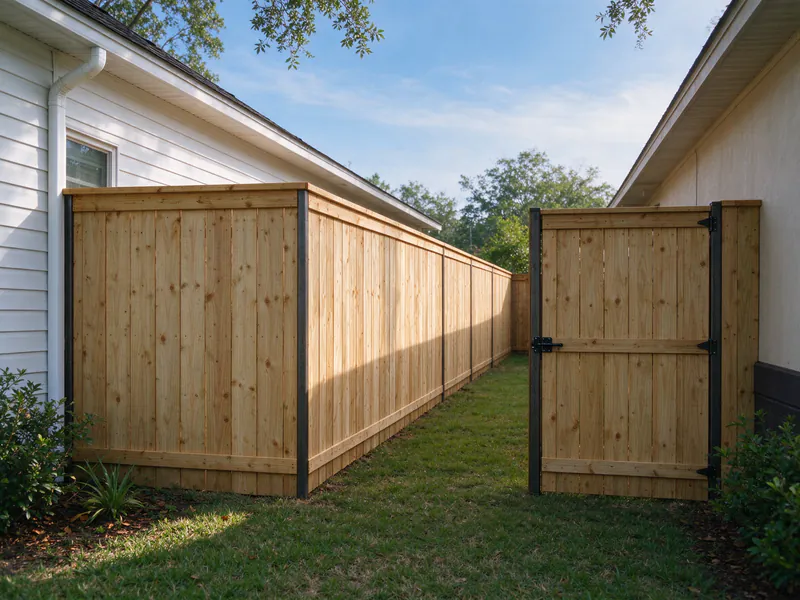
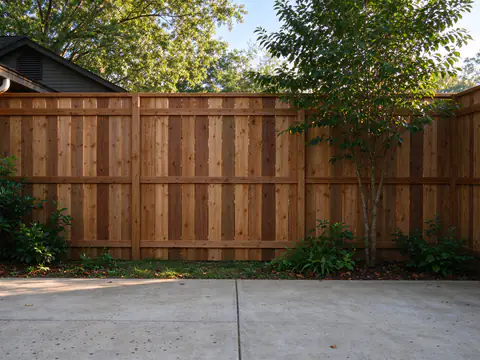
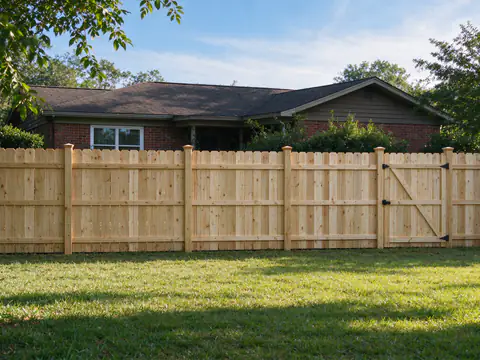
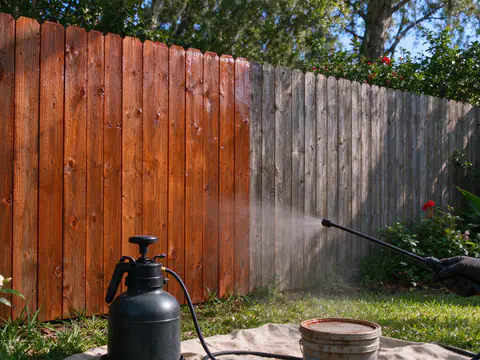
Board-on-board is the privacy fence for people tired of seeing daylight through the boards. Palisades Hammond Fence installs board-on-board and shadowbox fences in pressure-treated pine and cedar across Hammond and the surrounding towns of Tangipahoa, western St. Tammany and eastern Livingston Parish. Installation is carried out by licensed and insured fence contractors.
The style uses two layers. An inner row of boards goes on with a gap between each, and an outer row laps over those gaps. As the wood dries and narrows, the overlap shrinks too, but the face stays closed. Getting that right is a matter of board count, rail strength and post size, which is what this page covers.
Why standard privacy fences open up
New pressure-treated pine arrives wet from treatment and dries over its first months in place. As it dries, each board loses width. On a stockade or dog-ear fence, boards butted tight on install day end up with thin gaps between them by the end of the first summer, and Hammond’s heat speeds that along: NOAA’s normals for the Hammond station show 86 days a year at or above 90°F.
The gaps are small, but they are what people notice from a patio or a pool. Board-on-board builds the shrinkage into the design. Cedar moves less than pine as it dries, but it still moves, so the overlap does the same job in either wood. The pine vs cedar guide covers how the two species behave in this climate.
What happens on the first visit
The first visit walks and measures the line, marks gates and corners, and notes slopes, soil and where water stands after rain. For board-on-board, the measurements feed a layout: board width, overlap and length of run give an exact board count before anything is ordered. That count drives most of the price difference from a standard fence.
The visit also settles which face goes where. On most board-on-board fences both layers sit on one face of the rails, so the rails show on the other side. A two-faced version puts layers on both sides and finishes the fence for both neighbors, at the cost of more boards. Some builders call that version board-on-board too; the overlap is what matters, not the name.
The board math, and what it means for rails and posts
Take a common 5.5 in board. Butted edge to edge, a foot of fence needs about 2.2 boards. In a board-on-board layout with the inner boards spaced 2.5 in apart and each outer board lapping 1.5 in onto its neighbors, every pair of boards covers 8 in of fence, so a foot needs about 3 boards. That is roughly 35 to 40% more boards, and a tighter overlap pushes the count higher.
More boards means more weight hanging on the rails between posts. A 2x4 rail laid flat or on edge between posts 8 ft apart has to carry it without sagging, and over years a rail that is a little light droops in the middle, pulling the boards out of line. Shorter bays, rails set on edge or a fourth rail on tall fences keep the face straight.
The posts take the rest. A board-on-board fence is closed from straight on, so every square foot of it catches wind, and the extra boards add dead weight on top. The posts get sized for a fully solid face and the soil at the address. Posts that lean or rot early are the usual way a fence fails here, as the why fences fail guide shows. USDA soil survey points around Hammond map mostly poorly drained silt loams, and the wet clay post guide explains how footings are drained.
Shadowbox: the open version
A shadowbox fence alternates boards on opposite faces of the rails, leaving a space between each board on the same face. Looking straight at it you see a nearly solid wall; walking along it you catch glimpses through. Both faces look finished, which makes it a common choice on a shared line.
Shadowbox breathes in a way board-on-board does not. Air moves through the gaps, so the boards and the ground along the line dry faster after rain, and the wind load is lower than on a closed face. It is lower, not halved: a face with real openings still carries a large share of a solid face’s load. Where the main worry is storm wind on an exposed lot, the wind-resistant fence page goes further.
Choose the overlap before the boards are ordered
Send the length, height and wood. Overlap, board width and rail layout give a board count and a price that matches it.
Moisture at the overlaps
Where two boards lap, water wicks into the joint by capillary action and dries slowly, especially on the shaded side of the fence and in a climate with about 64 inches of rain a year. The hidden faces inside each overlap can’t be reached with a brush once the outer boards are nailed on. If the fence is going to be stained, staining those faces before assembly gives them the same protection as the exposed ones; fence staining explains timing on new pine.
Fasteners through two layers
Outer boards are fastened through the gaps to the rail, or through the inner board and into the rail, so fasteners must be long enough to bite into the rail properly. The copper in modern pine treatments corrodes plain steel, so nails and screws are hot-dip galvanized or stainless. A rusting fastener in a wet joint lets boards loosen and pull away in the first strong wind, long before the posts give.
Bottoms and tops
The bottoms of both layers stop short of the grass, an inch or two up, so the boards are not sitting in wet turf. A cap rail across the top covers the board end grain, which soaks up rain faster than any other surface, and ties the tops together so individual boards can’t cup outward. On a fence this heavy, the post tops get caps as well.
Where board-on-board fits the local rules
Inside Hammond, a board-on-board fence is a solid wood fence: allowed up to 8 ft behind the front of the house, held to 4 ft in front, and permitted for $10 on a home. The code also asks that wood fencing be weatherproofed wood. In Covington’s historic district, solid board fences belong in back yards and stop at 6 ft.
The fence permit guide covers the Hammond steps, and a line on the boundary is presumed common to both owners under Civil Code article 685, as the Louisiana fence law guide explains.
What board-on-board costs
There is no reliable regional range published for board-on-board alone, so no figure is quoted here. It sits above a standard privacy fence in the same wood, and the reasons are countable. The bigger drivers:
- Board count. Roughly 35 to 40% more boards at a 1.5 in overlap, more with a tighter one.
- Labor per foot. Two layers to lay out and fasten instead of one.
- Finish on both faces. A two-faced build and pre-staining the overlaps add material and time.
- Heavier frame. Extra rails, shorter bays or bigger posts for the added weight and a solid face.
- Site conditions. Wet ground, slope, gates and tear-out, the same as any wood fence.
For context, a typical Hammond-area range for a 6 ft pressure-treated pine privacy fence is about $15 to $45 per linear foot, and cedar privacy about $22 to $55. The privacy fence cost guide shows how each driver moves a job, and the fence cost estimator gives a starting range. How long the result lasts depends mostly on the posts, as the fence lifespan guide explains.