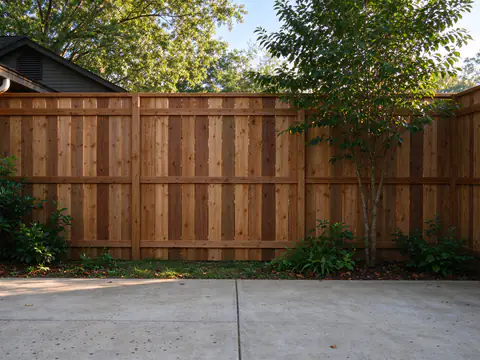
The best fence for a dog is the one that blocks the way that dog gets out. Jumpers need height, climbers need a face with nothing to grip, diggers need the bottom closed, and dogs that slip through gaps need tight spacing. For most medium and large dogs around Hammond, that means a 6 ft wood or vinyl privacy fence behind the house with a dig barrier and a self-closing gate.
Palisades Hammond Fence installs privacy, picket, chain link and ornamental fences for dog owners across Hammond, Tangipahoa Parish, western St. Tammany and eastern Livingston Parish. Installation is carried out by licensed and insured fence contractors. This guide matches fence features to escape habits, explains how Hammond’s height rules and wet ground shape a dog fence, and shows why the gate deserves the most attention. The privacy fence installation page covers the most common choice in detail.
Match the fence to how your dog escapes
Before choosing a material, watch where your dog tests the current fence or the yard’s edges. Each escape habit has its own fix:
| If your dog… | What stops it | Fences that suit |
|---|---|---|
| Jumps | Height, and no ledge to push off from | 6 ft wood, vinyl or aluminum behind the house |
| Climbs | A smooth face with no toeholds on the dog’s side | Wood or vinyl privacy with rails on the outside |
| Digs | A closed bottom: wire apron, kickboard, pavers | Any fence, with the barrier added along the base |
| Squeezes through gaps | Openings smaller than the dog’s head and chest | Privacy, tight-spaced pickets, puppy-picket panels on aluminum |
| Chews | Hard, smooth edges and metal at the bottom | Vinyl, aluminum or chain link; wood with a metal kick strip |
| Barks at passers-by | A solid face that blocks the view | Wood or vinyl privacy |
Some dogs do more than one of these. A young, athletic dog may jump at 4 ft, climb at 5 ft and dig when both fail, so plan for the habit you’ve seen and the next one it is likely to try.
Height and Hammond’s rules
Inside the City of Hammond, a fence in front of the house can be no more than 4 ft and can’t be chain link or woven wire (UDC 4.1.8, City of Hammond). From the front of the house back, solid fences up to 8 ft are allowed, measured from the lower side. Within 30 ft of a street intersection, nothing more than 3 ft high may stand. Those rules mean a secure dog yard is almost always behind the front line of the house.
For a jumper, 6 ft is the practical height. Watch for anything that acts as a launch step: a stacked woodpile, an air-conditioner pad, a raised bed or a horizontal rail on the dog’s side. Hammond’s fence permit is $10 for a home and doubles if work starts first. The fence permit guide and the Louisiana fence laws guide cover the rest, including shared boundary fences.
Diggers and wet ground
Around Hammond, the soil is mostly poorly drained silt loam, and after rain the ground along a fence line can stay soft for days. That makes digging easy, and a dog that finds a soft spot can be under a fence in minutes. Height does nothing for a digger. The fix is at the bottom.
The options are a galvanized wire apron laid flat on the inside of the fence and fastened to its base, a ground-contact treated kickboard along the bottom of a wood fence, or a strip of pavers or gravel along the line.
Each has a trade-off. Wood that touches the soil stays wet, so a kickboard is chosen as a replaceable part, separate from the pickets above it. A gap of an inch or two between pickets and the ground keeps them dry, and an apron closes that gap without burying wood.
Climbers and the face of the fence
Climbing dogs use whatever they can hook a paw on. Chain link’s diamonds work as a ladder, so a climber can go over 4 ft or even 5 ft of fabric. On a wood privacy fence, the rails and posts are the toeholds, so the better layout puts the smooth board face toward the dog and the frame toward the neighbor or the street. That choice also affects how the fence looks from outside, and on a shared line it is worth agreeing with the neighbor.
Horizontal board fences can work as a ladder if the boards have gaps, and lattice tops give a good grip. A vinyl privacy fence presents a smooth, hard face that is difficult to climb or chew. For dogs that go over the top anyway, a short inward-angled extension along the top is an option, provided the total height stays within the code.
Small dogs and gaps
Small dogs escape through openings rather than over the top. Picket fences with wide spacing, ornamental aluminum with standard picket spacing, and the space under a gate are the likely exits. Aluminum systems sold with “puppy pickets,” extra pickets in the lower section, close the bottom without changing the look above. On wood picket fences, tighter spacing or a wire mesh backing does the same.
Check every transition: where the fence meets the house, where two fence types join, and where it crosses a ditch or a dip in the ground. A dip of a few inches under a straight bottom rail is enough for a small dog.
The gate is the weak point
A fence is only as secure as its gate. Two gate problems let dogs out: a gate that doesn’t close behind people, and a gate that has sagged enough to leave a gap. Self-closing hinges and a gravity latch mounted high, or on the outside, fix the first. A gate leaf hung from a heavy, deep hinge post with a properly braced frame fixes the second.
On wet ground, a light hinge post slowly rotates under the gate’s weight, the latch side drops, and the gap at the bottom or between gate and post grows. The gate installation page covers sizing posts and frames, and gate repair covers fixing a sagging one. A walk gate typically adds $150 to $600 to a fence, installed.
Materials for a dog yard, compared
- Wood privacy suits most dogs: tall, smooth on the dog’s side, blocks the view and repairs easily. Typical Hammond-area range for 6 ft pine: $15 to $45 per foot.
- Vinyl privacy is smooth, chew-resistant and needs no stain; at $20 to $60 per foot it costs more.
- Chain link is the lowest-cost containment at $10 to $30 per foot but can be climbed, lets dogs see out and isn’t allowed in front of a Hammond home.
- Aluminum at $25 to $55 per foot keeps the view open and suits small dogs with puppy pickets; it doesn’t stop a determined jumper at 4 ft.
Buried-wire electronic containment is a different product and isn’t part of the fence work described here. To plan a dog yard for your lot, call Palisades Hammond Fence at (985) 866-3827 or price a layout with the fence cost estimator.
Planning a fence your dog can't beat?
Tell us how your dog gets out, the yard size and where the gates go, and get a layout priced for it.