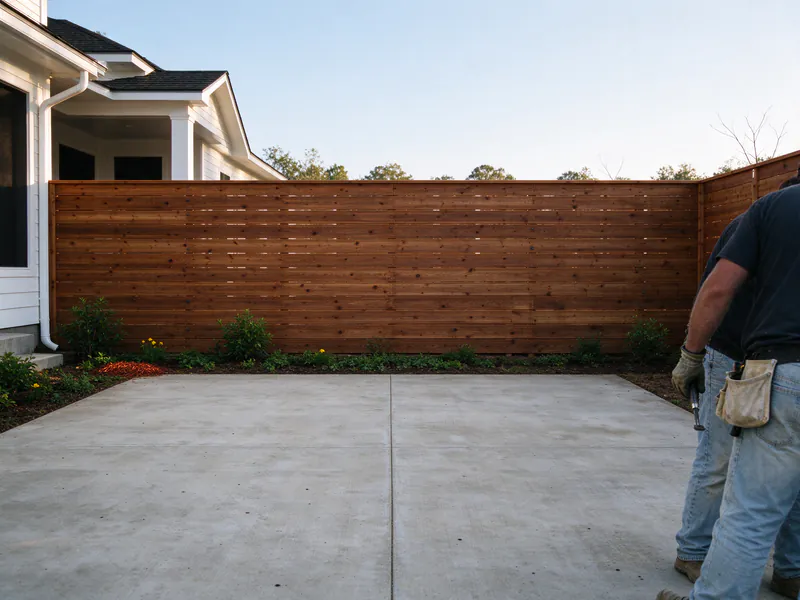
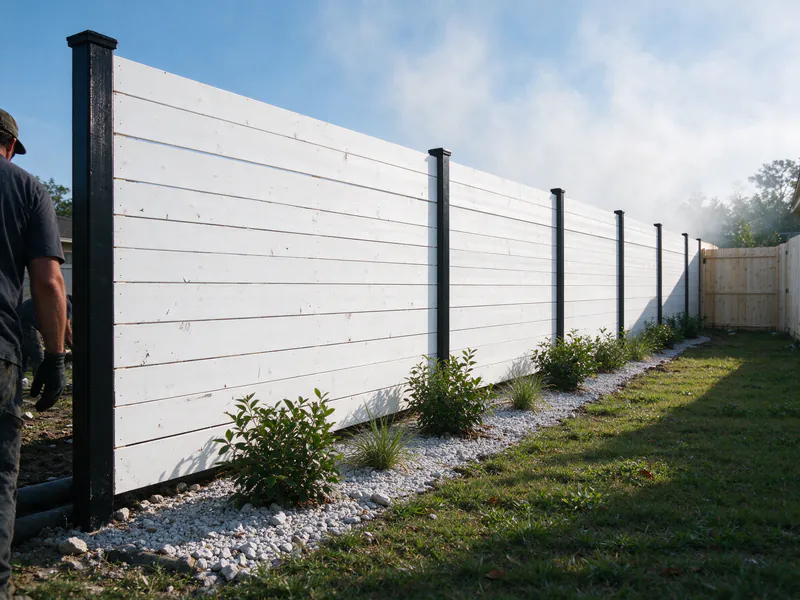
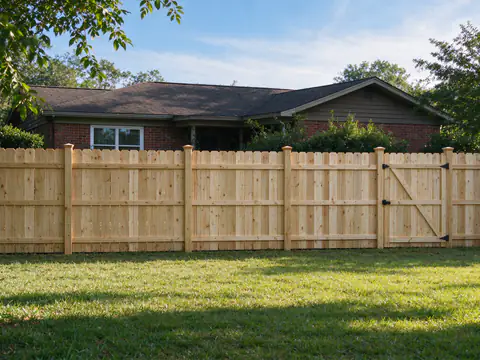
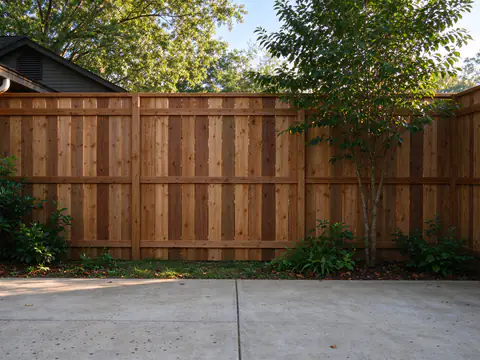
A horizontal fence looks simple, but it asks its frame to do more than any vertical fence. Palisades Hammond Fence installs horizontal board and slat fences in cedar and treated pine across Hammond and the surrounding towns of Tangipahoa, western St. Tammany and eastern Livingston Parish, on posts and supports spaced for long boards. Installation is carried out by licensed and insured fence contractors.
On a vertical fence, every board is held by two or three rails along its length. On a horizontal fence, each board spans from support to support and is held only at its ends. That one difference drives most of the decisions on this page: post spacing, board thickness, how the fence meets a slope and how it handles water.
What happens on the first visit
The first visit walks and measures the line, gates, slopes, soil and drainage. For a horizontal fence, slope gets measured more carefully, because a horizontal fence can’t tilt to follow the ground. The fall along each run decides where the fence steps down and how big each step is. The visit also settles the look you want, tight boards or even gaps, and the board size, since both change the frame behind them.
Why horizontal boards sag, and how the frame stops it
A board spanning between two supports bends under its own weight, and more when it is wet or someone leans on it. For an evenly loaded board, sag grows with the fourth power of the span: shorten the span from 8 ft to 6 ft and the sag drops to about a third. Thickness works the other way, with stiffness rising with the cube of the board’s thickness. A 5/4 board, about 1 in thick, is roughly 2.4 times as stiff as a standard 3/4 in board.
So the frame does the work. Posts go closer together than on a vertical fence, often about 6 ft, or a vertical center support splits each bay in half. Thicker boards stretch the span that stays straight. Each board gets two fasteners at every support, so it can’t cup or twist away from the frame as it dries. A board that sags in the first summer rarely comes back.
Cedar or treated pine for long boards
Cedar is the usual choice because it shrinks, cups and twists less than pine as it dries, and on a long horizontal board any movement shows across the whole bay. Pressure-treated pine is stronger and less costly, but it arrives wet from treatment and moves as it dries in Hammond’s heat, where NOAA’s normals count 86 days a year at or above 90°F. Pine works best kiln-dried after treatment, in thicker boards and on shorter spans.
Either way, the posts are ground-contact treated wood or galvanized steel. Steel posts suit horizontal fences well: they are straight, they don’t twist as they dry and they don’t rot at grade, and the boards fasten to wood nailers or brackets on the post. The pine vs cedar guide compares the two woods in this climate.
Gaps, privacy and the wind
Horizontal fences come tight or gapped. Tight boards give full privacy, though pine opens small gaps anyway as it shrinks across its width. Planned gaps of about a quarter to half an inch, set with spacers, look deliberate, let the boards dry on all four edges and let a little air through. Wider slat spacing trades privacy for light.
Gaps reduce wind load only modestly; a nearly closed face still loads its posts much like a solid one. A tall horizontal fence on an exposed lot is planned with the same post sizing as any privacy fence, and the wind-resistant fence page covers exposed runs.
Choose tight or gapped before the posts go in
Send the length, height, wood and the look you want. Gap, board size and post spacing are set together.
Slopes, water and the bottom board
A horizontal fence only looks right level, so on a sloped yard it steps down one bay at a time. Each step leaves a triangle of open space under the bottom board on the downhill side. It can stay open, be closed with a stepped bottom board cut to the grade, or sit behind a low edging; shorter bays make each step smaller.
Water treats horizontal boards differently too. On a vertical fence, rain runs down the board and off the bottom. On a horizontal fence, the top edge of every board is a small ledge where water sits, and the joint where boards meet the post holds it longest. Gaps, a top cap over the uppermost board and the post tops, and side trim over the board ends all help the fence dry. Hammond averages about 64 inches of rain a year (NOAA), so drying matters.
The rot board
The lowest board sits closest to soil that stays wet; USDA soil survey points around Hammond map mostly poorly drained silt loams with a seasonal water table about 9 inches down at the median point. That board is ground-contact treated, kept a little off the grade and fastened so it can be replaced alone without taking the fence apart. The wet clay post guide covers the footings behind it.
Fasteners that don’t streak
Cedar contains tannins that react with plain steel and leave dark streaks below every screw, and modern pine treatments corrode plain steel. Stainless or hot-dip galvanized screws avoid both, and screws hold a cupping board tighter than nails.
Where a horizontal fence is allowed
In Hammond, a horizontal wood fence is treated like any wood fence: 4 ft maximum in front of the house, up to 8 ft behind it, with a $10 residential permit and the location approved from a survey or parcel map. The code calls for weatherproofed wood. The fence permit guide covers the steps.
Covington’s historic district is different. Its guidelines place split or horizontal rail fences only in rear yards or where they can’t be seen from the street, so a horizontal fence there stays behind the house and out of street view, with the Historic District Commission’s approval first. The Covington page has the details.
What a horizontal fence costs
No regional range is published for horizontal fences alone, so no figure is quoted here. They sit above a vertical fence in the same wood, for countable reasons:
- More posts or supports. Shorter spans mean more posts, or a center support in every bay.
- Thicker or better boards. 5/4 boards, cedar or kiln-dried pine cost more per foot.
- Labor. Spacing every board evenly and stepping each bay takes longer than hanging vertical boards on rails.
- Trim. Top caps, side trim and a replaceable bottom board add material.
- Site. Slope, wet ground, gates and tear-out of an old fence, typically $2 to $8 per foot.
For context, a typical Hammond-area range for a 6 ft pressure-treated pine privacy fence is about $15 to $45 per linear foot, and cedar privacy about $22 to $55. The privacy fence cost guide and the fence cost estimator help set a budget, and wood fence installation covers the other wood styles. Finishing is covered under fence staining.