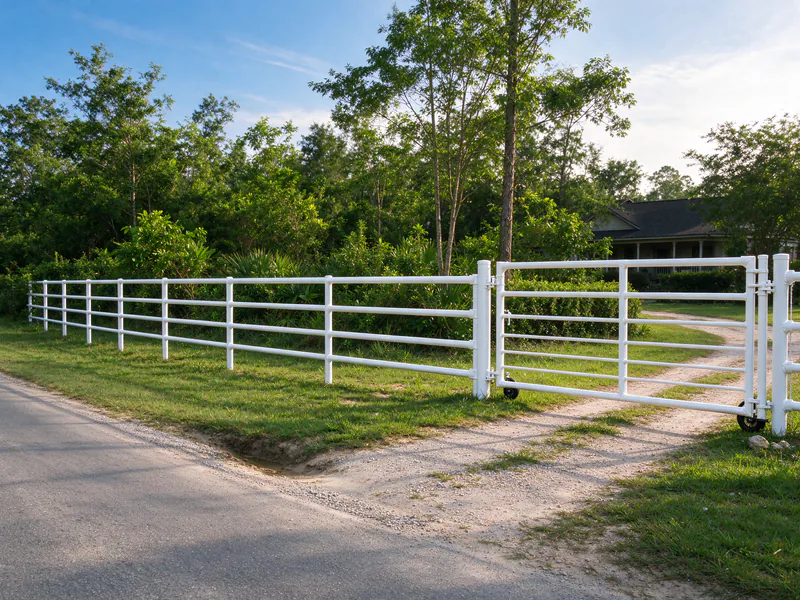
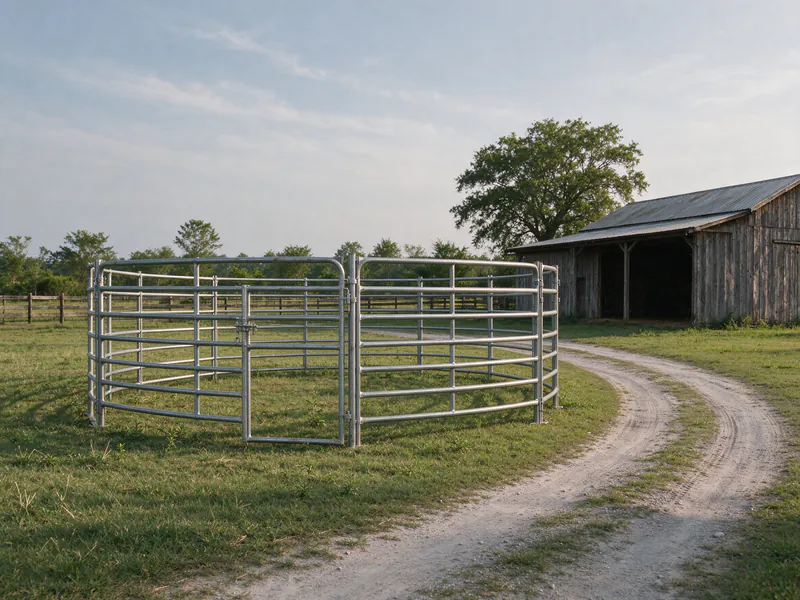
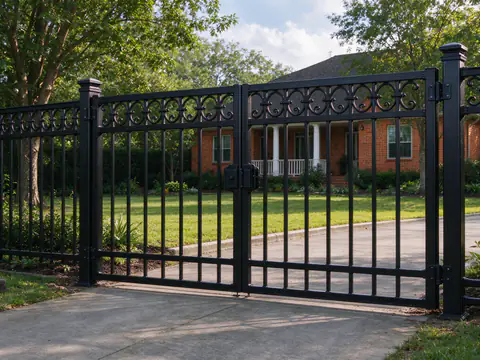
Pipe fence is the heavy-duty end of rural fencing: steel pipe posts with welded pipe rails, or pipe with cable or wire between. Palisades Hammond Fence installs pipe fencing around Hammond and the rural towns nearby, for ranch entrances, road frontage, horse and cattle pens, arenas and alleys. Installation is carried out by licensed and insured fence contractors. A welded pipe fence acts as a single rigid frame, which is why it holds up where animals push hardest and where an entrance needs to look solid.
The trade-off is rust. In a climate with about 64 inches of rain a year and long humid summers, a steel fence lasts only as long as the coating on it and the steel at its post bottoms. Planning for that from the start is what separates a pipe fence that stands for decades from one that rusts out at the ground. For lighter pasture fencing, see farm fence installation.
Where pipe fence earns its cost
Pipe fence costs more per foot than wire or board, so it goes where its strength or look matters most:
- Entrances and frontage. A pipe rail fence along a road or around a gated entrance reads as permanent and needs little upkeep beyond paint.
- Pens, alleys and working areas. Cattle crowd and push in pens, and horses lean and rub. A welded frame shrugs that off where a board would crack.
- Arenas and round pens. Smooth, continuous rails with no exposed fasteners.
- High-traffic corners of a pasture. Near a barn, a water trough or a feeding area, where animals gather.
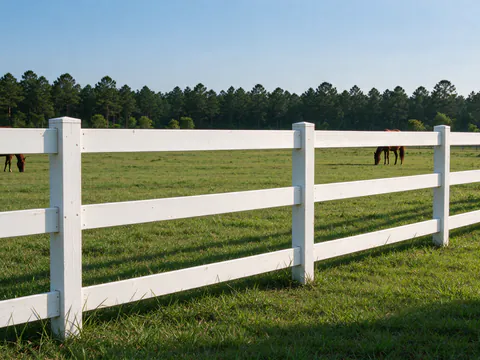
One practical mix is pipe at the entrance and pens, with field fence or board for the long perimeter. The horse fence page covers the horse side of that mix.
Choosing a style
Pipe rail uses pipe posts with two to five horizontal pipe rails welded between them. It is the most rigid style and the one used at entrances and around arenas.
Pipe and cable keeps the pipe posts and top rail but runs tensioned steel cables below it. The cables give a little on impact, and fewer posts are needed for a long run. Like any tensioned fence, it depends on braced end and corner posts; if those move, the cables slacken.
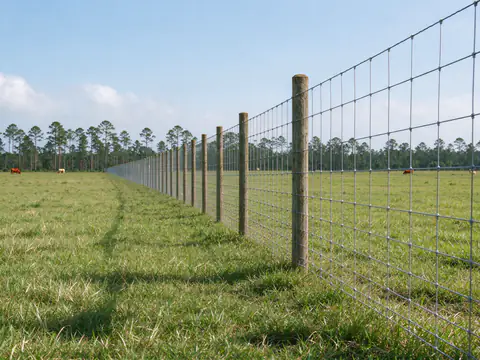
Pipe with infill uses the pipe as a frame and fills it with welded wire, no-climb mesh or livestock panels. This holds small stock and dogs, and suits horse pens when the mesh openings are small enough that a hoof can’t go through.
Pipe size, wall and source
Posts, top rails and lower rails are each sized for their loads; gate posts and corners use the heaviest pipe. Wall thickness matters as much as diameter, because a thin wall rusts through sooner. Used pipe, including oilfield pipe, is sold for fencing, and its wall thickness, internal corrosion and straightness vary from piece to piece. Sound used pipe makes a strong fence; each length is checked before it goes in.
Pick the style for the job
Tell us what the fence has to hold or show, and the length. The style and pipe sizes follow.
Posts in wet ground
A pipe post is a steel tube standing in soil that, around Hammond, stays wet much of the year. USDA soil data for Hammond maps mostly poorly drained silt loams with a seasonal water table between about 5 and 27 inches below the surface. Steel at the ground line rusts fastest, where it is wet and exposed to air, and moisture held against the post by soil or a cracked footing speeds that up.
Posts are set in concrete footings sized for the rail weight, the gates and the soil, and the concrete is finished above grade and crowned so water runs off. Open post tops are capped with welded caps so they don’t fill with rain and rust from the inside. Where a post is cut to height, the cut is sealed. The wet clay post guide covers footings in this soil.
Before any hole is dug, Louisiana’s damage prevention law requires an 811 notice at least 48 and no more than 120 hours ahead, weekends and holidays excluded. Road frontages can carry buried utility lines, which is one more reason the locate comes first.
Welding and paint
Pipe fence is assembled by welding in the field: rails to posts, caps on posts, hinges to gate posts. Each weld burns off any coating around it, so welds are cleaned and primed before painting. Paint is a system: cleaning off mill scale and rust, a rust-inhibiting primer, then a topcoat. Painting is priced as its own line, because it adds real time and materials.
Rust starts first at the welds, at chips from mowers and equipment, and at the post bottoms. In this climate, touching those up every few years keeps a pipe fence sound.
Pipe gates
Pipe fences are usually paired with pipe or tubular steel gates hung on weld-on hinges. A pipe gate is heavy, so the hinge post is the heaviest post in the line and gets the largest footing. Gates for a tractor, trailer or cattle truck are sized to the widest vehicle, and a chain or latch is set where an animal can’t work it open. For a gated entrance or a wider swing, see driveway gate installation and gate installation.
Rules and boundaries
Under Louisiana Civil Code article 685, a fence on a boundary is presumed common to both neighbors, and article 686 presumes a ditch between two properties common as well, so a frontage or side line along a ditch involves the neighbor. The Louisiana fence law guide explains those rules.
Inside the City of Hammond, a fence permit is required ($10 residential, $50 commercial, doubled if work starts first). A metal fence may stand in front of the house up to 4 ft, but not as chain link or wire, so wire-infill pipe stays behind the front building line. Most pipe fencing goes in outside city limits, where the parish or town rule is confirmed per address; the fence permit guide explains both.
What a pipe fence costs
There is no published Hammond-area price range for pipe fence. It is priced from the pipe diameter and wall thickness, the number of rails or cables, the welding and fabrication, the post setting depth and footings, the length of the run, the gates and the paint. Used and new pipe differ in material cost. The farm fence cost guide walks through those drivers alongside wire and board fencing.