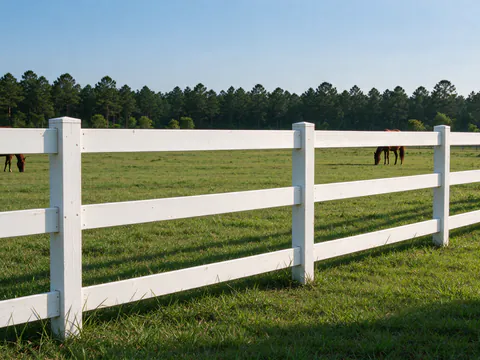
The right horse fence is one a horse can see, can’t get a hoof or head caught in, and won’t injure itself on. Board fencing, horse-rated polymer rail and no-climb woven mesh all meet that standard when built well; a visible top board or rail over mesh combines the strengths of both. Decorative rail and livestock field fence are not purpose-built horse containment.
Palisades Hammond Fence installs horse, farm and pasture fencing across Tangipahoa Parish, western St. Tammany and eastern Livingston Parish, from paddocks behind a house to long perimeter runs. Installation is carried out by licensed and insured fence contractors. This guide explains what a horse fence has to do, compares the three main types, and covers the details that separate a safe fence from a merely tall one. The horse fence installation page covers how the job is planned and built.
What a horse fence has to do
A horse is large, fast and easily startled, and it tests a fence differently from a dog or a cow. It leans over to graze the other side, rubs its neck and rump on posts and rails, paws at the bottom and sometimes runs straight at a fence it hasn’t noticed. Each of those behaviors sets a requirement: strength at the top, no hoof-sized openings at the bottom, a smooth contact surface and a fence the horse can see from a distance.
Size, age and temperament change the answer. A quiet, older gelding in a large pasture asks less of a fence than a group of young horses in a small paddock, where crowding and play put more weight on every rail. A mare with a foal needs a fence built for the foal, which can slip through gaps an adult can’t. Choosing a system starts with which horses, how many and how much space.
Board fencing
Board fencing is the traditional horse fence: wood posts carrying three or four horizontal boards. It is highly visible, solid enough to resist leaning, and looks right on most properties. Boards go on the pasture side of the posts, so a horse pushing on them pushes them against the post instead of pulling the fasteners out.
Its weaknesses show up with age. Horses chew exposed wood, especially when bored or short on forage, and a kicked board can crack, split or hang loose with nails exposed. Every board and post is wood exposed to weather, so it needs paint or stain and regular checks.
Around Hammond, posts stand in mostly poorly drained soil with a seasonal water table close to the surface, so ground-contact treated posts and footings that drain matter as much here as on any privacy fence. The post rot and termites guide explains what happens at the grade line.
Horse-rated polymer rail
Polymer rail systems use flexible rails made from vinyl or high-density polyethylene, sometimes with high-tensile wire molded inside. Unlike a decorative vinyl rail fence, a horse-rated system is designed to flex and give when a horse hits it, then spring back, rather than snap or splinter. The rails don’t need paint, horses don’t chew them the way they chew wood, and the color stays visible.
The trade-offs are cost and tension. Wire-reinforced rails rely on strong, well-braced end and corner posts to stay tight, and a sagging rail loses both its look and some of its strength. Not every product sold as vinyl rail is meant for horses; the manufacturer’s rating for equine use is what separates the two. Polymer rail can be paired with mesh below for foals or small horses.
Fencing a pasture or paddock?
Send the acreage, the kind of horses and where the gates go, and get the fence type and layout scoped for your ground.
Woven mesh and no-climb horse fence
Woven wire mesh made for horses, often called no-climb, uses a tight weave with small openings and smooth knots. A horse that paws at it can’t push a hoof through, and the mesh spreads the force of a horse leaning or running into it over a large area. It also keeps out dogs and many other animals, which matters on properties near roads or neighbors.
Mesh is hard for horses to see, so it is usually topped with a board, a polymer rail or a sight wire in a visible color along the top. Like polymer rail, it depends on tension. Mesh is stretched between braced end and corner assemblies, and if those move in soft ground, the mesh bellies and sags. On a long pasture run, those braced assemblies are the most important part of the build.
Mesh openings and hoof traps
The danger with the wrong wire is entrapment. Field fence and woven wire built for cattle, sheep or goats can have openings large enough for a hoof to slip through when a horse paws or kicks. A horse that gets a foot through and then pulls back can strip skin, cut tendons or break a leg. Horse owners who ask whether a 4 by 4 inch field fence will do are asking exactly this question.
Mesh rated for horses has openings small enough that a hoof can’t pass, and its knots and wire ends are finished so they don’t snag. Check the product’s own rating instead of judging by wire gauge. The same thinking applies to any gap along the fence: under gates, at transitions between fence types, and where a fence crosses a ditch or low spot.
Visibility
Horses see well at a distance and in motion but can miss thin, plain wire, especially at a gallop or in low light. A fence they can’t see is a fence they can run into. Boards and wide polymer rails are visible on their own; mesh and wire fences need a visible top element. White, black and dark brown all show against green pasture, and a consistent top line helps horses read the fence’s height.
Fasteners, edges and foals
Nails backing out of boards, cut wire ends, sharp post caps, bolt ends and protruding staples cause cuts and eye injuries. Screws and ring-shank nails hold better in boards that swell and shrink, wire ends are wrapped back, and hardware is set flush. Gate latches and hinges need the same attention, since horses gather at gates; the gate installation page covers hinge posts and latches.
Foals, ponies and miniature horses need a fence built for their size: lower bottom boards or rails, smaller mesh openings, and no gaps they can squeeze through or roll under. A pasture that holds adult horses safely can still let a foal through between the bottom board and the ground.
Decorative fencing is not containment
Split rail and decorative ranch rail fences are built to mark a boundary and look good. Their rails sit loosely or are lightly fastened, the gaps are wide, and they were never designed for a horse leaning or rubbing on them. They suit a front field or a driveway. Holding horses with one usually means backing it with horse-rated mesh.
The three types side by side
| Board | Horse-rated polymer rail | No-climb woven mesh | |
|---|---|---|---|
| Visibility | High | High | Low without a top board or rail |
| On impact | Can crack or splinter | Flexes and springs back | Spreads the load over the mesh |
| Hoof entrapment | Low with proper board spacing | Low; add mesh for foals | Lowest when horse-rated |
| Chewing | Horses chew wood | Little chewing | Not chewed; top board can be |
| Upkeep | Paint, board and nail checks | Re-tension, occasional cleaning | Re-tension, check braces |
| Depends most on | Sound posts | Braced ends and corners | Braced ends and corners |
Local rules and cost
Inside the City of Hammond, barbed wire isn’t allowed in residential districts (UDC 4.1.8, City of Hammond), and a fence permit is required within the city. Outside city limits, the parish or town rule is confirmed per address; the fence permit guide covers the steps. Post holes count as excavation under Louisiana’s damage-prevention law, so Louisiana 811 is notified 48 to 120 hours before digging, excluding weekends and holidays.
There is no published local price range for board, polymer rail or no-climb horse fencing, so each is priced from its drivers: the type and spec, line length, number of braced corners, post type and spacing, wet ground, clearing the line and gates.
A fence along a property line also raises boundary questions covered in the Louisiana fence laws guide. The farm fence cost guide explains those drivers, and the farm fence installation and pipe fence installation pages cover other livestock options. To plan a horse fence, call Palisades Hammond Fence at (985) 866-3827.