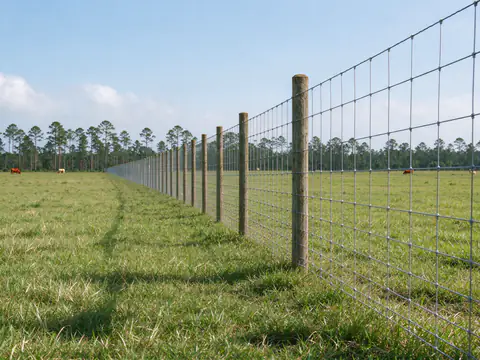
Farm and pasture fence near Hammond has no dependable per-foot range, so this guide gives no number. The cost per foot turns on the wire, the posts and their spacing, how many braced corners and ends the line needs, the length of the run, wet ground, clearing the line and the number of field gates. Long, straight runs cost less per foot; short, crooked ones cost more.
Palisades Hammond Fence installs farm, pasture, horse and pipe fencing on rural and acreage properties in Tangipahoa Parish, western St. Tammany and eastern Livingston Parish. Installation is carried out by licensed and insured fence contractors. Farm fence prices vary too much between properties, and between the wire types, to publish one range responsibly. What follows explains how the scope is built, so you can describe your job clearly and compare quotes line by line. The fence installation cost guide covers residential fence prices.
How a pasture fence is put together
A wire fence works by tension. The wire is stretched between braced assemblies at every corner, end and gate, and line posts between them hold it at height without carrying much load. That design explains the cost.
| Part | What it does | What moves its cost |
|---|---|---|
| Braced assemblies (H-braces) | Hold the wire’s pull at corners, ends and gates | How many there are; post size and depth |
| Line posts | Keep wire at height between braces | Spacing; wood vs steel T-post; ground |
| Wire | Contains the animals | Woven field fence, barbed, high-tensile, no-climb horse mesh, or boards |
| Top rail or board | Visibility and a sight line for horses | Board, pipe or a coated top wire |
| Field gates | Equipment and animal access | Width, tube or welded panel, hinge post bracing |
| Line clearing | A clear strip to build on | Brush, trees, stumps and access |
A farmer asking how far apart to space posts on a Louisiana property is asking a cost question too. Wider spacing means fewer posts but more sag between them and less holding power in soft ground. The right spacing depends on the wire, the animals and the soil, so it belongs in the quote, not in a rule of thumb.
Length, corners, terrain and gates
These four things set the scope more than anything else, and they work together.
Length
Setup, travel and the braced assemblies are partly fixed costs. A long run spreads them over more feet, so its cost per foot falls. A short paddock carries the same corners and gate on far less wire.
Corners and turns
Each corner is a braced assembly, and a line that follows a creek, a ditch or a tree line can need many. A gentle curve can sometimes be built with angled line posts rather than full braces; a sharp turn cannot. Counting corners before asking for a price is the single most useful thing you can do.
Terrain and ground
Most of the ground around Hammond is flat, but it is wet.
The USDA soil survey maps mostly poorly drained silt loams and fine sandy loams across the area, with the seasonal high water table within a foot of the surface at many sampled points (USDA NRCS). A corner post hole that hits water a few feet down holds less, so braces are set deeper or wider. Ditches, low swales and crossings over drains each need their own detail, and a fence across a drainage servitude may not be allowed at all.
Gates
Every field gate is an opening that needs a braced hinge post and a braced latch post. Wide gates for tractors and trailers need heavier posts and better bracing, or the gate sags and drags within a season. The gate cost guide explains how gates are priced as parts.
Wire and fence types compared
| Type | Typical use | What raises its cost |
|---|---|---|
| Woven field fence | Cattle, goats, sheep, general pasture | Wire height and gauge, close stay spacing, a top strand |
| Barbed wire | Cattle on open range | Strand count; not for horses |
| High-tensile smooth wire | Long cattle runs, often electrified | Tensioners and stronger braces |
| No-climb horse mesh | Horses, small animals | Mesh spec, a top board or rail, post spacing |
| Board fence | Horse paddocks, frontage | Board count, treatment, paint, post spacing |
| Pipe fence | Pens, frontage, horse arenas | Pipe diameter and wall, welding, paint, setting depth |
| Split rail | Frontage and boundary marking | Rail count and species |
Horse fencing usually costs more than cattle fencing on the same line because horses need a visible top, no barbs and mesh small enough to keep hooves out. The horse fence types guide compares the options.
What’s inside a farm fence price
| Part of the price | What sets it | Public figure or what to check |
|---|---|---|
| Labor | Hours and local wages | Louisiana fence erectors: mean $19.92 an hour vs $24.29 nationally, about 18% lower (BLS OEWS); Hammond-metro construction laborers: $19.63 vs $25.02, about 22% lower (BLS) |
| Wire, posts and gates | Type, gauge, post count | No public local price list; ask for a material list |
| Line clearing | Brush, trees, stumps | A scope item; often quoted separately |
| Permit | Jurisdiction | Inside Hammond, $10 residential or $50 commercial; unincorporated parish rules are confirmed per address |
| Utility locate | La. R.S. 40:1749.13 | Louisiana 811 notice 48 to 120 hours before digging; long rural lines may cross buried utilities |
| Boundary | La. Civil Code arts. 784-792 | A survey before a long line; costs of fixing a boundary out of court are split equally unless agreed otherwise |
A wage is not a billing rate. The quoted price also covers materials, equipment, travel, insurance, licensing and overhead.
Programs, boundaries and neighbors
No rebate covers farm fencing for homeowners. Agricultural producers working under a conservation plan with USDA NRCS can ask their local NRCS office whether fencing qualifies under the Environmental Quality Incentives Program; payment amounts were not confirmed, so do not budget on them.
A long pasture line is often a boundary. Under Louisiana Civil Code article 685, a fence on the line is presumed common, and where both properties are enclosed, a neighbor can be compelled to share the cost of building and repairing it. The Louisiana fence laws guide explains the rules.
Clearing the line before the fence
A fence needs a clear, walkable strip to build on, and many rural lines in this area run through brush, young pines or an old overgrown fence. Clearing that strip, pulling or grinding stumps where posts must go, and removing old wire and posts are often quoted apart from the fence itself. An old barbed or woven wire fence tangled in growth takes longer to remove than it looks. Ask each quote whether clearing and old fence removal are in it, and how wide a strip is cleared.
How to describe a farm fence for a quote
Give each contractor the same description: total length, the number of corners, ends and gates, gate widths, the animals, the wire type, the ground (wet spots, ditches, trees) and whether the line needs clearing. A sketch on an aerial photo with corners marked is ideal. Then compare quotes on the same items. See farm fence installation for the work itself, or call (985) 866-3827 to talk through a line. The wet soil post guide covers post setting in wet ground.
Get a farm or pasture fence priced
Send the length, corners, gates, animals and wire type, and a marked aerial photo if you have one.