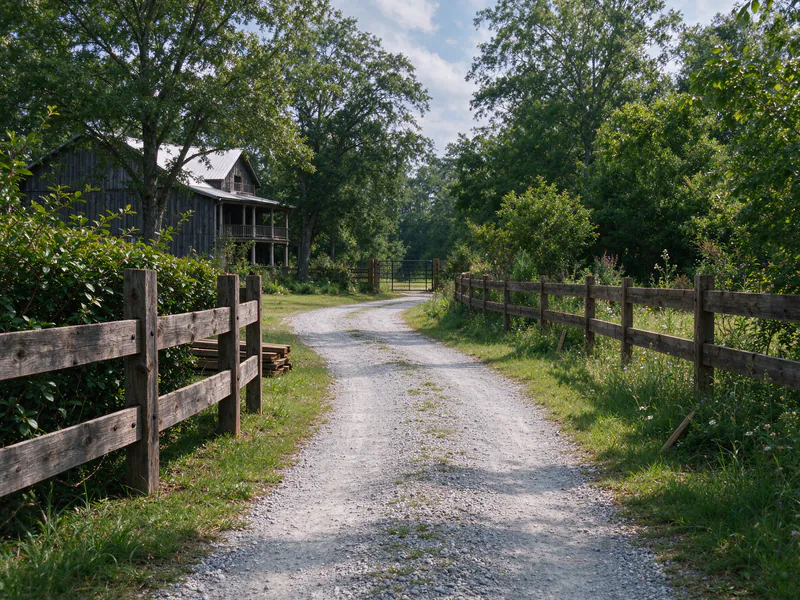
Split rail is a fence for marking a line rather than holding anything back. Palisades Hammond Fence installs two-rail and three-rail split rail fences across Hammond and the rural edges of Tangipahoa, St. Tammany and Livingston parishes, along lot lines, road frontage, drives and garden edges. Installation is carried out by licensed and insured fence contractors. Rails are fitted into mortises cut through the posts, with no nails, so the fence follows uneven ground and individual rails can be replaced without rebuilding a section.
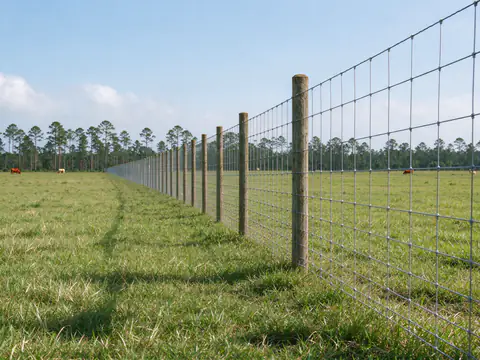
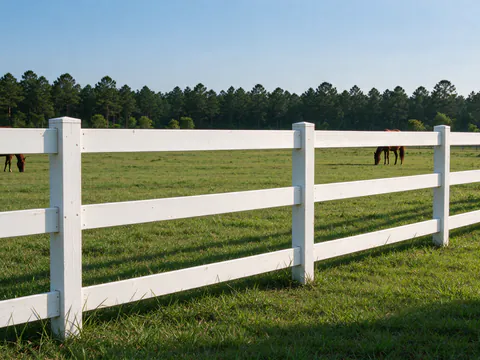
Because it is light and open, split rail is the wrong fence for horses or livestock; those have their own pages under horse fence installation and farm fence installation. Where a heavier rail look is wanted around a pasture, ranch rail on the horse fence page fills that role.
How a split rail fence is built
A split rail fence has two parts. The posts have rectangular mortises cut through them, two for a two-rail fence and three for a three-rail. The rails are rough-split lengths with tapered ends that slide into those mortises, overlapping inside the post with the rail from the next section. Line posts have mortises through the full width; end posts have blind mortises or half-depth slots; corner posts have mortises cut on two faces.
Nothing is nailed, which is both the strength and the weakness. The rails can shift in the mortises as wood shrinks and swells, so the fence tolerates movement that would split a nailed fence. It also means a rail can be lifted out by hand, so split rail is a boundary marker and a visual edge, not a barrier.
Two-rail or three-rail
Two-rail is lower and lighter. It reads as a simple line along a front lot, a drive or a garden bed, and costs less per foot because it uses fewer rails and shorter posts.
Three-rail is taller and fuller. It suits larger rural properties and frontage, and it gives a mesh backing three rails to attach to rather than two. On a corner lot, the lower height of a two-rail fence can matter: Hammond limits anything within 30 ft of a street intersection to 3 ft above the street centerline grade, and a low two-rail run may be able to stay under that line, which is checked on the permit drawing.
Wood, posts and wet ground
Split rail is made in a few woods. Rough-split rails show the grain and weather to gray; pressure-treated pine split rail is lower in cost and resists decay better in the ground. What matters most is the post, because its bottom sits in wet soil.
USDA soil data for Hammond maps mostly poorly drained silt loams with a seasonal water table that can rise within about 5 to 27 inches of the surface, and NOAA’s normals put Hammond’s rainfall at about 64 inches a year. A post standing in that ground for years needs to be treated for ground contact (AWPA Use Category UC4A, or UC4B for heavier exposure).
Split rail posts can be set in tamped gravel and soil rather than concrete, which lets water drain away from the base; corner and end posts in soft ground can get concrete finished above grade and crowned so it sheds water.
Termites and rot at the grade line
Subterranean termites live in the soil and reach any wood that touches it. Treated posts resist them, but a cut end or a rail left lying in the grass gives them a start. Keep the bottom rail clear of the ground, and keep mulch and leaf litter from piling against posts. The post rot and termite guide covers what to look for, and the wet clay post guide covers footings.
Plan the line and the posts
Send the address, the length and whether the fence has to hold a dog. Rail count and post setting follow from that.
Slopes, curves and openings
Split rail handles terrain better than most fences. Each section pivots in its mortises, so the rails tilt to follow a slope and the gap under the bottom rail stays even rather than opening into a triangle as a stepped panel would. Gentle curves along a drive or a bed are built by angling each section slightly at the post.
Openings are planned for what passes through: a gap the width of a riding mower at a garden edge, or a matching split rail gate on a walk path. Gates are hung on heavier posts than the line posts, because a gate is the only part of the fence that carries a cantilever load; the gate installation page explains why.
Adding wire mesh for a dog
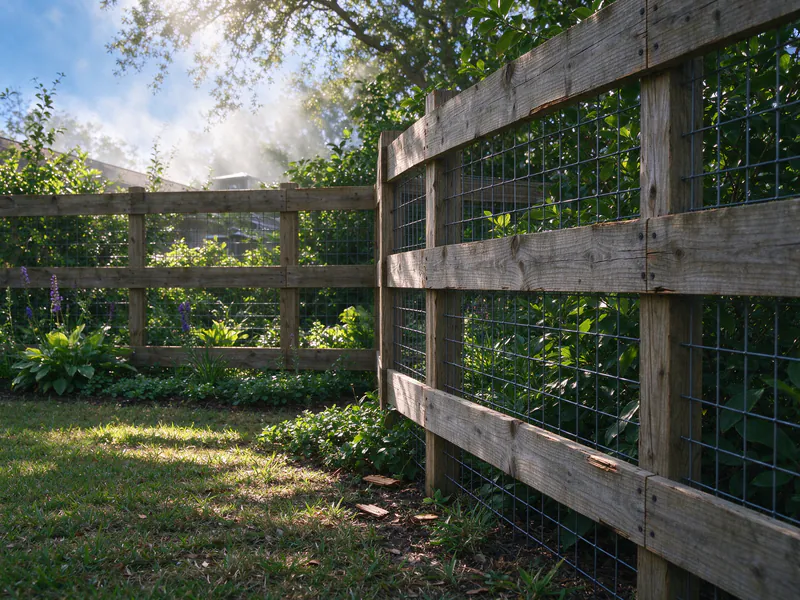
Welded wire mesh fastened to the inside face of the rails turns split rail into light containment for a dog that doesn’t jump or dig. The mesh adds no strength, and a determined dog or a heavy one can push through or under it. The best fence for dogs guide compares split rail with mesh against other options.
There is a local catch. Inside the City of Hammond, woven wire fence is not allowed beyond the front building line of the house, so mesh-backed split rail stays in side and back yards there. A plain split rail fence, as a wood fence, may stand in front of the house up to 4 ft.
Permits, historic districts and boundaries
Inside Hammond, every fence needs a permit from the Building Department, approved from a survey or parcel map, with a $10 residential fee that doubles if work starts first. The Hyer-Cate overlay and the Historic District add their own review.
In Covington, the historic district guidelines allow split rail only in rear yards or where it isn’t visible from the street, and the Historic District Commission reviews fences there; Covington’s permit is covered on the Covington page. Elsewhere the parish or town rule is confirmed per address, as the fence permit guide explains.
Split rail often goes in exactly on a property line, which in Louisiana makes it presumptively common to both neighbors under Civil Code article 685. An old fence or a row of trees is not proof of where the line is; a survey settles it, and the Louisiana fence law guide explains the choice between building on the line and just inside it.
What a split rail fence costs
There is no published Hammond-area price range for split rail. It is priced from the number of rails, the wood for posts and rails, how the posts are set, the length of the run, the number of corners, ends and gates, any wire mesh backing and the terrain. For a wood fence that also gives privacy, see wood fence installation and its Hammond-area ranges.